
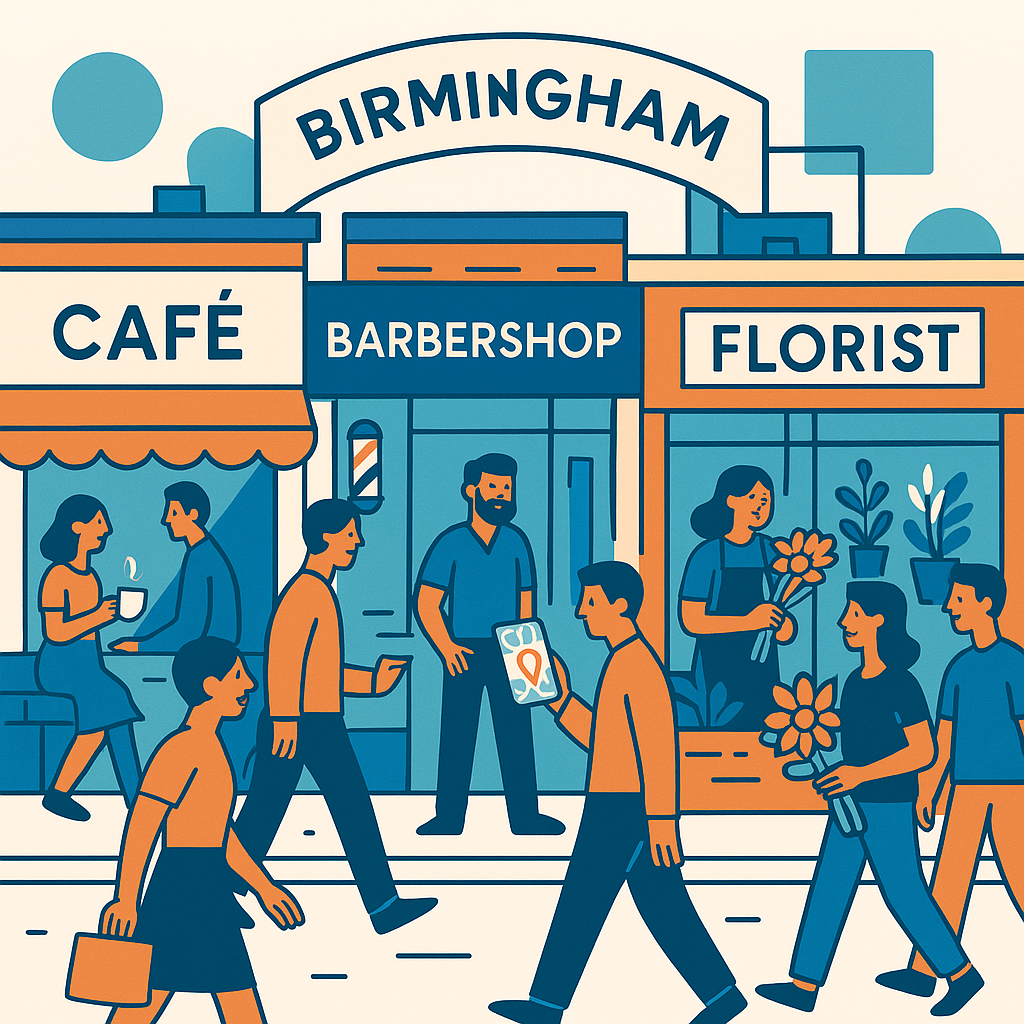
The Beginner's Guide to Local SEO for New Birmingham Businesses is really about one simple thing: helping nearby customers find you at the exact moment they are looking. If you have just opened a café in Moseley, a barbershop in Digbeth, a florist in Sutton Coldfield, or a small retail shop near the Bullring, you probably do not need the whole world to discover you. You need people in Birmingham, ideally within walking distance or a short bus ride, to see your business online and choose you over the place down the road.
Local SEO can sound a bit technical at first. I think that is partly because people make it sound bigger than it is. Yes, there are tools, listings, citations, maps, keywords and all that. But at heart, local SEO is about making sure your business information is accurate, trustworthy and visible in the places customers already use, especially Google.
Quick local SEO reality check
If someone searches for “coffee near New Street Station” or “emergency plumber Birmingham”, Google is not just ranking websites. It is also checking location, reviews, opening hours, business categories, photos, and how consistent your details are across the web.
Why local SEO matters for Birmingham High Street businesses
Birmingham is not a small market. That is good and bad. There are plenty of customers, students, commuters, office workers, residents and visitors moving around the city every day. But there is also a lot of competition, even in fairly niche trades. A new business can easily get lost online if it relies only on footfall, word of mouth, or the hope that people will notice the shopfront.
Local SEO gives you another way to be found. When your business appears in Google Maps, the local map pack, and organic search results, you start showing up in the small moments that often lead to sales. Someone searches while standing outside Grand Central. Someone looks up a service provider from home in Harborne. Someone asks their phone for the nearest place to buy a birthday cake. These are not vague browsing moments; they are often buying moments.
For many High Street businesses, local SEO can be more useful than broad social media activity. Social posts come and go quickly. Search visibility can build up over time. It is not instant, admittedly, and there can be frustrating weeks where nothing seems to move. But when it works, it brings in people who are already looking for what you sell.
The Beginner's Guide to Local SEO for New Birmingham Businesses: start with Google Business Profile
Your Google Business Profile is probably the most important starting point. This is the business listing that appears on Google Maps and in the local results when someone searches for your product or service. If you do nothing else this week, claim it, verify it, and fill it in properly. It sounds basic, but plenty of businesses still leave it half finished.
Use your real business name, not a keyword-stuffed version of it. Google is fairly strict about this, and customers do not usually trust odd-looking names anyway. Choose the most accurate primary category, then add secondary categories if they genuinely fit. A bakery should not pretend to be a restaurant just because it wants more searches. That sort of shortcut can backfire.
- Add your correct address, phone number and website URL.
- Set accurate opening hours, including bank holidays where possible.
- Upload clear photos of your shopfront, products, team and interior.
- Write a simple business description that mentions Birmingham naturally.
- Add services, products, accessibility details and payment options if relevant.
- Use Google Posts now and then for offers, events or seasonal updates.
Photos are worth a small extra effort. A dark photo from three years ago does not do much for confidence. Customers like to know what they are walking into. If your shop is on a side street, show the entrance clearly. If parking is tricky, say so politely or mention nearby public transport. It all helps people decide.
| Profile element | Why it matters | Beginner tip |
|---|---|---|
| Business category | Helps Google understand what you offer | Pick the closest match, not the broadest one |
| Reviews | Build trust and influence map visibility | Ask happy customers soon after purchase |
| Photos | Shows customers what to expect | Add fresh images every month or so |
| Opening hours | Prevents wasted trips and negative experiences | Update special hours before holidays |
Use Birmingham-specific keywords without sounding awkward
Local keywords are the phrases people type into Google when they want something nearby. For a Birmingham business, that might include the city name, a district, a landmark, or a more general phrase such as near me. You do not have to force these phrases into every sentence. In fact, please do not. It reads badly and can make your website feel slightly desperate.
Instead, build pages and content around what people actually need. A hair salon in Jewellery Quarter might have a main service page for colour treatments, then mention that it serves clients from Jewellery Quarter, city centre Birmingham, Hockley and nearby areas. A tradesperson could create separate pages for boiler repairs in Birmingham, landlord gas safety checks, and emergency call-outs.
The trick is to be specific enough to be useful. Birmingham is big, and someone searching in Kings Heath may not want a result from Erdington unless the service travels. Equally, you do not need a separate page for every tiny area if the content is basically copied. Google, and humans, can spot thin pages pretty quickly.
Good local keyword use
“Independent opticians in Harborne offering eye tests, glasses and contact lens checks.”
Less natural keyword use
“Best Harborne opticians Harborne eye tests Harborne glasses Birmingham near me.”
Make your website clear, fast and locally useful
Your website does not need to be enormous. A small business website can perform well if it answers the right questions clearly. What do you offer? Where are you based? What areas do you serve? How can people contact you? Are you open today? Can customers book online? It sounds obvious, but I have seen plenty of local websites where the phone number is hidden at the bottom, the address is missing, or the service page says almost nothing.
Put your name, address and phone number on key pages, especially the contact page and footer. This is often called NAP consistency. It should match your Google Business Profile and other listings. If one site says Road and another says Rd, that is usually not the end of the world, but avoid bigger differences such as old phone numbers, former addresses or different trading names.
- Create a clear contact page with a map, address, phone number and opening hours.
- Add useful service pages rather than one vague services page.
- Mention nearby areas you genuinely serve.
- Make sure your site works properly on mobile phones.
- Use simple page titles, such as “Bike Repairs in Birmingham” or “Café in Moseley”.
- Add internal links between related pages so visitors can move around easily.
Speed matters too, although it is easy to obsess over it. Your site does not have to be perfect, but it should not take ages to load on a mobile connection. Compress images, avoid unnecessary pop-ups, and make buttons easy to tap. A customer standing on a pavement in the rain is not going to wait patiently for a fancy homepage animation to finish.
Build trust with reviews and local citations
Reviews are one of the strongest signals for local businesses. They influence customers, and they also seem to help Google understand that your business is active and trusted. You do not need hundreds overnight. A steady flow of honest reviews is better than a suspicious burst of glowing praise in one weekend.
Ask customers politely, ideally soon after a good experience. You can send a review link by email, add it to receipts, or display a small sign near the till. Do not offer rewards for positive reviews. That can breach platform rules, and it feels a bit off anyway. What you can do is make it easy for people who already like you to leave feedback.
Reply to reviews as well. Thank people for kind comments. Respond calmly to complaints, even if the complaint feels unfair. I know that is easier said than done. A measured reply can show future customers that you take service seriously. Sometimes the reply matters almost as much as the review.
Local citations are mentions of your business details on other websites, such as directories, local business groups, trade bodies, chamber of commerce pages, event listings or industry platforms. For Birmingham businesses, relevant local directories and community websites can be useful. Quality matters more than quantity. A listing on a respected local site is better than being added to hundreds of strange directories nobody visits.
A simple rule: if a real Birmingham customer might use the website to find a business like yours, it is probably a citation worth considering.
Create local content that is actually worth reading
Content is where local SEO can become more interesting. You do not have to start a huge blog, but useful local pages and occasional articles can help. Think about the questions customers ask you in person. Those questions are often search queries in disguise.
A Birmingham wedding florist could write about seasonal flowers for city centre venues. A café could create a guide to dog-friendly places nearby and naturally include its own business. A gym could explain the best ways to get back into exercise after time away, with references to local classes. It does not always need to be heavily sales-focused. In fact, it is usually better when it is not.
- Write down ten questions customers regularly ask.
- Turn each strong question into a short, helpful page or article.
- Add local context where it genuinely helps the reader.
- Include photos from your business or local area where appropriate.
- Link from the article to your relevant service or booking page.
Try not to copy generic advice from national competitors. Birmingham has its own neighbourhoods, transport habits, events and customer patterns. A restaurant near the theatre district might have different search behaviour from one in Stirchley. A repair shop near a university may get seasonal demand from students. These details make your content feel more real, and frankly, they make it more useful.
Track what is working, but do not check every hour
Local SEO takes time. That can be annoying when you have rent, stock, wages and bills to think about. Still, it helps to track a few basic numbers so you know whether your efforts are moving in the right direction. Google Business Profile insights can show calls, direction requests, website clicks and how people found you. Google Search Console can show which search terms are bringing visitors to your site.
Do not panic if rankings move around. They often do. A competitor may get new reviews, Google may test different results, or searches may change depending on where the person is standing. Look for patterns over weeks and months rather than daily movement.
Small monthly SEO checklist
- Check your Google Business Profile details are still accurate.
- Add one or two fresh photos.
- Ask a few recent happy customers for reviews.
- Review your top website pages in Search Console.
- Update any outdated offers, events or seasonal information.
Final thoughts on The Beginner's Guide to Local SEO for New Birmingham Businesses
The Beginner's Guide to Local SEO for New Birmingham Businesses does not have to be complicated. Start with the basics: a complete Google Business Profile, consistent contact details, a clear website, honest reviews and content that reflects your actual location and customers. Those things may not sound glamorous, but they are the foundations.
If you are new to the High Street, it is tempting to look for quick wins. Sometimes you will get them. More often, local SEO is a gradual build. You tidy up your online presence, you earn reviews, you answer useful questions, and slowly you become easier to find. For a small Birmingham business, that can be the difference between someone walking past and someone walking in.