
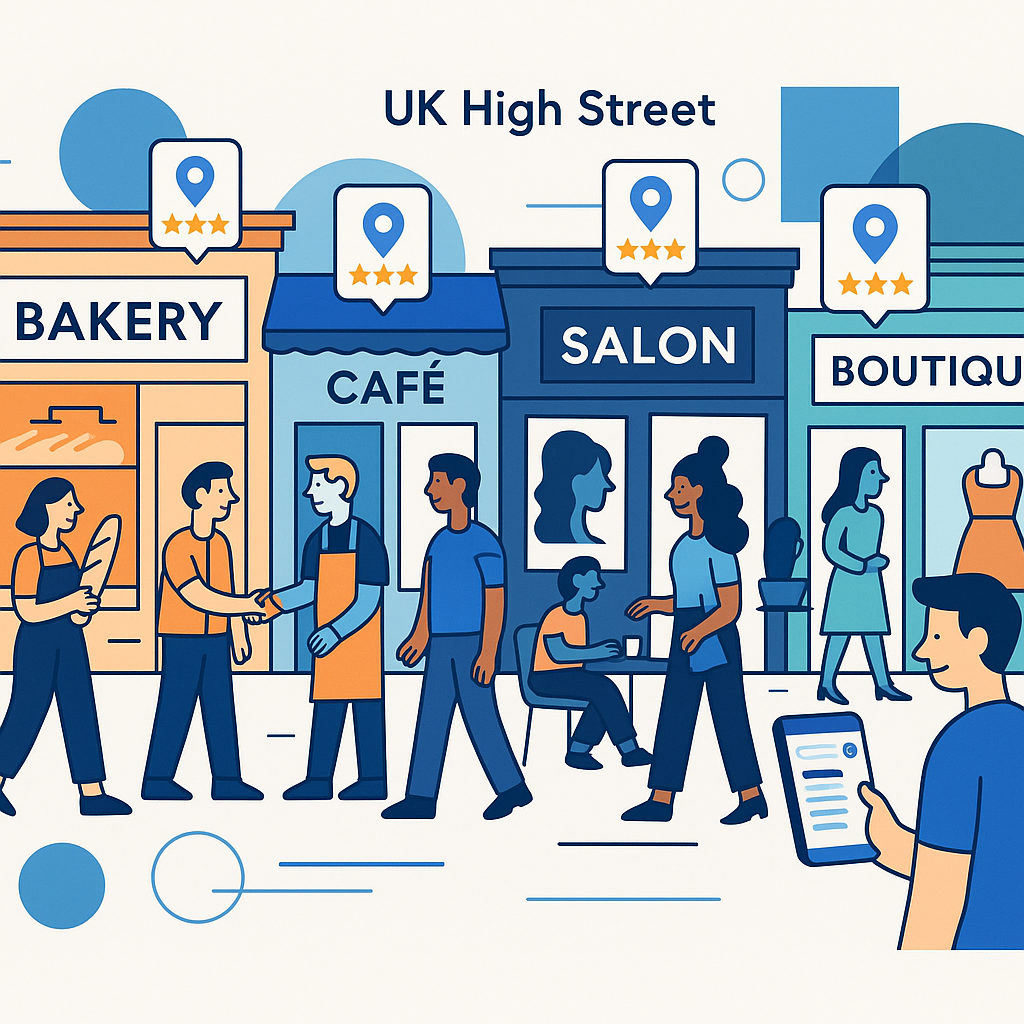
If you run a small High Street business, the phrase 23 Local Developments You Need to Know About From Q2 2026 probably sounds a bit specialist at first. But actually, it points to something very practical: Google’s local results are shifting again, and those shifts affect whether people find your bakery, salon, café, repair shop, estate agency, clinic, or independent retailer when they search nearby.
The original Whitespark article makes a useful central point: local search is no longer just about having a Google Business Profile and hoping for the best. It is about staying alert to lots of small changes across Maps, reviews, AI-led search features, business attributes, photos, service listings, spam filtering, and user behaviour. None of these changes feels enormous on its own. Put together, though, they can change who gets seen first.
For UK High Street businesses, this matters because local discovery is often immediate. Someone searches “shoe repair near me”, “best brunch in York”, or “emergency plumber open now”, and they make a decision within seconds. There is rarely a long research journey. It is quick, slightly impatient, and very influenced by what Google chooses to show.
23 Local Developments You Need to Know About From Q2 2026: The High Street View
The big lesson from 23 Local Developments You Need to Know About From Q2 2026 is that Google Business Profiles are becoming more layered. They are not just digital shop windows anymore, although that is still a decent way to explain them. They are closer to mini-websites, review hubs, product catalogues, booking tools, question boards, and trust signals all rolled into one.
That might sound like extra work, and, to be fair, it is. But it also gives smaller businesses a chance to compete with larger chains. A national brand may have a bigger marketing budget, but an independent florist that posts current photos, replies warmly to reviews, keeps opening hours accurate, and describes services clearly can often look more relevant in a local search.
Quick takeaway for small businesses
Google is rewarding profiles that feel active, specific, trustworthy, and genuinely useful. A complete profile is good. A maintained profile is better. A profile that reflects what is happening in your business this week is better again.
One slightly uncomfortable truth is that many High Street businesses still treat their profile as something they set up years ago and only revisit when Christmas hours need changing. I understand why. There is always something more urgent: staff rotas, suppliers, stock, rent, customers standing at the till. But local SEO tends to reward the businesses that pay attention to small details consistently.
Why Google Business Profiles Now Carry More Weight
Google Business Profiles influence both visibility and trust. Visibility is obvious: you want to appear in the local pack, on Google Maps, and in branded searches. Trust is more subtle. A searcher may compare three businesses and choose the one with better photos, clearer services, recent reviews, and accurate opening times, even if it is not technically ranked first.
In Q2 2026, the direction of travel is clear. Google is trying to answer more local questions directly in the results. That means your business information may be pulled into search experiences before someone clicks through to your website. In some cases, the profile is the conversion point. People call, request directions, book, message, or check stock without ever visiting your site.
- Keep primary and secondary categories accurate, not just broad.
- Add services and products in plain language that customers actually use.
- Upload recent photos that show the real premises, team, products, and atmosphere.
- Check special hours for bank holidays, local events, and seasonal changes.
- Respond to reviews in a way that sounds human, not copied and pasted.
- Use Google Posts when you have genuine news, offers, events, or updates.
The review element is especially important. People have become quite good at spotting awkward review management. A flood of generic five-star reviews can feel less convincing than a steady mix of detailed feedback, occasional criticism, and thoughtful owner responses. Nobody expects perfection. In fact, a business that replies calmly to a less-than-perfect review often looks more credible.
What Has Changed for UK Local SEO in Q2 2026?
Although many updates are global, UK businesses should interpret them through local buying habits. High Street customers still care about convenience, price, reputation, and proximity. But they also care about proof. Is the shop really open? Is parking nearby? Do they repair this particular item? Is the café dog-friendly? Can I book online? These small questions often decide the click.
| Q2 2026 local trend | What it means on the High Street | Practical action |
|---|---|---|
| More detailed profile signals | Thin profiles look less useful beside active competitors. | Review categories, services, attributes, and descriptions monthly. |
| AI-influenced local answers | Google may summarise your business before users click. | Make information clear, consistent, and easy to understand. |
| Review quality over volume | Detailed, recent reviews carry more persuasive value. | Ask customers for specific feedback after real experiences. |
| Local content still matters | Your website supports your profile and helps confirm relevance. | Create pages for locations, services, events, and community links. |
Another change, or perhaps more accurately a growing pressure, is the need for consistency across the web. If your Google profile says one thing, your website says another, and an old directory listing shows a previous phone number, it weakens confidence. Google can usually work things out, but customers may not. I have personally abandoned local businesses online simply because the opening hours looked uncertain. It seems trivial until you are the person outside a closed door.
This is where local SEO becomes part technical task, part customer service. The aim is not to trick an algorithm. It is to remove doubt. Every accurate photo, every answered question, every updated service description helps a potential customer feel more comfortable choosing you.
How Small High Street Businesses Should Respond
The temptation with local SEO updates is to look for a hack. There usually is not one, at least not one that lasts. A better response is to build a simple routine. You do not need to spend hours every day inside your Google Business Profile. But you do need to treat it as a living asset.
- Do a profile audit once a month. Check categories, opening hours, phone number, website link, booking links, attributes, and services.
- Add photos regularly. A few authentic images from the shop floor are often better than polished stock-style images.
- Create a review process. Ask happy customers politely, and never pressure them or offer incentives that break platform rules.
- Reply to reviews within a reasonable time. Keep replies short, specific, and polite.
- Post updates when they are useful. New menu, late-night opening, local market appearance, seasonal stock, new treatment, new team member.
- Check competitors. Not obsessively, but enough to see what they are doing well.
There is also a role for your website. Google Business Profiles are powerful, but renting all your visibility from Google is risky. Your website should back up your profile with clear service pages, local landing pages where appropriate, FAQs, opening information, contact details, and useful content. For example, a bike repair shop in Bristol might have pages for puncture repairs, e-bike servicing, wheel truing, and cycle-to-work scheme support. That level of detail helps both customers and search engines.
Do this weekly
Check new reviews, answer questions, add a timely post if there is something worth saying, and make sure no suggested edits have changed key details.
Do this monthly
Refresh photos, review services, compare competitors, check citations, and look at performance data for calls, directions, and website clicks.
Do this quarterly
Revisit your broader local SEO plan, update website content, assess review themes, and plan seasonal campaigns around real customer demand.
One point that is easy to overlook is language. Use the words your customers use. A legal firm may prefer “private client services”, but local searchers might type “will writing solicitor near me”. A beauty clinic may talk about “aesthetic treatments”, while customers search for “skin booster in Leeds”. You do not have to abandon professional wording, but you should bridge the gap.
Reviews, Photos, and Trust Signals Are Doing More Heavy Lifting
Reviews have always mattered, but they now seem to shape perception faster than almost anything else. Star rating is only the beginning. Searchers read snippets, scan for repeated themes, and notice how recent the reviews are. If the last review was eight months ago, they may wonder whether the business is still as good. That may be unfair, but it happens.
Photos work in a similar way. A restaurant with current food photos, exterior shots, menu images, and pictures of the dining area answers questions before they are asked. A locksmith with a marked van, team photos, and real job images can appear more trustworthy than a faceless listing. Again, it is not always perfectly rational. Local decisions are made quickly and visually.
A strong Google Business Profile does not just tell people you exist. It helps them decide whether they feel safe, confident, and ready to contact you.
For independent businesses, authenticity is an advantage. You do not need glossy brand photography every week. A slightly imperfect photo of today’s window display, a new product shelf, or the team preparing for a local event can feel more believable than something overly staged. Obviously, keep it tidy and professional enough. But real is often better than flawless.
Measuring What Actually Matters
It is tempting to focus only on rankings. Rankings matter, of course. But they are not the whole story. A business can rank well and still fail to convert if the profile looks neglected. Equally, a business that appears slightly lower may win more calls because its reviews, photos, and services are more convincing.
Look at the actions people take. Calls, direction requests, website clicks, bookings, messages, and popular times all offer clues. Then compare those signals with what is happening offline. If direction requests rise but footfall does not, perhaps people cannot find parking information. If calls increase but bookings do not, maybe pricing or availability is unclear. Local SEO data is useful, but it needs a bit of common sense beside it.
Small warning: do not change everything at once and then wonder what worked. Make steady improvements, note what you changed, and give the results time to show. Local SEO is often a slow accumulation of better signals.
Conclusion: Turning Q2 2026 Insights Into Local Advantage
The practical message from 23 Local Developments You Need to Know About From Q2 2026 is not that small businesses need to panic about every Google update. It is more balanced than that. The message is to pay attention, keep your Google Business Profile fresh, and understand that local search is becoming richer, more visual, and more trust-based.
For UK High Street businesses, this is a real opportunity. Your local knowledge, customer relationships, and day-to-day presence can all become search advantages if they are reflected online. Update the details. Ask for reviews. Show real photos. Explain your services clearly. Keep your website aligned. None of it is glamorous, perhaps, but it works.
Google will keep changing the local landscape. That much is certain. The businesses that benefit most will not necessarily be the biggest; they will be the ones that look active, useful, and trustworthy at the exact moment a nearby customer is ready to choose.