
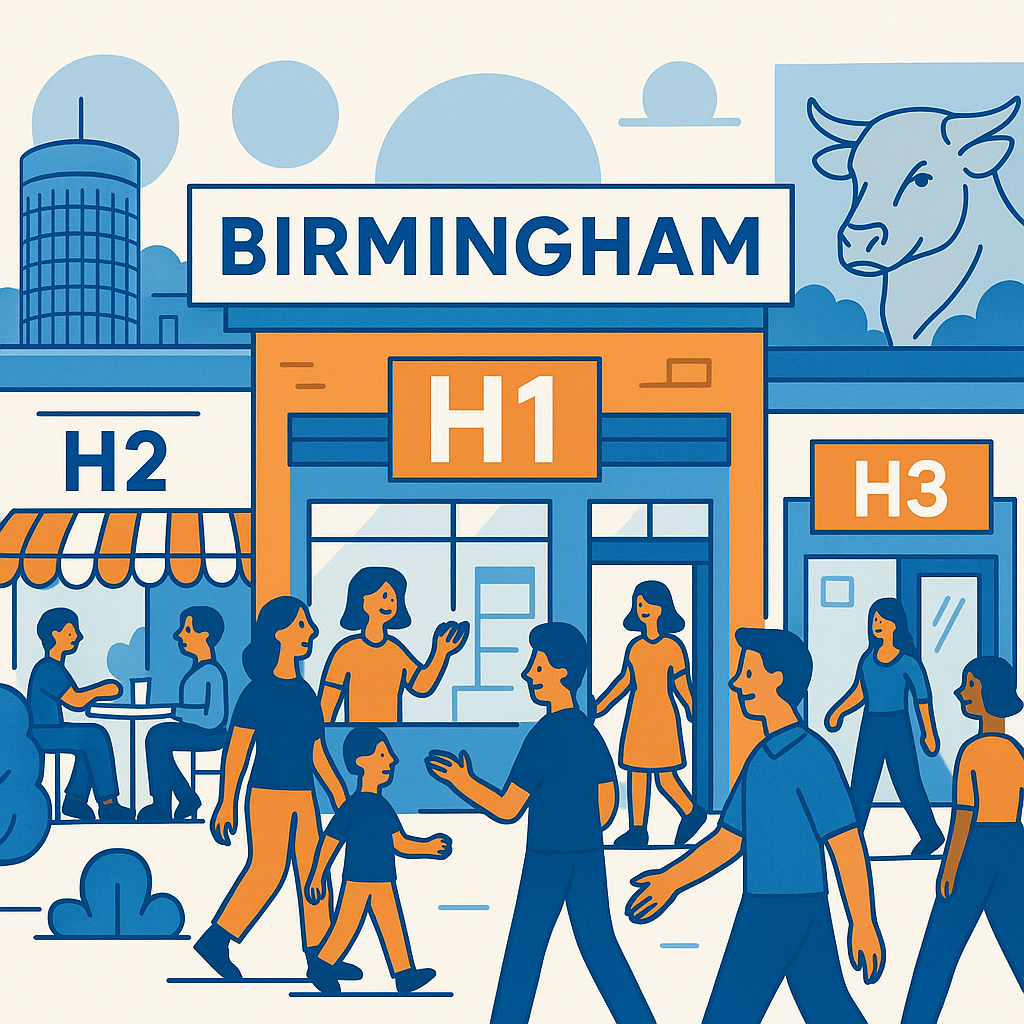
Header Tags Explained: How H1–H6 Structure Helps Birmingham Businesses Rank might sound like a technical topic at first, but it is actually very practical for small High Street businesses. If you run a salon in Moseley, a café near New Street, a repair shop in Kings Heath, or an independent retailer in Harborne, the way your web pages are structured can affect how easily people and search engines understand what you offer.
Header tags are the headings and subheadings on a web page. They are usually labelled H1, H2, H3, H4, H5 and H6 in the background code of your website. Most business owners never look at the code, which is fair enough. Still, these tags matter because they help organise your content, guide visitors through the page, and give Google clues about the main topic. For local SEO, those clues can make a real difference.
The slightly awkward part is that header tags are often treated as a design choice. A heading looks big, so someone uses it. A subheading looks nice in bold, so it goes there. But headers are not just visual styling. They are a structure. And when that structure is clear, your page usually becomes easier to read, easier to scan, and easier to rank for the right local searches.
Header Tags Explained: How H1–H6 Structure Helps Birmingham Businesses Rank
Think of header tags like the layout of a shop window and the signs inside a store. Your H1 is the main shop sign. It tells people, and search engines, what the page is mainly about. H2 tags are like section signs: services, prices, locations, FAQs, reviews. H3 tags sit underneath those sections and break things down further. H4, H5 and H6 are used less often, but they can help on longer or more detailed pages.
For a Birmingham business, this matters because local searches are often specific. People do not just search for “hairdresser”. They search for “hairdresser in Birmingham city centre”, “best Turkish restaurant Digbeth”, or “emergency locksmith Selly Oak”. If your page has a messy structure, Google may still understand it eventually, but you are making the job harder than it needs to be.
Quick local SEO example
A page called Bathroom Fitters in Birmingham with clear H2 sections for services, areas covered, costs, and FAQs is usually more useful than one long block of text. It feels better to read, and it sends clearer topic signals to search engines.
What each header tag actually does
The simplest way to understand headers is to imagine a document outline. You would not put the conclusion before the introduction, or make every line a chapter title. Website headings work in much the same way. They create a hierarchy.
Your H1 should normally be used once on a page. It is the main title. On a service page, that might be “Wedding Florist in Birmingham” or “Boiler Repairs in Erdington”. On a blog post, it is usually the article title. WordPress themes often apply the H1 automatically, although not always correctly, so it is worth checking.
H2 tags divide the main topic into useful sections. These are the headings most people notice when scanning a page. H3 tags support H2s by breaking a section into smaller parts. H4 to H6 tags are there for deeper detail, but most small business pages will rarely need all six levels. In fact, forcing them in can make a page feel oddly over-engineered.
| Header tag | Best use | Local SEO example |
|---|---|---|
| H1 | Main page title | Independent Bookshop in Birmingham |
| H2 | Main content sections | Our Birmingham Book Events |
| H3 | Subsections under an H2 | Children’s Story Sessions |
| H4-H6 | Extra detail on complex pages | Terms, small notes, nested FAQs |
Why headers matter for local High Street SEO
Local SEO is not only about adding your business to Google Business Profile and collecting reviews, although those things are important. Your website still has to explain what you do, where you do it, and why someone nearby should choose you. Header tags help organise that information into sections people can quickly understand.
This is especially useful for High Street businesses, where customers are often comparing options quickly. Someone standing outside the Bullring, sitting on a bus through Bearwood, or searching at home in Sutton Coldfield may only give your page a few seconds. If the headings immediately answer their questions, they are more likely to stay.
- They make pages easier to scan on mobile, which is where many local searches happen.
- They help search engines identify your main service, location and supporting topics.
- They improve accessibility for people using screen readers.
- They reduce confusion when a page covers several services or areas.
- They can support featured snippets and FAQ-style results, though there are no guarantees.
There is also a trust element here. A page with clear headings feels more professional. It gives the impression that the business has thought about the customer journey. That may sound a bit soft, but online, those small signals add up. I think most of us have clicked away from a site simply because it felt like too much effort to read.
A practical header structure for a Birmingham service page
Let’s say you run a small plumbing company serving Birmingham and the surrounding areas. A weak page might have a vague H1 like “Services” followed by scattered blocks of text. A stronger page would use headers to make the location and service obvious.
Weak structure
H1: Services
Text about plumbing, repairs, bathrooms, emergency callouts and areas served, all mixed together with few clear headings.
Stronger structure
H1: Emergency Plumber in Birmingham
H2s: 24-Hour Plumbing Repairs, Areas We Cover, Common Plumbing Problems, Why Choose Us, FAQs.
That second version gives Google more context, but it also helps the visitor. They can quickly find the information they care about. Do you cover their area? Are you available today? Do you handle leaks, blocked toilets, boiler issues, or only general plumbing? Headings turn those questions into signposts.
For local pages, it is often sensible to include Birmingham or a specific neighbourhood in the H1 or at least in one or two important H2s, as long as it reads naturally. Do not stuff every heading with the same place name. “Birmingham plumber”, “plumber Birmingham”, “best Birmingham plumber”, repeated over and over, looks clumsy and can feel spammy.
Common header tag mistakes small businesses make
Most header problems are not dramatic. They are usually small habits that build up over time, especially on WordPress sites where several people may have edited pages. A designer adds headings for appearance. A business owner adds a new section. A plugin changes the template. Suddenly the page has three H1s and no sensible H2s.
- Using more than one H1 on a standard page when one clear H1 would be better.
- Choosing heading tags purely because of how large or bold they look.
- Skipping levels, such as jumping from H1 straight to H4 for no real reason.
- Writing vague headings like “More Information” instead of useful, descriptive ones.
- Repeating the same keyword in every heading until the page sounds unnatural.
- Forgetting mobile readers, who rely heavily on headings to skim quickly.
The fix is not to make everything perfect in a technical sense. It is to make the page logical. If a real person can glance down your headings and understand the page, you are probably moving in the right direction.
How to write better H1 and H2 tags
A good H1 is clear rather than clever. It should describe the page in a way that matches what your customers might search for. For example, “Handmade Cakes in Birmingham” is usually stronger than “Beautiful Bakes for Every Occasion”, even though the second one sounds nicer. There is room for personality elsewhere, but the main heading should do its job.
H2s can be a bit more varied. They should answer the main questions a visitor has before they contact you, visit your shop, or make a booking. If you are a local restaurant, your H2s might cover menus, opening times, private dining, location, parking, and reviews. If you are a solicitor, they might cover services, fees, process, accreditations, and the areas you serve.
A simple test: copy only the headings from one of your key pages into a blank document. If those headings tell a clear story on their own, your structure is probably decent. If they read like random labels, it may need work.
It is also worth remembering that headings do not need to be stuffed with keywords to be useful. A natural phrase such as “Repairs for laptops, phones and tablets” may be better than “Birmingham device repair laptop repair phone repair tablet repair”. Google has become much better at understanding context, and people have always been good at spotting awkward writing.
Where H3-H6 tags fit in
H3 tags are helpful when a page has sections within sections. For example, under an H2 called “Our Beauty Treatments”, a salon could use H3s for “Facials”, “Waxing”, “Nails” and “Massage”. This keeps the page tidy without turning every small point into a major section.
H4, H5 and H6 tags are less common for small business websites. You might use them on detailed guides, product comparison pages, help documents or long FAQ pages. But on a typical High Street business website, if you are regularly reaching H5 or H6, it may be a sign the page is doing too much. Perhaps that content should be split into separate pages.
That said, there is no penalty for using deeper headings properly. The issue is not the tag itself. The issue is whether the structure helps. Local SEO is full of these small judgement calls, which is probably why it can feel more confusing than it needs to.
Using headers with location pages
Many Birmingham businesses create location pages for nearby areas. This can work well, but only if each page is genuinely useful. A separate page for Solihull, West Bromwich, Edgbaston or Jewellery Quarter should not be the same text with the place name swapped out. Headers can help you build a more specific page.
For example, a fitness studio might create a page for “Personal Training in Edgbaston”. The H2s could include “Training sessions near Edgbaston Village”, “Who our programmes suit”, “How to get to our Birmingham studio”, and “Client results from local members”. These headings naturally support the location without sounding forced.
If you serve the whole city from one premises, you may not need dozens of area pages. Sometimes one strong Birmingham service page is better than ten thin local pages. It depends on the business, competition, and how people search. Not a very satisfying answer, perhaps, but usually the honest one.
A quick checklist before publishing
Before you publish or update a page, spend five minutes checking the headings. This is one of those small SEO jobs that does not require expensive software, though tools can help. You can often spot the main issues just by looking at the page and asking whether it flows properly.
- Does the page have one clear H1?
- Does the H1 include the main service, product or topic?
- Do the H2s divide the page into useful sections?
- Are location terms used naturally, not repeatedly?
- Do the headings make sense when read on their own?
- Is the page easy to scan on a phone?
- Have you avoided using headings only to change font size?
If you use WordPress, check how your theme handles page titles. Some page builders make it easy to select heading levels manually, which is useful but also dangerous if you are not paying attention. A heading might look fine visually while being the wrong level structurally.
Conclusion: better structure helps people and search engines
Header Tags Explained: How H1–H6 Structure Helps Birmingham Businesses Rank is really about clarity. Clear headings help local customers find answers faster, and they help search engines understand the purpose of each page. For small High Street businesses, that combination is valuable.
You do not need to become a technical SEO expert to improve your header tags. Start with your most important pages: your homepage, main service pages, location pages and popular blog posts. Make the H1 specific. Use H2s as signposts. Add H3s where they genuinely help. Keep the language natural and local where appropriate.
Good structure will not magically take a business from page five to the top overnight. SEO rarely works like that. But it gives your content a better foundation, and in competitive local markets like Birmingham, the basics still matter more than people sometimes admit.