
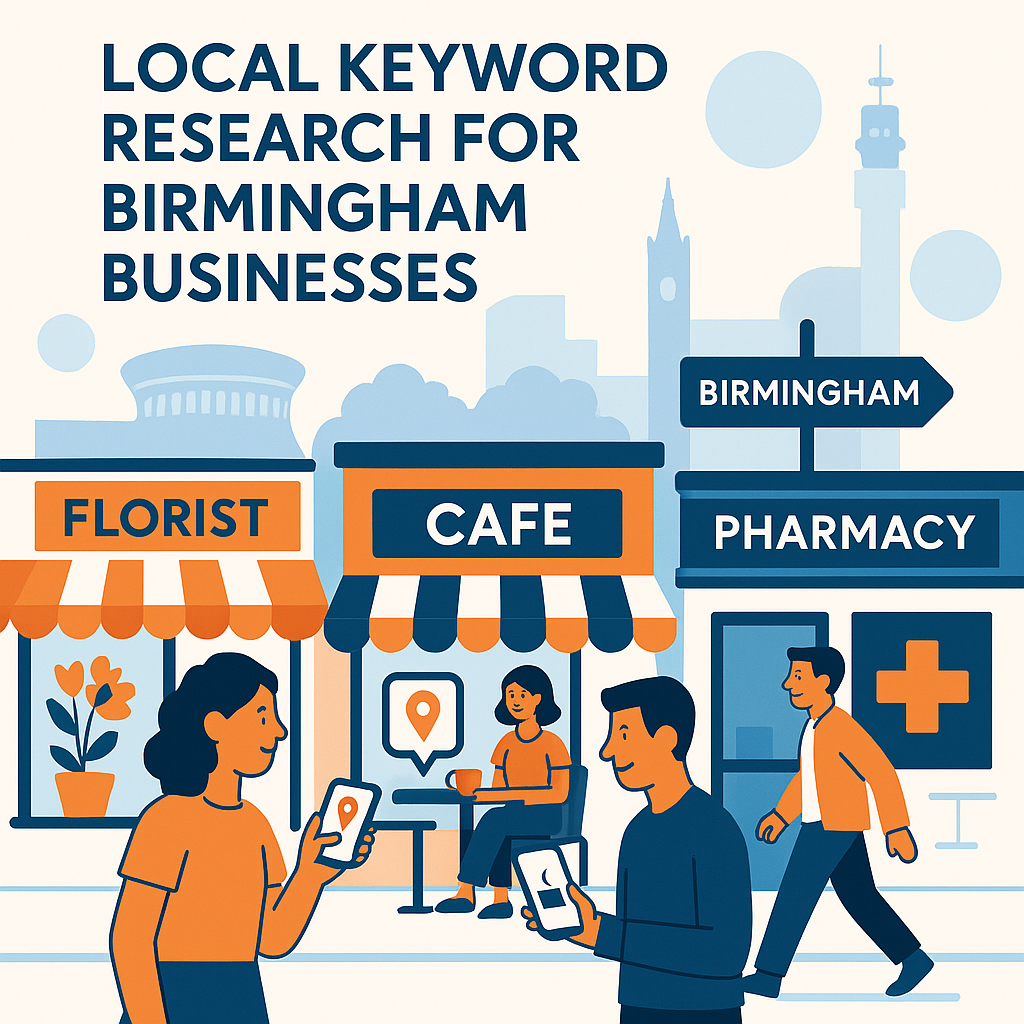
If you are wondering How to Do Keyword Research for a Birmingham-Based Business, the short answer is this: think like a local customer first, and an SEO tool second. That sounds a bit too neat, I know, but it is where many small High Street businesses go wrong. They chase broad phrases like “best hairdresser” or “accountant near me” without checking how people in Birmingham actually search, what areas they mention, and what they need at that moment.
For a small business in Birmingham, keyword research is not just about ranking nationally. In fact, most local businesses do not need national visibility at all. A Moseley florist, a Jewellery Quarter café, a Kings Heath physio, or a Solihull-adjacent plumbing firm usually needs to show up when someone nearby is ready to call, book, visit, or ask for a quote. Local SEO is practical like that. It is less glamorous than big content strategy, perhaps, but it can be much more useful.
Quick idea
Local keyword research is not just “service + city”. It is also “problem + area”, “product + near me”, “brand alternative + Birmingham”, and sometimes very specific High Street language customers use without thinking about it.
Why local keyword research matters for High Street businesses
High Street businesses compete in a slightly awkward space. You are not only up against the shop next door, but also online-only brands, marketplaces, directories, social media results, and paid ads. A customer searching for “school shoes Birmingham city centre” might see maps, shopping results, Reddit threads, a department store, and three local shops before they ever reach a normal website result.
That does not mean SEO is pointless. It means your keyword research has to be grounded in real local behaviour. Someone searching “emergency dentist Birmingham” is not in the same mood as someone searching “teeth whitening Harborne prices”. One needs help now. The other is comparing options, probably over a few days. Both searches matter, but they need different pages, different wording, and maybe even different calls to action.
Local keywords also help Google understand where you fit. Birmingham is large and varied. People search by city, district, postcode area, landmark, road name, shopping area, and sometimes by nearby transport links. A business near New Street Station might benefit from different phrases than one in Sutton Coldfield, even if they offer the same service.
City-level search
“accountant Birmingham” or “wedding florist Birmingham”. Useful, but often competitive.
Area-level search
“hair salon Harborne” or “café Digbeth”. Usually more realistic for small businesses.
Intent-led search
“same day phone repair Birmingham” or “walk in optician near Bullring”. Often converts well.
How to Do Keyword Research for a Birmingham-Based Business: start with real services
Before opening any keyword tool, write down what you actually sell. Not what sounds impressive. Not your internal categories. The services and products people ask for in plain English. This is a small step, but it prevents a lot of odd SEO decisions later.
For example, a beauty clinic might describe a treatment as “advanced skin rejuvenation”, while customers search for “microneedling Birmingham”, “acne scar treatment near me”, or “facial for dull skin”. A solicitor may talk about “residential conveyancing”, while many people type “house purchase solicitor Birmingham” or “fixed fee conveyancing Edgbaston”. Neither wording is wrong. The customer wording just needs to appear somewhere useful.
- List your core services or products first.
- Write the informal phrases customers use when they call or walk in.
- Add Birmingham, nearby districts, and any well-known local landmarks.
- Include urgent, price-led, comparison, and advice-based searches.
- Mark which terms are likely to lead to a visit, booking, phone call, or enquiry.
If you have staff, ask them what customers say. Front desk teams, baristas, receptionists, delivery drivers, and sales assistants often know the language better than the owner does. I have seen this happen more than once: the phrase that gets typed into Google is the same phrase people say while standing at the till.
Build Birmingham modifiers into your keyword list
Once you have your service list, add local modifiers. This is where Birmingham keyword research becomes more specific. You are not just adding “Birmingham” to everything. You are building a realistic map of how people describe your area.
Start with the obvious places: Birmingham, Birmingham city centre, Digbeth, Jewellery Quarter, Edgbaston, Harborne, Moseley, Kings Heath, Selly Oak, Erdington, Perry Barr, Bournville, Sutton Coldfield, and so on. Then think smaller. Are you near the Bullring, Mailbox, Custard Factory, Snow Hill, Moor Street, Cannon Hill Park, Queen Elizabeth Hospital, or the University of Birmingham? These can all influence searches, especially for businesses where convenience matters.
| Keyword type | Example | Best use |
|---|---|---|
| Service + city | bike repair Birmingham | Main service page or homepage |
| Service + district | bike repair Stirchley | Location section or local landing page |
| Problem + near me | puncture repair near me | Google Business Profile and service content |
| Urgent intent | same day laptop repair Birmingham | Dedicated page or prominent callout |
Be careful not to create dozens of thin pages for every district unless you genuinely serve those areas and can write something useful. A page called “plumber in Harborne” that says the same thing as “plumber in Moseley” with only the place name changed is not very convincing. It feels lazy to readers, and search engines are not especially fond of it either.
Check search intent before you choose a keyword
Search volume is tempting. Everyone likes a big number. But for local SEO, intent is often more important than volume. A keyword with 30 searches a month and strong buying intent can be more valuable than a broad phrase with 2,000 searches and no clear local action.
Type your keyword into Google and look at what appears. Do you see local map results? Service pages? Blog posts? Product listings? Directories such as Yell, Checkatrade, Treatwell, or TripAdvisor? The current results tell you what Google thinks the searcher wants. You do not have to copy everyone, but you should understand the pattern.
- Search the phrase in an incognito window or with location settings close to Birmingham.
- Look at the map pack and note which businesses appear.
- Check whether ranking pages are homepages, service pages, category pages, or guides.
- Read the page titles and descriptions for repeated wording.
- Decide whether your page can genuinely satisfy that search better than the current results.
For example, “best brunch Birmingham” may need a list-style guide, photos, menus, reviews, and location details. “brunch café Jewellery Quarter” may suit a specific café page. “private room brunch Birmingham” is more niche, but if you offer it, that could be a brilliant keyword because it shows a very clear need.
Use tools, but do not let them overrule common sense
Keyword tools are helpful, although they are not perfect at local detail. Google Keyword Planner, Google Search Console, Google Trends, Semrush, Ahrefs, Moz, Ubersuggest, and even Google autocomplete can all give clues. For many small businesses, you do not need a huge paid subscription at the start. A spreadsheet, Google autocomplete, Search Console data, and a bit of competitor checking can get you surprisingly far.
Autocomplete is especially useful for spotting natural phrasing. Type your service and pause. Try “Birmingham”, “near me”, “open now”, “prices”, “same day”, and local district names. Also check the “People also ask” box and related searches. Some suggestions will be irrelevant. Some will be strange. But a few will be exactly how customers think.
Small warning
Do not ignore a keyword just because a tool says it has low volume. Local tools often under-report searches, especially for neighbourhood terms and very specific services.
Your own data is even better. If your website already gets traffic, look in Google Search Console for queries that include Birmingham, nearby areas, “near me”, “open”, “price”, or service terms. These are not guesses. They are searches where your site has already appeared. Sometimes the easiest SEO win is improving a page that is sitting in position 8 or 12 for a useful local phrase.
Look at competitors without becoming a copycat
Competitor research is useful, but it can make people weirdly nervous. You are not stealing. You are studying the market. Search for your main services in Birmingham and note who appears in the map results and normal organic results. Look at their page titles, headings, service pages, FAQs, reviews, and location wording.
Ask a few simple questions. Are they targeting Birmingham broadly, or specific districts? Do they mention prices? Do they answer practical questions? Are their pages genuinely helpful, or are they ranking mostly because their website has been around for years? This gives you a sense of what you need to beat, or at least match.
But avoid copying their keyword list blindly. Your business may have different strengths. Maybe you offer evening appointments, accessible parking, vegan products, same-day repairs, family appointments, student discounts, or trade services. These details can become long-tail keywords, and they often make your page more persuasive too.
Match keywords to pages, not just blog posts
A common mistake is thinking keyword research automatically means writing blog articles. Blogs can help, yes, especially for advice-led searches. But for local High Street businesses, your main commercial pages usually matter more: homepage, service pages, product category pages, location pages, booking pages, and your Google Business Profile.
Each important keyword should have a sensible destination. “wedding florist Birmingham” probably needs a wedding flowers service page. “how much do wedding flowers cost in Birmingham” could be a blog post or pricing guide. “florist near Birmingham New Street” might be handled on your homepage or contact page if the location is genuinely relevant.
Simple keyword mapping example
Homepage
Main business type + Birmingham + strongest local trust signals.
Service page
Specific service, benefits, FAQs, prices or process where possible.
Blog or guide
Questions, comparisons, cost guides, seasonal topics, and local advice.
This mapping stage keeps your site tidy. It also prevents keyword cannibalisation, which is when several pages compete for the same phrase. That can confuse search engines, but it also confuses people. If someone searches for “children’s shoes Birmingham” and lands on a vague blog post instead of your children’s shoe range, that is not ideal.
Remember your Google Business Profile keywords
For local SEO, your Google Business Profile is part of keyword research too. It can appear before your website in map results, especially for “near me” and “open now” searches. Your primary category, secondary categories, services, products, description, posts, photos, and reviews all help build relevance.
This does not mean stuffing keywords into your business name. Please do not rename your shop “Smith & Co Best Accountants Birmingham Tax Return VAT Payroll” unless that is somehow your legal trading name, which it almost certainly is not. It looks spammy and may breach Google’s guidelines.
Instead, use natural keywords in your services, product descriptions, updates, and Q&A. Encourage customers to leave specific reviews if they are happy to do so, without scripting them. A review saying “quick watch repair in the Jewellery Quarter” is more useful than a generic “great service”, although both are nice to have.
Turn your keyword research into content that feels local
Local content should not feel like a template with Birmingham sprinkled on top. Mention real details where they are helpful. Talk about parking, public transport, nearby areas you serve, local delivery options, appointment availability, common customer questions, or seasonal patterns. A dry cleaner near the business district might write about suit cleaning for office workers. A bike shop in Stirchley might mention commuter repairs, canal routes, and weekend cyclists. Small details make the page feel rooted.
Also, write naturally. You can use a keyword like “emergency locksmith Birmingham”, but you do not need to repeat it ten times. Use variations: emergency locksmiths in Birmingham, locked out, urgent lock repair, locksmith near me, same-day lock replacement. Search engines understand related language much better than they used to, and readers certainly prefer it.
The best local SEO pages usually sound like they were written by someone who knows the area and understands the customer’s problem.
That may sound obvious, but it is surprisingly rare. Many local pages are either too thin or too polished. A bit of practical, specific, slightly ordinary information often does more than a glossy paragraph full of marketing phrases.
Conclusion: keep keyword research practical and local
Learning How to Do Keyword Research for a Birmingham-Based Business is really about connecting your services with the way local people search. Start with your real products and services, add Birmingham and neighbourhood modifiers, check search intent, study competitors, and map each keyword to the right page. Then keep improving based on Search Console data, enquiries, calls, bookings, and the questions customers keep asking.
For small High Street businesses, keyword research does not need to be overcomplicated. It needs to be accurate, local, and useful. If your website clearly says what you offer, where you offer it, and why someone nearby should choose you, you are already doing something many competitors are not. The rest is refinement, and honestly, that is where the best local SEO gains often happen.