
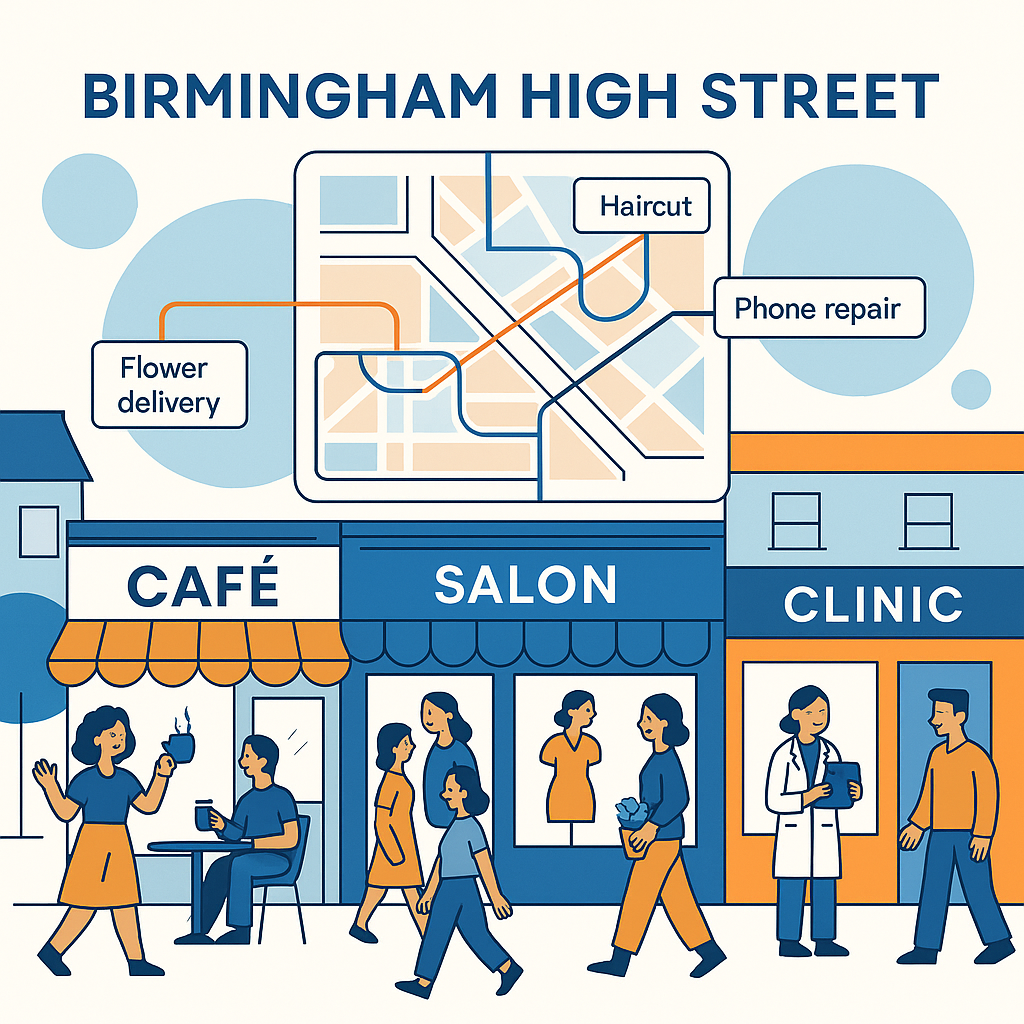
If you run a small shop, salon, clinic, café, studio, or service business in Birmingham, knowing How to Map Keywords to Pages for a Birmingham Business Website can make your SEO work feel much less random. Instead of trying to rank every page for everything, you give each important search term a proper home. It sounds tidy, maybe even a bit too tidy, but in practice it saves a lot of confusion.
Local SEO is often talked about as if it is only about Google Business Profile, reviews, and being close to the person searching. Those things matter, obviously. But your website still has a job to do. It needs to show Google, and real customers, which services you offer, where you offer them, and why your business is relevant to someone searching in Birmingham, Moseley, Harborne, Sutton Coldfield, Digbeth, Erdington, or wherever your customers actually come from.
Keyword mapping is basically the process of matching search terms to the most suitable pages on your site. A local florist might map “wedding flowers Birmingham” to a wedding flowers page, while “same day flower delivery Birmingham” belongs somewhere else. Simple enough. But once you have twenty services, a few locations, and a blog, it can get messy quite quickly.
Why keyword mapping matters for High Street businesses
For a High Street business, search intent is rarely abstract. People are usually looking for something quite practical: a haircut this weekend, a phone repair near New Street, a solicitor in the Jewellery Quarter, a children’s shoe shop close to home. If your pages are vague, or if three different pages seem to target the same thing, Google may struggle to decide which page deserves to rank.
There is also the issue of wasted effort. I have seen small business websites with five nearly identical pages all trying to rank for “best accountant Birmingham”. None of them ranked especially well, partly because they were competing with each other. One stronger page would probably have done better. Not always, because SEO is never quite that neat, but usually.
A clear keyword map helps you avoid that. It tells you which page is responsible for which topic. It also helps when you are writing page titles, headings, internal links, FAQs, and blog posts. You stop guessing so much.
Quick example
A Birmingham optician might use the homepage for broad brand and local searches, a separate page for eye tests, another for designer glasses, and a blog article for “how often should I get an eye test?”. Each page has a different purpose, even though the topics are related.
How to Map Keywords to Pages for a Birmingham Business Website
The easiest way to start is not with a keyword tool. Start with your business. Write down what you actually sell or provide, who you provide it for, and where people come from to buy it. This sounds almost too basic, but it keeps the map grounded in reality. A boutique on a busy Birmingham street does not need to chase every keyword in the world. It needs to chase searches that can become customers.
Once you have the business basics, you can group your keywords into themes. A theme might be a service, a product category, a customer problem, or a location. For example, “emergency plumber Birmingham”, “boiler repair Birmingham”, and “blocked drain Birmingham” are related, but they probably do not all belong on one page unless the business is very small and the services are described briefly.
A useful keyword map usually includes the target page, the main keyword, secondary keywords, search intent, and notes about content. You can do this in a spreadsheet. Nothing fancy. In fact, fancy tools sometimes make this feel more complicated than it needs to be.
| Page | Primary keyword | Secondary keywords | Intent |
|---|---|---|---|
| Homepage | Independent bakery Birmingham | Bakery near Bullring, artisan bread Birmingham | Find a local business |
| /birthday-cakes/ | Birthday cakes Birmingham | Custom cakes Birmingham, cake shop Birmingham | Buy or enquire |
| /wedding-cakes/ | Wedding cakes Birmingham | Bespoke wedding cakes West Midlands | Research and enquire |
Start with your core pages, not your blog
A common mistake is to write blog posts before the main commercial pages are clear. Blogs can be helpful, but for most small High Street businesses, the money pages come first. Your homepage, service pages, product category pages, location pages, contact page, and perhaps booking or enquiry pages should be mapped before you start chasing long-tail blog topics.
Think of your homepage as the broad introduction. It can target a general local phrase, but it should not carry every keyword. If you are a Birmingham hair salon, your homepage might naturally mention haircuts, colouring, balayage, bridal hair, and children’s cuts. But each important service may still deserve its own page if people search for it separately.
- Homepage: best for brand, broad local relevance, and overall business positioning.
- Service pages: best for specific searches such as “mens haircut Birmingham” or “boiler servicing Birmingham”.
- Product category pages: useful for retailers, especially if stock or ranges are searched for locally.
- Location pages: helpful when you genuinely serve multiple areas, not just when you want to stuff place names onto the site.
- Blog posts: best for advice, comparisons, seasonal searches, and early-stage research queries.
It is tempting to create a page for every area around Birmingham. Sometimes that works, particularly for trades and mobile services. But a local café in Kings Heath probably does not need separate pages for Solihull, Edgbaston, and Handsworth unless there is a real reason. Google is not easily fooled by thin location pages anymore, and customers are not impressed by them either.
Match keywords to the right search intent
Search intent is the reason behind the search. It is where keyword mapping becomes more than admin. Someone searching “emergency dentist Birmingham open now” wants fast help. Someone searching “how much does teeth whitening cost in Birmingham” is probably comparing options. Those two searches should not necessarily land on the same page.
For local businesses, intent often falls into a few familiar groups: find, compare, buy, book, visit, or learn. If a keyword suggests the person is ready to act, map it to a service or booking page. If it suggests they are researching, a guide or FAQ may be better.
Ready to buy
Use a service, product, booking, or enquiry page. Make opening times, pricing signals, and contact details easy to find.
Comparing options
Use a detailed page that explains benefits, differences, proof, and reviews. People need reassurance before they choose.
Looking for advice
Use a blog post or guide. Link back to the relevant service page when it feels natural, not every other sentence.
This matters because the wrong page can rank and still disappoint. A person looking to book an MOT in Birmingham does not want to land on a 1,500-word article about the history of MOT testing. Well, perhaps one person does. But most just want the price, availability, garage location, and a booking button.
Use Birmingham place names carefully
Local keywords often include place names, and for Birmingham businesses this can get interesting. People may search for the city as a whole, but they may also search by neighbourhood, shopping area, transport hub, or nearby landmark. “Coffee shop Birmingham city centre” is different from “coffee shop near Snow Hill”, even if the same café could appear for both.
Your keyword map should reflect how customers describe your area, not only what appears on an official address. A business in Stirchley might want to mention Bournville naturally if it attracts customers from there. A shop near the Bullring can mention Grand Central, Moor Street, or New Street if those details genuinely help people find it.
The key word is genuinely. Do not force every Birmingham district into the footer or build dozens of weak pages that say almost the same thing. Local relevance works best when it is backed by useful details: directions, parking, bus routes, nearby landmarks, service areas, delivery zones, or examples of work in that area.
Avoid keyword cannibalisation
Keyword cannibalisation happens when multiple pages compete for the same or very similar keywords. It is a dramatic term for a fairly ordinary problem. For example, a Birmingham gym might have a homepage, a “personal training” page, and three blog posts all targeting “personal trainer Birmingham”. Google may switch between them, rank the wrong one, or rank none of them strongly.
A keyword map helps you spot this before it becomes a problem. Each important keyword should have one primary page. Other pages can mention the phrase where relevant, but they should support the main page rather than compete with it.
- Choose the strongest page for the main keyword.
- Update that page so it clearly satisfies the search intent.
- Adjust competing pages so they target a slightly different angle.
- Add internal links from supporting pages to the main page.
- If two pages are almost identical, consider merging them.
This is one of those SEO tasks that feels boring until it works. Then it feels obvious. A cleaner site structure often improves rankings without creating loads of new content.
Build internal links around your map
Once your keywords are mapped, internal linking becomes much easier. You know which pages matter most and which pages should point to them. A blog post about “how to choose school shoes” could link to a children’s shoes category page. A guide to “signs your boiler needs servicing” could link to the boiler servicing page.
Use natural anchor text. You do not need to repeat the exact keyword every time. “Book a boiler service”, “our Birmingham boiler servicing team”, or “see our servicing options” can all make sense depending on the sentence. Exact-match anchors are fine occasionally, but if every link sounds engineered, it can make the page feel stiff.
A good keyword map is not just an SEO document. It is a plan for helping visitors find the right page faster.
You can also use the map to improve navigation. If a service is important enough to target with a keyword, it may deserve a place in the menu, a homepage section, or a visible card on a services page. SEO and usability are not always the same thing, but here they overlap nicely.
Review the map as your business changes
A keyword map is not permanent. High Street businesses change all the time. You might add a new treatment, stop selling a product range, move premises, extend delivery areas, or notice that customers keep asking for something you barely mention online. Your map should change with that.
It is worth reviewing it every few months. Look at Google Search Console, your website enquiries, phone call patterns, and even the questions people ask in-store. Sometimes the best keyword ideas come from ordinary customer language. Someone says, “Do you fix iPhone screens while I wait?” and suddenly you realise that phrase deserves space on your phone repair page.
Small business tip
Keep a simple note of customer questions for two weeks. The repeated phrases often reveal useful local keywords, page sections, FAQs, and blog topics.
Do not panic if rankings move around after you update pages. Local search can be a bit twitchy. What matters is whether the right pages are becoming clearer, more useful, and more aligned with the searches that bring real customers.
Conclusion: make every page earn its place
Learning How to Map Keywords to Pages for a Birmingham Business Website is really about giving your site a clearer purpose. Your homepage introduces the business. Your service and product pages answer buying questions. Your location content proves local relevance. Your blog supports the journey without trying to do every job at once.
For small High Street businesses, this can be a practical advantage. You may not have the biggest marketing budget, but you can have a website that is organised, locally relevant, and genuinely useful. Start with your main services, map one keyword theme to one page, tidy up overlaps, and build from there. It is not glamorous work, I admit, but it is the sort of steady SEO work that tends to pay off.