
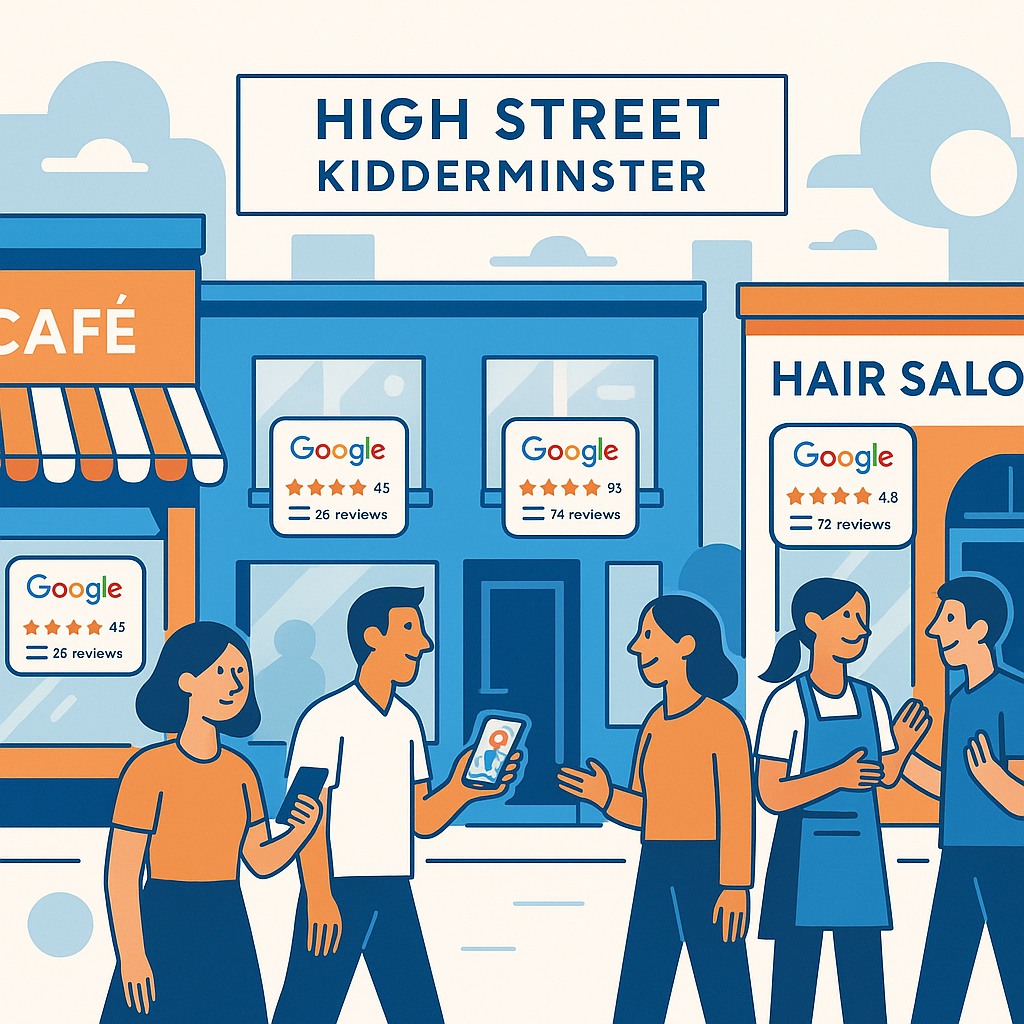
If you run a shop, salon, café, trades business, clinic, or small office in town, learning How to Rank in the Kidderminster Google Map Pack can make a real difference to the number of calls, visits, and enquiries you get. The Map Pack is that small but powerful set of local business results that appears near the top of Google when someone searches for things like “plumber near me”, “hairdresser Kidderminster”, or “best café in Kidderminster”. It looks simple from the outside. Three listings, a map, some reviews. But there is quite a bit going on behind it.
For High Street businesses, it is often more valuable than a standard website ranking. People using the map results are usually close to making a decision. They want opening hours, directions, a phone number, or a quick sense of whether your business looks trustworthy. I think this is where many smaller businesses slightly underestimate local SEO. They focus on the website, which matters, but forget that for local searches, Google Business Profile is often the first thing people see.
Quick local SEO reality check
If your business depends on customers in and around Kidderminster, your Google Business Profile is not just an online listing. It is part shop window, part advert, part review platform, and part directions tool. It deserves proper attention.
Why the Google Map Pack matters for Kidderminster High Street businesses
Kidderminster has a familiar pattern to many UK towns. You have shoppers and residents looking locally, people travelling in from surrounding areas such as Stourport-on-Severn, Bewdley, Wolverley, Cookley, and Blakedown, and a mix of established High Street names alongside independent businesses. When someone searches on their phone while walking through town, Google tends to favour results that are close, relevant, and trusted.
That is the basic idea. However, it is not only about being physically nearby. A business hidden down a side street can still appear prominently if its profile is stronger than competitors. Likewise, a shop in a great location can struggle if its Google profile is incomplete, has no recent reviews, or shows inconsistent information across the web. Slightly annoying, perhaps, but also good news. It means you can influence it.
The Map Pack can help with three very practical things: visibility, trust, and action. A potential customer sees your name. They notice your reviews. Then they click to call, visit your website, or ask for directions. That entire journey can happen in less than a minute. For some businesses, especially emergency trades, food, beauty, health, and retail, that is a big deal.
| Map Pack factor | What it means | Why it matters locally |
|---|---|---|
| Relevance | How closely your business matches the search | Google needs to understand exactly what you offer in Kidderminster |
| Distance | How near you are to the searcher or searched location | Town centre and surrounding village searches can behave differently |
| Prominence | How trusted and established your business appears | Reviews, links, mentions, and consistency all help build confidence |
How to Rank in the Kidderminster Google Map Pack: start with your Google Business Profile
Your Google Business Profile, formerly known as Google My Business, is the foundation. If this is weak, everything else becomes harder. It sounds obvious, but plenty of businesses still have missing categories, old opening hours, blurry photos, or descriptions that were written years ago and then forgotten.
Start by claiming and verifying your profile if you have not already. Then work through each section carefully. Your business name should match your real-world name, not a stuffed version with extra keywords. For example, “Smith & Co Florist” is fine if that is your name. “Smith & Co Florist Best Wedding Flowers Kidderminster Cheap Bouquets” is not. Google does not like that, and customers usually do not either.
- Choose the most accurate primary category, such as hair salon, accountant, café, plumber, or gift shop.
- Add relevant secondary categories, but avoid adding everything vaguely related.
- Make sure your address, phone number, website, and opening hours are correct.
- Write a clear business description that mentions your services and local area naturally.
- Upload good-quality photos of your premises, team, products, vehicles, or completed work.
- Use the products and services sections to explain what you actually offer.
- Keep holiday hours updated, especially around Christmas, Easter, and bank holidays.
Photos are worth pausing on. People often underestimate them. A profile with recent, genuine images feels alive. A profile with one old exterior photo and no interior shots feels neglected, even if the business itself is excellent. You do not need professional photography every month, although it can help. A decent phone photo of your shop display, treatment room, menu board, new stock, or finished project is better than nothing.
Get your local keywords right without sounding strange
Local SEO is not about repeating “Kidderminster” in every sentence until the page becomes unreadable. Google has become much better at understanding context. Still, you need to give it enough clues. Your website and Google profile should make it clear what you do, where you do it, and who you help.
For a High Street business, this might mean having a page that talks about your services in Kidderminster, mentions nearby areas you serve, and includes practical local details. Not forced details, just useful ones. If parking nearby matters, say so. If you are close to the town centre, Weavers Wharf, or a recognisable local landmark, that can be helpful for customers and search engines. Although, to be fair, do not overdo the landmark thing. It can start to sound a bit odd.
Your page titles, headings, and body text should include sensible local phrases. For example, a dentist might use “Private Dentist in Kidderminster”, while a repair shop might use “Phone Repairs in Kidderminster”. These phrases should appear naturally on the site, not just hidden in footers or repeated in a long list of towns.
Good local wording
“We provide boiler servicing and repairs for homes across Kidderminster, Stourport, Bewdley, and nearby villages.”
Awkward wording
“Kidderminster boiler repair Kidderminster plumber Kidderminster heating engineer best Kidderminster services.”
Build trust with reviews, and actually reply to them
Reviews are one of the clearest signals customers use when choosing a local business. They also appear to support local rankings, especially when they are consistent, recent, and relevant. A business with 140 reviews and a 4.8 rating is usually going to look more reassuring than a business with 6 reviews from three years ago. That does not mean you need hundreds overnight. In fact, a sudden flood of reviews can look suspicious.
The simplest approach is to ask regularly. After a positive appointment, sale, meal, job, or consultation, ask the customer if they would mind leaving a Google review. You can send a direct review link by email, text, invoice, or follow-up message. Make it easy. People are busy, and even happy customers forget.
Reply to reviews too. A short thank you is enough for positive ones. For negative reviews, stay calm and professional. It is tempting to argue, especially if the review feels unfair. But remember, your reply is not only for that reviewer. It is for every future customer reading it. A measured response can make you look reasonable, even when the review is not ideal.
A steady stream of genuine reviews usually beats a one-off campaign. Local SEO is more like gardening than switching on a sign.
Make your website support your Map Pack ranking
Your website and Google Business Profile should back each other up. If your profile says you are a florist in Kidderminster but your website barely mentions flowers, locations, opening hours, or contact details, Google gets mixed signals. Customers do too.
At minimum, your website should have a clear homepage, service or product pages, an about page, and a contact page with your full name, address, and phone number. This is often called NAP consistency: name, address, phone. It should match your Google Business Profile and other listings online. Small differences, such as “Road” versus “Rd”, are usually not catastrophic, but the main details should be consistent.
- Add your business address and local phone number to your contact page.
- Embed a Google Map if it is useful for visitors.
- Create dedicated pages for your main services instead of cramming everything onto one page.
- Use local testimonials or case studies where appropriate.
- Make sure your site works properly on mobile phones.
- Improve page speed, especially if images are large or the site feels sluggish.
- Add schema markup for local business details if you or your web developer can do it.
Mobile performance deserves a special mention. Many local searches happen on phones, often while someone is out and about. If your website is slow, hard to read, or has a contact form that is painful to use, people may go back to the map results and choose someone else. It sounds harsh, but it happens all the time.
Create local signals beyond your own website
Google looks beyond your website and profile to understand how established your business is locally. Local citations, links, and mentions all help create a broader picture. A citation is simply a mention of your business details on another website, such as a directory, chamber of commerce page, local news site, or industry platform.
For a Kidderminster business, useful signals might include listings on reputable UK directories, local business groups, supplier pages, charity sponsorship pages, event listings, or partnerships with nearby organisations. Quality matters more than quantity. You do not need to be listed on 300 low-quality directories that nobody uses. A handful of relevant, trustworthy mentions can be far more useful.
Local PR can help as well. If you sponsor a community event, support a school fundraiser, launch a new service, or run a seasonal campaign, there may be opportunities to earn mentions from local websites. Not every mention will include a link, and that is okay. But links from relevant local sites can be especially helpful.
Local link idea
Think about the real relationships your business already has. Suppliers, neighbouring businesses, charities, clubs, local publications, and professional associations can all create natural online mentions.
Post updates and keep your profile active
Google Business Profile lets you publish updates, offers, events, and announcements. Are these posts a magic ranking button? Probably not. But an active profile looks more trustworthy, and updates can help customers understand what is current. If you have a seasonal offer, new menu, changed hours, workshop, sale, or new product range, post it.
This is especially useful for High Street businesses because your day-to-day changes are often exactly what customers care about. Are you open late on Thursday? Do you have Christmas stock in? Are appointments available this week? Is there a January offer? These details can turn a searcher into a visitor.
You do not need to post every day. Once a week or a couple of times a month is often realistic for a small business. The bigger issue is consistency. Local SEO rarely rewards bursts of activity followed by six months of silence. Again, slightly frustrating, but manageable if you build it into your routine.
Track what is working, not just where you rank
Rankings are useful, but they are not the whole story. Map Pack results change depending on where the searcher is, what device they use, and even their search history. Someone standing near Kidderminster train station may see different results from someone searching in Franche or Broadwaters. So if you only check rankings from your desk, you may get a misleading picture.
Instead, track practical actions. Look at calls from your Google profile, direction requests, website clicks, form enquiries, bookings, and sales. Ask new customers how they found you. Not everyone will remember accurately, but patterns emerge. If more people say “I found you on Google Maps”, you know the work is starting to land.
It can also be worth using call tracking carefully, although some businesses prefer to keep one consistent phone number everywhere. There is a balance. The main point is to measure outcomes, not vanity metrics alone.
Conclusion: How to Rank in the Kidderminster Google Map Pack
The honest answer to How to Rank in the Kidderminster Google Map Pack is that there is no single trick. It is a combination of a well-optimised Google Business Profile, accurate local information, steady reviews, a useful website, and genuine local trust signals. None of it is especially mysterious, but it does take attention.
For small High Street businesses, that is actually encouraging. You do not need a huge national marketing budget to compete locally. You need to be clear, consistent, visible, and credible. Start with the basics, improve them bit by bit, and keep your profile alive. Over time, those small actions can help more people in Kidderminster find you at exactly the moment they are ready to visit, call, or buy.