
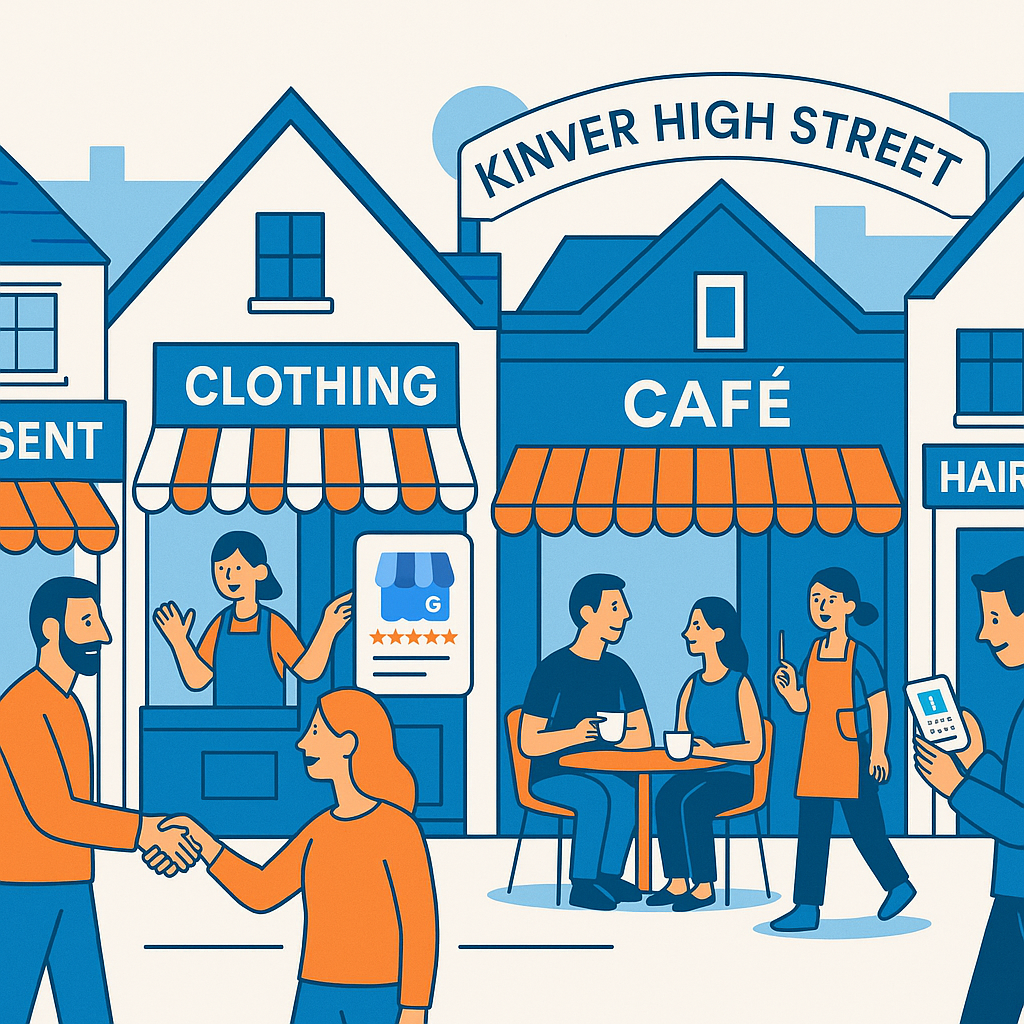
If you run a shop, café, salon, trades business, clinic, or any other small High Street business, learning How to Rank in the Kinver Google Map Pack in 2026 is no longer a nice extra. It is often the difference between being found by someone ready to buy today and being quietly ignored while a competitor gets the call. That sounds a little dramatic, perhaps, but anyone who has searched “near me” for a plumber, lunch spot, florist, or dentist knows how quickly we make decisions from those three map results.
The Kinver market is local, personal, and quite specific. People are not just searching for “best café”. They are searching from Kinver, Stourbridge, Enville, Wollaston, Wordsley, or somewhere nearby, and Google is trying to work out which businesses are genuinely relevant, nearby, trusted, and active. So, ranking in the Map Pack is not about one clever trick. It is a steady mix of Google Business Profile optimisation, reviews, local content, citations, website quality, and plain old customer trust.
Quick reality check
Google Map Pack rankings are influenced by three main things: relevance, distance, and prominence. You cannot move your premises closer to every searcher, but you can make your business more relevant and more prominent online.
How to Rank in the Kinver Google Map Pack in 2026: Start with your Google Business Profile
Your Google Business Profile is the foundation. Not your website, not your Instagram page, not even your paid ads. For the Map Pack, your profile is where Google gathers a lot of its confidence about what you do, where you are, when you are open, and whether people seem to like you.
Start by checking the boring details. I know, it is not the exciting part. But many small businesses lose visibility because their opening hours are old, their category is vague, or their services are half-filled. A Kinver hairdresser using only “Hair salon” may be missing opportunities for searches around colouring, bridal hair, children’s cuts, or gents’ styling. A local garage might not have MOT testing, tyres, diagnostics, and servicing clearly listed.
- Choose the most accurate primary category, not the broadest one.
- Add secondary categories only where they genuinely fit.
- Write a clear business description that mentions your services and local area naturally.
- Add every key service or product you want to be found for.
- Keep your opening hours accurate, especially for bank holidays.
- Upload real photos of your premises, team, products, and work.
- Use the Q&A section to answer common customer questions before people ask them.
Photos matter more than some business owners think. A slightly imperfect photo of your actual shop front on Kinver High Street can be more useful than a polished stock image. Google wants signals that your business is real and active. Customers do too. If I am choosing between two local cafés and one has recent photos of the counter, menus, seating, and cakes, I am probably going there first. It just feels safer.
Profile signal
Accurate categories, services, hours, photos, posts, and Q&A.
Trust signal
Consistent reviews, sensible replies, real customer language, and local mentions.
Location signal
A clear Kinver address, matching citations, embedded maps, and local website content.
Understand what Google is really ranking
Google does not rank businesses in the Map Pack simply because they want it more. It looks at signals. Some are obvious, some are a bit hidden, and some change depending on the search. For example, a person standing outside Kinver Edge searching for “coffee near me” may see different results from someone in Stourbridge searching “coffee Kinver”. That can be frustrating, but it makes sense.
In simple terms, Google is balancing three things: how relevant your business is to the search, how close you are to the searcher or searched location, and how prominent your business appears online. You can improve relevance by making your services clear. You can improve prominence through reviews, links, local mentions, and good website content. Distance is the awkward one. If your shop is in Kinver, you are naturally more likely to show for Kinver searches than for Birmingham searches, and that is probably how it should be.
| Ranking factor | What it means | What a Kinver business can do |
|---|---|---|
| Relevance | How closely your profile matches the search. | Add detailed services, categories, product info, and local wording. |
| Distance | How near you are to the searcher or location term. | Be clear about your address and service areas, but avoid pretending to be somewhere you are not. |
| Prominence | How well-known and trusted your business appears. | Build reviews, local links, press mentions, citations, and useful website pages. |
Reviews are not just stars, they are local SEO content
Reviews influence both people and search engines. A business with 4.8 stars and recent, detailed reviews usually feels more trustworthy than a business with two old reviews from 2019. But the wording inside reviews matters too. If customers naturally mention “Kinver”, “High Street”, “dog-friendly café”, “emergency boiler repair”, or “wedding flowers”, those words help describe your business in a way that is difficult to fake.
Do not bribe people for reviews. Do not set up a tablet in-store and ask everyone to review from the same device. And definitely do not buy them. It is tempting, especially when competitors look suspiciously perfect, but fake reviews can damage your profile and your reputation. The better route is slower but more stable: ask happy customers at the right moment.
- Ask soon after a positive experience, while the customer still remembers the details.
- Send a direct Google review link by text, email, or invoice follow-up.
- Invite customers to mention the service they used, without scripting their words.
- Reply to every review in a calm, human way.
- Mention useful context in replies, such as the service provided or your Kinver location, but do not overdo it.
A reply like “Thanks, Sarah, we’re really pleased you enjoyed your afternoon tea with us in Kinver” sounds natural. A reply like “Thank you for choosing the best café in Kinver for afternoon tea Kinver Staffordshire” sounds like it was written for a machine. Google is cleverer than that, and so are customers.
The best review strategy is not complicated: do good work, ask consistently, and reply like a real person.
Your website still matters for Map Pack rankings
There is a small misconception that because the Map Pack is based on Google Business Profiles, the website does not matter. It does. Maybe not in the same way as traditional organic SEO, but your website gives Google extra evidence. It confirms your services, location, expertise, and local relevance.
For a small Kinver High Street business, your website does not need to be huge. In fact, a simple, well-structured website often beats a bloated one. What matters is clarity. Your homepage should say what you do, where you do it, and who you help. Your contact page should show your name, address, phone number, opening hours, and embedded Google Map. Your service pages should explain each core service properly, not just list a sentence and hope.
Local content can help as well, but it needs to be useful. A dentist could write about emergency dental appointments in Kinver and nearby areas. A boutique could create pages around occasionwear, school prom fittings, or local gift ideas. A tradesperson could explain response times for Kinver, Enville, Cookley, and surrounding villages. It does not have to be literary. It just has to answer the questions real customers have.
Small website improvement with a big impact
Make sure your business name, address, and phone number appear exactly the same on your website as they do on your Google Business Profile. Tiny differences can create unnecessary confusion.
Build local citations and mentions around Kinver
Citations are online mentions of your business details, usually your name, address, and phone number. They can appear on directories, industry websites, local business groups, chamber pages, event listings, supplier pages, and sometimes local news sites. In 2026, citations are not the magic ranking lever they once were, but they still help establish legitimacy.
The key is consistency. If one directory says you are on “High St”, another says “High Street”, and another has an old phone number, it may not ruin everything, but it does not help. Clean it up where you can. Prioritise important platforms first: Google, Bing Places, Apple Business Connect, Facebook, Yell, Yelp, Thomson Local, industry directories, and any respected local business directories for Staffordshire, South Staffordshire, or the wider Black Country area.
Local links are even better than basic citations. A sponsorship mention from a Kinver sports club, a supplier feature, a local event page, a charity fundraiser listing, or a blog post from another nearby business can all strengthen your prominence. This is where offline relationships become online SEO signals, which I quite like because it rewards businesses that are actually part of the community.
Create content for nearby searches without looking desperate
Many businesses want to rank not only in Kinver but also in Stourbridge, Kingswinford, Kidderminster, Wolverhampton, and surrounding villages. That is understandable. But there is a clumsy way to do it, and it usually looks like dozens of near-identical pages with the town name swapped out. Google has seen that pattern thousands of times.
Instead, create genuinely useful area content where it makes sense. If you are a service-area business, such as a plumber, electrician, dog groomer, mobile mechanic, or cleaning company, you can build pages for areas you genuinely serve. Add real information: typical travel times, examples of jobs completed nearby, customer questions, parking or access notes, and photos if you have permission.
For a fixed-location High Street business, be a little more careful. A shop in Kinver should usually focus its strongest signals on Kinver, then mention nearby areas naturally. You might have a page for “Visiting us from Stourbridge” if that is useful, but you probably do not need twenty thin pages pretending you have branches everywhere.
Use Google Posts, products, and updates to show activity
Google Business Profile posts are easy to ignore. I have ignored them myself on projects when other tasks felt more urgent. But for small local businesses, they are a simple way to show freshness. You can post about seasonal offers, new stock, appointment availability, events, menus, changes to opening hours, or helpful tips.
Products and services are also worth completing. A gift shop can add popular ranges. A restaurant can add menu highlights. A beautician can list treatments with price ranges. A solicitor can list service areas like wills, conveyancing, or family law. These details help customers decide quickly, and they give Google more context.
Simple monthly Map Pack routine
- Add 3 to 5 fresh photos.
- Publish 1 Google Post.
- Ask recent happy customers for reviews.
- Check your opening hours and services.
- Look at search terms in your profile insights.
Track progress, but do not obsess over one ranking
Map Pack rankings move around. They change by location, device, search phrase, time, and sometimes for reasons that are not obvious. So, if you check from home and see yourself in position four, then check from the shop and see yourself in position two, you are not imagining it. Local SEO is like that.
Track a handful of important searches, but also watch real business outcomes. Are calls increasing? Are direction requests rising? Are more people mentioning they found you on Google? Are website enquiries better? Rankings matter, of course, but they are not the whole story. A business that ranks for fewer but more relevant searches may make more money than one chasing every possible keyword.
- Google Business Profile calls and direction requests
- Website contact form submissions
- Click-throughs from your profile to your website
- Review growth and average rating
- Rankings for your main services in Kinver
- Actual new customers who say they found you on Google
Common mistakes Kinver businesses should avoid
The most common mistake is neglect. A business claims its Google profile, fills in the basics, and then leaves it untouched for two years. Another mistake is over-optimisation. That means stuffing keywords into the business name, writing robotic replies, creating fake locations, or publishing thin pages for every nearby town. It might work briefly, but it is risky and, frankly, it looks poor.
Also avoid using tracking numbers inconsistently. Call tracking can be useful, but your core phone number should remain consistent across major listings unless it is set up properly. And if you move premises, update everything quickly. An old address hanging around online can confuse customers and weaken trust.
Avoid this
Adding keywords to your business name if they are not part of your real trading name.
Do this instead
Use your real name, then describe your services properly in categories, services, posts, and website content.
Conclusion: How to Rank in the Kinver Google Map Pack in 2026
How to Rank in the Kinver Google Map Pack in 2026 comes down to being clear, consistent, active, and trusted. There is no single switch to flick. Your Google Business Profile needs to be complete, your reviews need regular attention, your website should support your local relevance, and your business details should match across the web.
For small High Street businesses, the good news is that local SEO often rewards real-world quality. If customers know you, talk about you, review you, visit you, and see you involved locally, those signals can carry through online. It takes time, and yes, competitors may be doing some of it too. But a steady monthly routine can make a visible difference.
Start with the basics this week: check your profile, add fresh photos, ask for a couple of honest reviews, and make sure your website clearly says what you do in Kinver. It is not glamorous work. But for a local business that depends on nearby customers, it is work worth doing.