
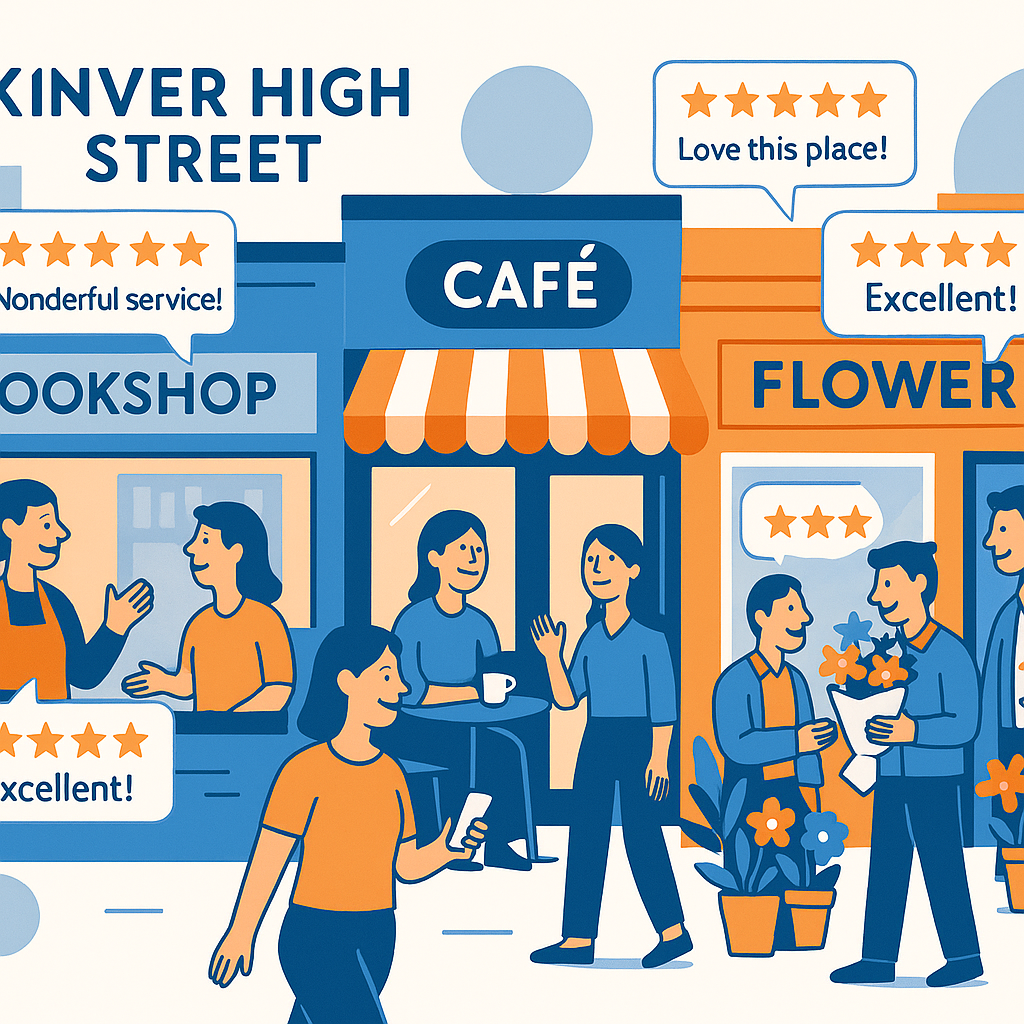
If you run a shop, café, salon, trades business, clinic, or any other small local business in Kinver, knowing How to Use Customer Reviews to Improve Your Kinver SEO Rankings can make a bigger difference than many people realise. Reviews are not just nice comments that sit on your Google profile. They are signals. They tell Google that your business is active, trusted, relevant, and worth showing to people nearby who are searching for what you offer.
And, perhaps more importantly, they tell real people the same thing. Someone searching for a plumber near Kinver, a dog groomer, a gift shop, or somewhere to have lunch is often making a quick decision. They might not read every page on your website. They may not compare ten businesses in detail. They will usually glance at your star rating, skim a few recent reviews, look at your photos, and decide whether you feel like a safe choice.
That sounds simple, but it is where a lot of small High Street businesses miss an opportunity. Reviews can support your local SEO, improve click-through rates, increase trust, and give you a steady flow of fresh, locally relevant content. Used properly, they become part of your marketing, not just a bit of feedback after a sale.
Why Customer Reviews Matter for Local SEO in Kinver
Local SEO is slightly different from general SEO. You are not trying to rank across the whole country, or at least most Kinver businesses are not. You are trying to appear when someone nearby searches for something like “coffee near me”, “hairdresser Kinver”, “accountant near Stourbridge”, or “best pub in Kinver”. Google looks at a mix of relevance, distance, and prominence. Reviews can influence all three, though not always in a perfectly direct way.
When customers mention your services, location, staff, products, or experience in their reviews, they naturally add context to your business profile. A review saying “Lovely little florist in Kinver, helped me choose flowers for my mum’s birthday” is far more useful than a generic “Great service”. Both are welcome, obviously. But one gives Google and potential customers more detail.
For small High Street businesses, this matters because local searches are often full of intent. Someone looking for “Kinver bakery open today” is probably ready to visit. Someone searching “best massage therapist near Kinver” may be ready to book. Reviews help your business stand out at exactly that point.
Quick local SEO reminder
Google reviews are not the only ranking factor, but they can support visibility, trust, and customer action. Think of them as proof that your Kinver business is alive, useful, and worth visiting.
How to Use Customer Reviews to Improve Your Kinver SEO Rankings
So, How to Use Customer Reviews to Improve Your Kinver SEO Rankings in a practical sense? Start by treating reviews as part of your everyday business process. Not as an awkward favour you ask once in a while, and not as something you only think about when a competitor suddenly has more stars than you. The businesses that do well with reviews usually make it easy, regular, and low-pressure.
A good review strategy does not need to feel pushy. In fact, it probably should not. People in smaller communities tend to notice when marketing feels too forced. A simple, friendly request after a positive interaction often works best. If someone compliments your service in person, that is usually the moment to say, “Thank you, that means a lot. If you had a minute to leave that on Google, it would really help us locally.” It is direct, but still human.
You can also add a review link to receipts, email footers, appointment reminders, follow-up messages, and small cards at the till. For restaurants, cafés, and shops, a QR code near the counter can work, though I think it helps if it is designed nicely rather than looking like an afterthought. For trades and service businesses, a follow-up text after completing the job is often more effective.
- Ask soon after a good customer experience, while the details are still fresh.
- Send customers directly to your Google review link to reduce friction.
- Avoid offering discounts, prizes, or rewards in exchange for reviews, as this can breach platform guidelines.
- Encourage honest feedback rather than only five-star praise.
- Reply to every review where possible, especially detailed ones.
- Look for keywords customers naturally use, such as “Kinver”, “High Street”, “friendly staff”, or your specific service.
The aim is not to manipulate what customers say. That rarely ends well, and it tends to sound false anyway. The aim is to make it easier for happy customers to share the kind of specific feedback they might already have said to you face to face.
What Makes a Review Useful for SEO?
Not all reviews carry the same practical value. A five-star rating with no words is still helpful, but a detailed review gives more substance. It can include the service used, the location, the reason for the visit, the problem solved, or the type of customer experience. That detail is useful for both search engines and people.
For example, imagine you run a beauty salon in Kinver. A review saying “Excellent facial, really relaxing” is good. A review saying “I booked a facial at this salon in Kinver before a wedding and the therapist was brilliant, really calm and professional” is better. It includes service information, location, occasion, and sentiment. It sounds real because it is specific.
| Review type | SEO value | Example |
|---|---|---|
| Star rating only | Helpful, but limited context | 5 stars |
| Short comment | Adds some trust | Great service, thank you |
| Detailed local review | Strongest for relevance and conversions | Brilliant coffee shop in Kinver, friendly staff and lovely cakes after our canal walk |
You cannot write reviews for your customers, of course, and you should not try to script them. But you can gently prompt useful detail. A phrase like “It helps us if you mention what you bought or what service you used” is usually acceptable, provided you are not telling them what rating to give or what opinion to express.
Getting More Reviews Without Feeling Awkward
This is the bit many business owners dislike. Asking for reviews can feel a little uncomfortable, especially if you are used to letting your work speak for itself. But the truth is, even your happiest customers may not think to leave a review unless you ask. They are busy. They may assume you already have plenty. Or they might mean to do it later and then forget, which is probably what most of us do.
The trick is to build the request into natural moments. If you own a shop, ask when a customer says they love what they have bought. If you run a café, include a small line on the receipt or a card near the till. If you provide home services, send a short message after the work is finished and the customer has confirmed they are happy.
Here is a simple message you could adapt:
“Thanks again for choosing us. If you were happy with everything, would you mind leaving us a quick Google review? It really helps local customers in and around Kinver find us.”
That wording is not magic, and you should make it sound like you. But it works because it is brief, polite, and explains why the review matters. People are often more willing to help when they understand that it supports a local business, not some faceless company with a giant marketing budget.
Responding to Reviews Helps More Than You Might Think
Replying to reviews is one of those tasks that is easy to postpone. You tell yourself you will do it on Friday, then Friday disappears. But responses matter. They show customers that you are listening, and they add more useful text to your Google Business Profile. A thoughtful reply can reinforce your location, your services, and your tone of voice.
For a positive review, you might reply with something like: “Thank you, Sarah. We’re really pleased you enjoyed your visit to our Kinver shop, and we hope to see you again soon.” It is short, but it mentions the location and sounds genuine. Avoid copying and pasting the same reply every time. People notice, and Google probably does too in its own way.
Negative reviews need a calmer approach. It can be tempting to defend yourself, especially when the review feels unfair. Still, it is usually better to pause before replying. A public argument rarely helps your SEO or your reputation. Keep it professional, acknowledge the issue, and invite the customer to contact you directly.
- Thank the reviewer for their feedback.
- Respond to the specific issue without sounding defensive.
- Mention that you would like to resolve it.
- Move detailed discussion offline where possible.
- Use the feedback to improve your service if there is a genuine pattern.
Oddly enough, a few negative reviews can make your profile look more believable. A perfect wall of five-star reviews sometimes feels suspicious, especially if they all sound similar. What matters is the overall pattern: recent reviews, mostly positive sentiment, and professional responses from the business.
Use Review Content Across Your Website
Reviews should not live only on Google. With permission, you can use snippets on your website, service pages, landing pages, and blog posts. This can help visitors feel more confident, especially if the review relates to the exact service they are considering. A testimonial about wedding flowers belongs on your wedding flowers page. A review about emergency repairs belongs on your emergency repair page.
For Kinver businesses, it is also useful to include local context. A page that mentions your work with customers in Kinver, Stourbridge, Wollaston, Wall Heath, Enville, or nearby villages can feel much more relevant than a generic service page. Be careful not to overdo it, though. Repeating place names every other sentence looks clumsy, and it can put readers off.
Website testimonial
Add short customer quotes to service pages where they support a buying decision.
Local proof
Use reviews that mention Kinver or nearby areas to strengthen local relevance naturally.
Fresh content
Regular reviews give you new wording, customer language, and ideas for FAQs or blog content.
Reviews can also help you understand the words customers actually use. You might describe your business as “artisan homeware”, while customers say “lovely gifts for birthdays”. You may talk about “domestic electrical services”, while they search for “electrician to fix lights”. This gap is worth paying attention to. Customer language often makes better SEO copy because it matches real search behaviour.
Keep Your Google Business Profile Active
Reviews work best when your wider Google Business Profile is also in good shape. If your opening hours are wrong, your photos are old, or your services are vague, reviews can only do so much. For High Street businesses in particular, accurate opening hours are essential. People might be planning a visit during a lunch break, after school pickup, or on a Saturday morning. If Google says you are open and you are not, that frustration may turn into a bad review.
Add current photos, update seasonal hours, list your services clearly, and use Google Posts occasionally for offers, events, or updates. You do not need to post every day. This is not social media in the usual sense. But a profile that looks maintained is more reassuring than one that feels abandoned.
For Kinver businesses that rely on footfall, photos can be especially useful. Show the front of your shop so people recognise it. Add interior photos so visitors know what to expect. If parking, accessibility, dog-friendliness, or outdoor seating is relevant, make that clear too. Small practical details often influence local choices more than polished marketing claims.
Common Review Mistakes to Avoid
There are a few mistakes that can weaken your review strategy. The first is asking for lots of reviews all at once and then doing nothing for months. A steady trickle looks more natural and gives potential customers confidence that your business is currently active. Ten reviews from three years ago are not as persuasive as three reviews from the last month.
Another mistake is ignoring reviews completely after they arrive. Even a simple thank you is better than silence. Also, do not create fake reviews or ask friends and family to pretend they are customers. It is risky, it can damage trust, and honestly, fake reviews often have a strange tone that people pick up on.
- Do not buy reviews.
- Do not review your own business from personal accounts.
- Do not pressure customers to leave only positive feedback.
- Do not use identical reply templates for every review.
- Do not ignore negative feedback if the same issue appears repeatedly.
It is also worth checking which review platforms matter in your sector. Google is usually the main one for local SEO, but TripAdvisor, Facebook, Trustpilot, Checkatrade, Yell, or industry-specific directories may also influence customer decisions. You do not need to chase every platform at once. Start with Google, then expand where it makes sense.
Conclusion: How to Use Customer Reviews to Improve Your Kinver SEO Rankings
The simplest answer to How to Use Customer Reviews to Improve Your Kinver SEO Rankings is to make reviews a normal part of how your business operates. Ask at the right time, make the process easy, encourage honest detail, reply properly, and use the best feedback across your website and local marketing.
For small High Street businesses, reviews are powerful because they sit right between SEO and reputation. They help Google understand your business, but they also help real people decide whether to visit, call, book, or buy. That combination is what makes them so valuable.
You do not need hundreds of reviews overnight. In fact, that would probably look a bit odd. What you need is consistency: recent feedback, local detail, genuine responses, and a business profile that feels alive. Do that steadily, and your Kinver business gives itself a much better chance of standing out when nearby customers are ready to choose.