
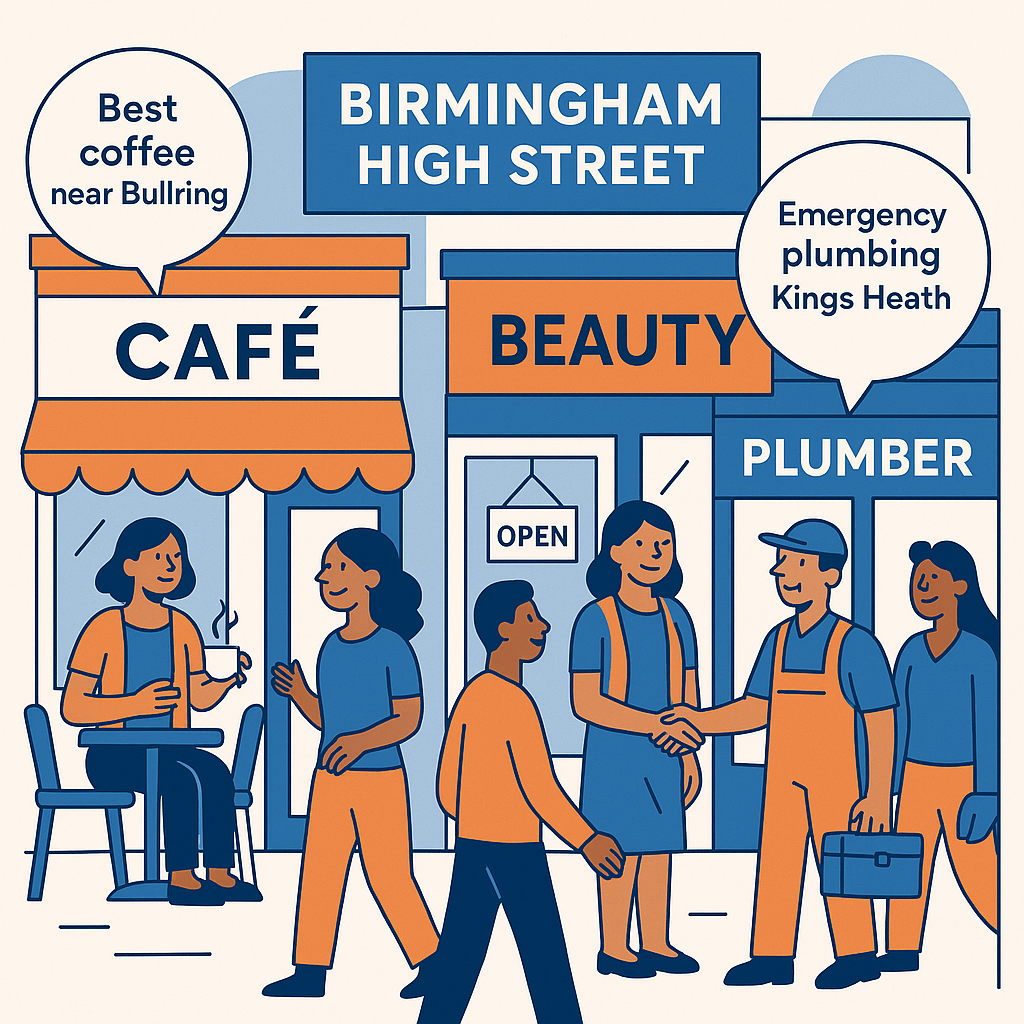
If you are wondering How to Use LSI Keywords to Strengthen Birmingham Service Pages, the short answer is this: stop writing around one stiff keyword and start building pages that sound like they genuinely understand the service, the area, and the customer’s problem. For small High Street businesses in Birmingham, that can make a real difference. A plumber in Kings Heath, a solicitor near Colmore Row, a beauty salon in Harborne, or an accountant serving Digbeth all need pages that feel specific, useful, and local. Not just pages that repeat “Birmingham” until nobody wants to read them.
LSI keywords, or terms people often describe as semantically related keywords, are words and phrases that sit naturally around your main topic. Strictly speaking, Google does not use old-school latent semantic indexing in the way some SEO blogs used to suggest. But the practical idea still matters. Search engines look for meaning, context, entities, and relevance. So if your page is about emergency locksmith services in Birmingham, it helps if the page also talks about lock repairs, uPVC doors, lost keys, call-out times, local neighbourhoods, security upgrades, and perhaps even landlord access issues.
Quick thought: LSI-style keywords are not magic dust. They work best when they help you explain your service more clearly. If a phrase feels forced, it probably is.
Why Birmingham Service Pages Need More Than One Main Keyword
Local SEO has become more nuanced than “service plus city”. Years ago, you could create a page called “Electrician Birmingham”, add the phrase several times, mention a few surrounding areas, and hope for the best. That approach still appears on plenty of small business websites, to be fair. But it often produces thin, similar pages that do not give customers much confidence.
A good Birmingham service page needs to answer the questions people actually have before they contact you. How quickly can you get there? Do you cover Moseley, Erdington, Selly Oak, Jewellery Quarter, or Sutton Coldfield? Are prices fixed or quoted after inspection? Do you work with homes, shops, offices, landlords, or all of them? These details create natural keyword variety without making the page feel like it was written by a machine.
This is especially important for High Street businesses, because people often search with local intent but not always with the same wording. Someone might search “best hair colourist near Bullring”, while another person types “balayage Birmingham city centre”. A café might be found through “independent coffee shop near New Street Station”, “brunch Birmingham”, or “quiet place for laptop work Birmingham”. The business is the same, but the search language shifts.
| Main service keyword | Helpful related terms | Local context to add |
|---|---|---|
| Boiler repair Birmingham | Gas Safe engineer, no heating, boiler servicing, pressure fault | Edgbaston flats, Harborne homes, landlord call-outs |
| Solicitor Birmingham | Conveyancing, family law, legal advice, consultation | City centre office, local property market, West Midlands clients |
| Beauty salon Birmingham | Facials, waxing, brows, skin treatments, appointments | High Street visitors, parking nearby, after-work bookings |
How to Use LSI Keywords to Strengthen Birmingham Service Pages
The easiest way to use LSI keywords is to think in clusters rather than single phrases. A service page should have a core topic, a local angle, and supporting language that proves the page is genuinely about that topic. I tend to think of it as building a small cloud around the main keyword. Not a huge foggy cloud, just enough context so that both Google and the reader understand what you do.
Start with your primary service. Then list the problems customers describe, the tools or methods you use, the types of customers you serve, and the Birmingham areas you cover. If you run a dental practice, related phrases might include check-ups, hygienist appointments, emergency dental care, teeth whitening, nervous patients, NHS and private treatment, and family dentistry. If the page only says “dentist Birmingham” repeatedly, it misses all of that useful meaning.
- Write down the main service phrase, such as “roof repairs Birmingham” or “accountant Birmingham”.
- Add common customer problems, for example leaks, tax returns, payroll, blocked drains, damp patches, or last-minute appointments.
- Include service variations, such as emergency, same-day, commercial, domestic, mobile, fixed-fee, or specialist support.
- Mention genuine local areas you serve, but do not stuff every Birmingham district into one paragraph.
- Look at your customer emails, reviews, and phone enquiries. The best related terms are often hiding there.
- Use the terms naturally in headings, FAQs, image alt text, internal links, and body copy.
One small warning, though. Do not turn this into a box-ticking exercise. A page with fifty related phrases crammed into it can be worse than a plain page with ten useful ones. The point is to make the page richer, not heavier. If you read it aloud and it sounds odd, cut something.
Finding Local Keyword Ideas Without Overcomplicating It
You do not need an expensive SEO toolkit to begin. Tools can help, of course, and I would not pretend otherwise. But small High Street businesses can gather a lot of useful keyword ideas from everyday sources. Google’s autocomplete suggestions, “People also ask” boxes, competitor pages, Google Business Profile reviews, and even conversations at the till can all show how real customers describe your service.
For Birmingham businesses, the local layer is particularly useful because the city is large and varied. People search differently depending on whether they are in the city centre, the suburbs, or nearby towns. Someone in Solihull may still search for a Birmingham service if they think the provider is better. Someone in Digbeth may want a walk-in appointment. Someone in Sutton Coldfield may care more about parking and home visits. These little differences can shape your content.
Google Search
Type your service and note autocomplete suggestions, related searches, and question boxes.
Customer Reviews
Look for repeated phrases customers use to describe your work, speed, price, or location.
Competitor Pages
Check what established Birmingham competitors mention, then improve on the useful parts.
A simple spreadsheet is enough at first. Put your main services down one side, then add related phrases, customer questions, and location modifiers. You might end up with clusters like “emergency plumber Birmingham”, “blocked toilet”, “leaking pipe”, “24-hour call-out”, “Landlords in Selly Oak”, and “student accommodation plumbing”. Suddenly you have a page that feels much more specific.
Where to Place Related Keywords on a Service Page
Placement matters, but it does not need to be fussy. Your main keyword should usually appear in the page title, H1, introduction, and perhaps one subheading. Related terms can sit throughout the page wherever they make sense. Think of them as supporting details, not decorations.
The opening section should quickly confirm the service and the Birmingham area. After that, use related phrases to explain what you offer. A section about “common boiler problems we repair” can naturally include pilot light issues, pressure drops, thermostat faults, noisy boilers, and radiators not heating properly. A section about “who we help” can mention homeowners, landlords, letting agents, local shops, and small offices.
- Use related keywords in subheadings when they introduce a useful section.
- Add customer questions as FAQs, especially if they match real search queries.
- Include local landmarks or areas only when they are relevant to your service area.
- Use internal links from blog posts to service pages with varied, natural anchor text.
- Add image alt text that describes the actual image, not just a keyword phrase.
One area that is easy to overlook is internal linking. If you have a blog post about “how to prepare for a house move in Birmingham”, it can link to your conveyancing page. If you have a guide to “signs your boiler needs replacing”, it can link to boiler installation and repair pages. These links help users, and they also reinforce the topic relationships across your website.
Making Pages Feel Local, Not Just Keyword-Rich
There is a difference between a local page and a page with a place name sprinkled through it. A genuinely local service page references practical details: travel times, parking, nearby areas, local property types, common customer needs, or the realities of serving businesses on and around the High Street. For example, a shopfitter in Birmingham might mention working around trading hours, deliveries, listed buildings, and retail units in busy locations.
This kind of content helps conversion as much as SEO. People want to feel that you know their world. If a customer runs a café near Corporation Street, they may be reassured by a cleaning company that talks about early morning visits, food hygiene standards, and minimal disruption. It sounds obvious, but many service pages stay so generic that they could belong to a business in any town.
A stronger local page does not just say where you are. It shows that you understand how people in that area actually buy, travel, work, and ask for help.
Try adding a short “areas we cover” section, but keep it restrained. Mentioning Birmingham city centre, Edgbaston, Harborne, Moseley, Kings Heath, Erdington, Handsworth, and Sutton Coldfield may be useful if you genuinely cover those places. Listing thirty areas in a block of text can look spammy. Sometimes a small service-area map or a neat table works better.
Mini page section idea
Instead of writing “We serve Birmingham” ten times, add a useful paragraph like this:
“Our team regularly works with shops, offices, and homeowners across Birmingham, including the city centre, Jewellery Quarter, Edgbaston, Harborne, and Moseley. If you are not sure whether we cover your postcode, call us and we will confirm availability before booking.”
Common Mistakes Small Businesses Make With LSI Keywords
The most common mistake is overuse. Business owners hear that related keywords help SEO, then they add every possible variation to the page. The result is a page that feels bloated. Another mistake is creating lots of near-identical location pages, such as “plumber Birmingham”, “plumber Harborne”, “plumber Moseley”, and “plumber Edgbaston”, with only the place name changed. That might seem efficient, but it often creates weak content.
It is usually better to have one strong Birmingham service page than six thin ones. Later, if you have enough genuine local information, case studies, reviews, photos, or specific service differences, you can create separate area pages. But they need a reason to exist. Google is fairly good at spotting pages that are only there to catch searches.
- Do not repeat the same phrase in every sentence.
- Do not add neighbourhood names you do not actually serve.
- Do not copy competitor wording and simply swap in your business name.
- Do not write for search engines before writing for customers.
- Do not ignore basics like page speed, mobile layout, reviews, and contact details.
That last point matters. Keywords cannot rescue a poor page experience. If your phone number is hard to find, your contact form is broken, or the page loads slowly on mobile, better wording will only take you so far. Local SEO is a mix of relevance, trust, usability, and prominence. The writing is one part, albeit an important one.
A Simple Framework for Updating an Existing Birmingham Page
If you already have service pages, you do not need to rewrite everything from scratch. Start with one important page. Perhaps the page that brings in the most leads, or the one that should bring in leads but does not. Read it like a customer. Is it clear what you do? Does it mention the specific problems you solve? Does it sound like a Birmingham business, or just a generic service provider?
Then improve it section by section. Add a better introduction, expand the service explanation, include customer questions, add local proof, and link to related services. If you have reviews from Birmingham customers, use them. If you have completed work on or near the High Street, mention it carefully without revealing anything private. Real-world proof is hard to fake, and readers can usually sense it.
Quick audit checklist
- Does the page clearly name the service and Birmingham location near the top?
- Are there related phrases that match real customer needs?
- Does the page answer price, timing, coverage, and booking questions?
- Are there internal links to and from relevant pages?
- Is there a clear call to action for calls, bookings, or enquiries?
Keep an eye on performance after making changes. Rankings can shift slowly, and not every edit will create a dramatic jump. Look at impressions, clicks, enquiries, and the search terms appearing in Google Search Console. Sometimes the best sign is not a sudden ranking win, but a wider range of relevant searches starting to bring people to the page.
Conclusion: Use Better Context to Win Better Local Traffic
For small High Street businesses, local SEO is not about sounding clever. It is about being findable, believable, and useful at the exact moment someone needs your service. LSI-style keywords help because they add context. They let your Birmingham service pages speak the same language as your customers, while giving search engines clearer signals about what you offer.
So, when thinking about How to Use LSI Keywords to Strengthen Birmingham Service Pages, focus less on squeezing in phrases and more on building a complete, helpful page. Cover the service properly. Mention real local details. Answer practical questions. Use related terms where they genuinely belong. It is not the flashiest SEO tactic, perhaps, but for a local business trying to earn more calls, bookings, and walk-ins, it is one of the more dependable ones.