
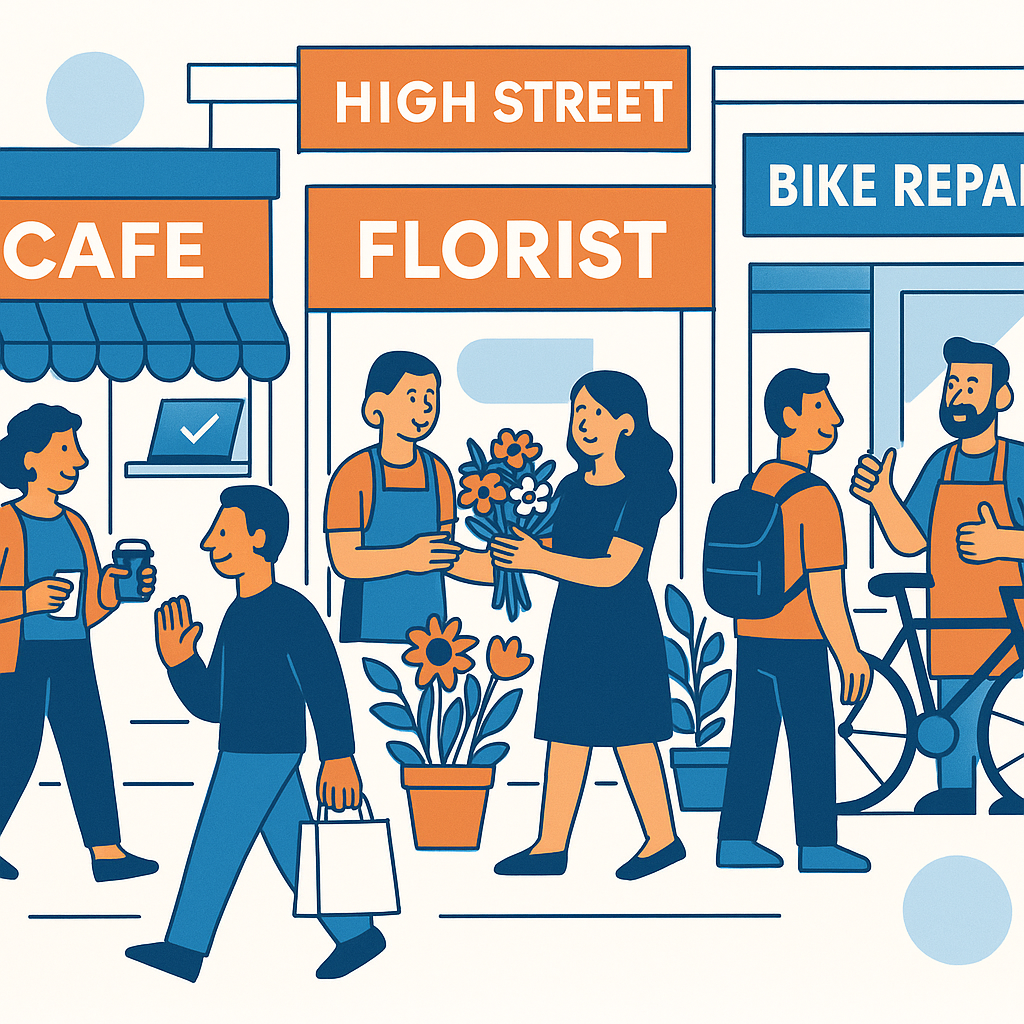
Search for Ultra-Practical Local SEO Tasks AI Can Help You With and you will find plenty of useful advice, much of it sensible. AI can speed up awkward little jobs, tidy messy text, suggest ideas, and help a busy shop owner get unstuck. But somewhere along the way, a slightly odd belief has crept in: that local SEO now belongs to whoever has the cleverest AI tools. I do not think that is true. In fact, for many small High Street businesses, the basics still matter more than the software.
A florist in Leeds, a café in Bristol, a bike repair shop in York, or a family-run optician in Cardiff does not need to behave like a tech start-up to be visible locally. They need to be findable, trusted, consistent, and genuinely useful to nearby customers. AI may help with parts of that. It will not replace the daily reality of answering the phone, updating opening hours, asking for reviews, fixing inaccurate listings, taking decent photos, and writing in a way that sounds like a real business with real people behind it.
This article takes inspiration from the practical argument made by Local Visibility System: AI is most useful when it is pointed at small, specific local SEO tasks. That is a fair point. But I want to push the conversation a little further, especially for UK High Street businesses that may feel overwhelmed by the noise. AI can be useful. It is not essential. And sometimes, strangely enough, too much reliance on it can make a local business feel less local.
The short version
AI is a useful assistant for local SEO, not the engine of success. High Street businesses still tend to win through accurate details, visible trust, useful pages, good photos, local relevance, and steady review habits.
Why the AI-local SEO myth feels so convincing
The myth is easy to understand. Local SEO can feel fiddly. There are Google Business Profile updates, service pages, posts, reviews, citations, photos, FAQs, keywords, maps, directories, and competitors who somehow seem to appear everywhere. When a tool promises to make all that easier, it is tempting to believe it might be the missing piece.
And to be fair, some AI tools are impressive. They can turn a rough list of services into a decent first draft. They can summarise reviews and spot repeated customer language. They can suggest blog topics for a locksmith in Manchester or a dog groomer in Brighton. If you have ever stared at a blank screen trying to write a page about “emergency boiler repair in Stockport”, you will appreciate the help. I certainly would.
But helpful is not the same as essential. A calculator is helpful for bookkeeping, yet it does not make someone a good accountant. A sat nav helps you get around, but it does not know the customer who prefers the back entrance because the front step is awkward. Local SEO is full of these human details. Search engines may process data, but customers respond to signs of life.
The businesses that often perform well locally are not always the ones producing the most content or using the newest platform. They are the ones whose information is correct, whose reputation looks genuine, whose website answers obvious questions, and whose local presence feels consistent across the web. None of that requires AI. It requires attention. Slightly boring attention, unfortunately, but attention all the same.
What local SEO actually means for High Street businesses
For a small High Street business, local SEO is not an abstract marketing channel. It is the digital version of being easy to find on the corner, having a clean shopfront, and being recommended by someone down the road. It is making sure that when someone searches “shoe repair near me”, “best café open Sunday”, or “independent bookshop in town centre”, your business has a fair chance of appearing.
That usually depends on a few familiar signals. Your Google Business Profile needs to be complete and accurate. Your name, address, and phone number should match across important directories. Your website should explain what you do and where you do it. Reviews should be recent and believable. Photos should help people recognise the place before they arrive. Your pages should not sound like they were written for a search engine alone.
| Local SEO area | Human advantage | Where AI can help |
|---|---|---|
| Google Business Profile | Knowing real hours, services, access details, and seasonal changes | Drafting updates, posts, and Q&A answers |
| Reviews | Earning trust through real service and thoughtful replies | Suggesting response drafts and spotting common themes |
| Website content | Explaining local knowledge in a genuine voice | Creating outlines, editing rough copy, and finding gaps |
| Photos and updates | Showing the real shop, team, work, and neighbourhood | Writing captions or organising image checklists |
The human side is not sentimental fluff. It is practical. People want to know if you are open, whether parking is nearby, whether you repair that specific thing, whether you are good with nervous children, whether the shop has step-free access, or whether you stock a particular brand. AI can help phrase answers, but it cannot know those things unless you tell it. That is where the business owner, manager, or team member still matters most.
Ultra-Practical Local SEO Tasks AI Can Help You With, without taking over
Let us be clear: there are Ultra-Practical Local SEO Tasks AI Can Help You With, and it would be silly to pretend otherwise. The problem is not using AI. The problem is treating it like the main strategist, the local expert, and the voice of the business all at once. It is better used as a helper sitting beside you, not as a replacement for judgement.
For example, AI can turn a rough note into a clearer Google post. You might type, “We’re staying open late on Thursday for Christmas shopping and have gift cards available,” and ask the tool to produce three short versions. That saves time. You still need to check the date, tone, offer, and whether it sounds like you. A very polished post can feel weirdly distant if your usual style is warm and plain-speaking.
- Drafting first versions of service pages, especially when you know what you want to say but cannot quite get started.
- Creating a list of common customer questions for your website, Google Business Profile, or sales team.
- Summarising review themes, such as repeated praise for speed, friendliness, value, or specialist knowledge.
- Rewriting clunky page titles and meta descriptions so they are clearer and more locally relevant.
- Turning bullet points from staff into short posts about new products, seasonal hours, events, or offers.
- Checking whether a page answers obvious practical questions, such as price ranges, areas served, parking, or booking details.
Those are genuinely useful tasks. They are also limited tasks, and that is the point. AI is best when the input is specific and the output is reviewed by someone who understands the business. If you simply ask it to “write local SEO content for my bakery”, you may get something bland about delicious treats, friendly service, and the heart of the community. True, perhaps, but not especially helpful. If you give it your actual bestsellers, your location near the station, your early opening times, and the fact that you make gluten-free brownies on Fridays, the result becomes far more useful.
The local details AI usually misses
AI tends to smooth things out. That can be useful when you need cleaner writing, but local SEO often benefits from specifics that are not smooth at all. A tiny alley entrance. A market-day parking problem. A delivery cut-off at 2 pm. A repair service that is technically available across the county, except not on Wednesdays because the van goes north. These are the details customers care about.
A good local page might mention nearby landmarks, surrounding villages, common customer situations, or practical constraints. Not in a forced way. Nobody wants to read a paragraph stuffed with every district within 20 miles. But a page for a physio in Exeter could naturally mention runners training along the Quay, office workers near the city centre, and people travelling in from Topsham or Exminster. That sort of detail feels lived-in.
Photos are another obvious example. AI can suggest that you upload photos. It cannot stand outside your shop at 8.45 on a rainy Tuesday and take a picture of the actual frontage, with the sign visible, so customers recognise it. It cannot photograph the new display, the repaired watch before collection, the team at a charity event, or the dog bowl by the entrance. Those small things create trust in a way that generic content does not.
Generic
“We provide high-quality repairs with friendly service in your local area.”
More local
“We repair shoes, bags, and zips from our shop opposite the bus station, usually with same-week turnaround.”
The second example is not poetic. It is not trying very hard, honestly. But it is more useful. It gives a person something to picture and a reason to believe the business is real. That is a lesson worth remembering whenever AI produces content that sounds tidy but slightly empty.
Google Business Profile: less automation, more accuracy
For many High Street businesses, the Google Business Profile is more important than the website, at least at the first point of contact. People check hours, directions, photos, reviews, and whether they can ring quickly. If that information is wrong, no amount of clever writing will fully make up for it.
This is where a manual habit beats a shiny system. Check your opening hours before bank holidays. Add special hours for Christmas, Easter, and local events. Make sure your primary category is right. List services accurately. Remove old photos if they confuse people. Add fresh images every so often. Respond to reviews, especially recent ones. These tasks are not glamorous, but they have a direct effect on customer confidence.
AI can support this routine. It can help draft review replies, suggest post ideas, or turn an event note into a short update. But the accuracy has to come from you. If the AI says you are open until 6 pm and you actually close at 5.30, the customer will not blame the tool. They will blame the business. Fair enough, really.
- Set a 15-minute monthly reminder to check your Google Business Profile details.
- Review special opening hours at least two weeks before bank holidays.
- Add one or two real photos each month, even simple phone photos.
- Reply to reviews in a human tone, not with the same copied response every time.
- Check your main competitors occasionally, not obsessively, to see what information they show that you do not.
Reviews are not a content problem, they are a trust problem
Reviews are one area where AI can be both helpful and risky. Helpful, because many business owners freeze when replying to criticism or feel awkward responding to praise. Risky, because AI-generated review replies can sound painfully similar. You have probably seen them: “Thank you for your kind words. We are delighted to hear you had a positive experience.” Fine once. Suspicious after the twentieth time.
A better approach is to use AI for a nudge, then add a human detail. If someone praises your staff member by name, mention that person. If a customer travelled from a nearby village, acknowledge it. If the review mentions a specific service, refer to it. You do not need long replies. In fact, short often feels more genuine.
The bigger issue is review generation. AI cannot earn reviews for you. It can draft a polite request message, but the timing and relationship matter more. A hairdresser asking a delighted regular after a good appointment will usually do better than an automated email sent two weeks later. A tradesperson who sends a simple text after finishing a job may collect better reviews than someone relying on a complicated funnel they never actually uses. Well, use. You get the idea.
The best review strategy is often not clever. It is simply asking the right customer, at the right moment, in a way that feels normal.
Content that sounds local, not manufactured
Small business websites often fall into two traps. The first is saying too little: a homepage, a contact page, and perhaps a vague services page that could apply to anyone. The second is saying far too much in a way nobody believes: dozens of near-identical location pages with swapped town names and no real local substance. AI can make both traps easier to fall into because it can produce passable text very quickly.
A better local content strategy starts with real customer questions. What do people ask before they buy? What do they misunderstand? What nearby areas do you genuinely serve? What makes visiting you easier or harder? Do customers need to book? Is there parking? Are you wheelchair accessible? Do you offer emergency appointments, repairs while you wait, free consultations, gift wrapping, collection, delivery, or weekend availability?
These details can become service pages, FAQ sections, blog posts, or simple homepage improvements. A jeweller might write about resizing rings bought elsewhere. A café might explain private hire for small gatherings. A garden centre might publish a month-by-month planting guide for local conditions. A solicitor might create a plain-English page about what to bring to a first appointment. None of this has to be groundbreaking. It just has to be useful and true.
Quick content test
Read a page aloud and ask: could this have been written by any business in any town? If yes, add real details: nearby landmarks, actual services, staff experience, common customer questions, or practical visiting information.
AI can help shape those raw details into readable copy. It can also suggest headings and spot missing information. But if the raw material is generic, the finished article will probably be generic too. That is not a technology problem. It is a source material problem.
A sensible workflow for using AI without losing the human touch
If you do want to use AI, and most businesses probably should at least experiment, keep the workflow simple. Start with what you know. Feed the tool specific details. Ask for drafts, not final answers. Edit for accuracy. Remove exaggerated claims. Add a sentence or two that only your business could say. That last step matters more than people think.
Here is a practical example. Suppose you run an independent pet shop in Nottingham. Instead of asking, “Write a local SEO page for a pet shop,” give the AI a note like this: “We are an independent pet shop in Sherwood, Nottingham. We stock natural dog food, cat litter, small animal bedding, leads, treats, and toys. Customers often ask about switching food and puppy starter products. We deliver locally on Fridays to Arnold and Mapperley. Friendly advice, no pressure.” That prompt gives the tool something real to work with.
Then review the output with a slightly suspicious eye. Does it invent services? Does it sound too grand? Has it repeated “Nottingham pet shop” in every other sentence? Has it promised same-day delivery when you only deliver Fridays? AI is very good at sounding confident while being wrong. That is not a character flaw, exactly. It is just something you have to manage.
Simple AI-assisted local SEO workflow
- Write messy notes about the real business, customers, services, and location.
- Ask AI for a draft, outline, review reply, or checklist.
- Check every factual claim before publishing.
- Replace bland phrases with specific details.
- Publish, then revisit the page or profile after a few weeks.
Where small businesses should spend time first
If your time is limited, and it probably is, prioritise the work that affects customer decisions most directly. It is easy to spend an afternoon playing with AI prompts and still avoid the boring job of fixing wrong opening hours on a directory listing. I have done the marketing equivalent of that many times: polishing something optional while ignoring the thing that actually matters. It feels productive, but it is not always productive.
Start with the essentials. Make sure people can find you, contact you, understand what you offer, and trust that you are active. Then improve from there. A modest website with accurate local pages and good reviews will often outperform a bloated site full of generic content. Especially in smaller towns, where trust and recognition still carry real weight.
- Your Google Business Profile is complete, accurate, and updated for special hours.
- Your website clearly states your services, location, contact details, and opening times.
- Your key pages mention real local details where useful, not just town names for the sake of it.
- You have a simple, repeatable way to ask happy customers for reviews.
- You reply to reviews in a way that sounds like a person, not a template.
- Your photos show the real premises, team, products, work, or surroundings.
- Your business details are consistent across major UK directories and platforms.
Once those are in place, AI becomes more valuable because it is helping you improve a solid base. Without that base, it can become a distraction. A very clever distraction, admittedly, but still a distraction.
Conclusion: AI helps, but local trust still wins
The real lesson is not that AI is bad for local SEO. It is that AI should not be given more importance than the fundamentals. High Street businesses succeed locally when they are accurate, visible, responsive, and recognisably part of the area they serve. That comes from real-world knowledge as much as digital technique.
So yes, explore Ultra-Practical Local SEO Tasks AI Can Help You With. Use AI to draft review replies, improve service pages, brainstorm FAQs, tidy meta descriptions, and turn staff notes into useful updates. Just do not confuse the assistant with the business. Your customers are still looking for signs that you are nearby, reliable, and worth choosing. AI can help express that. It cannot be that for you.
For a small High Street business, the most powerful local SEO tool may still be a regular habit: check your details, answer real questions, ask for reviews, upload honest photos, and write like someone who knows the place. It is not glamorous. But it works, and it feels human. That is probably the point.