
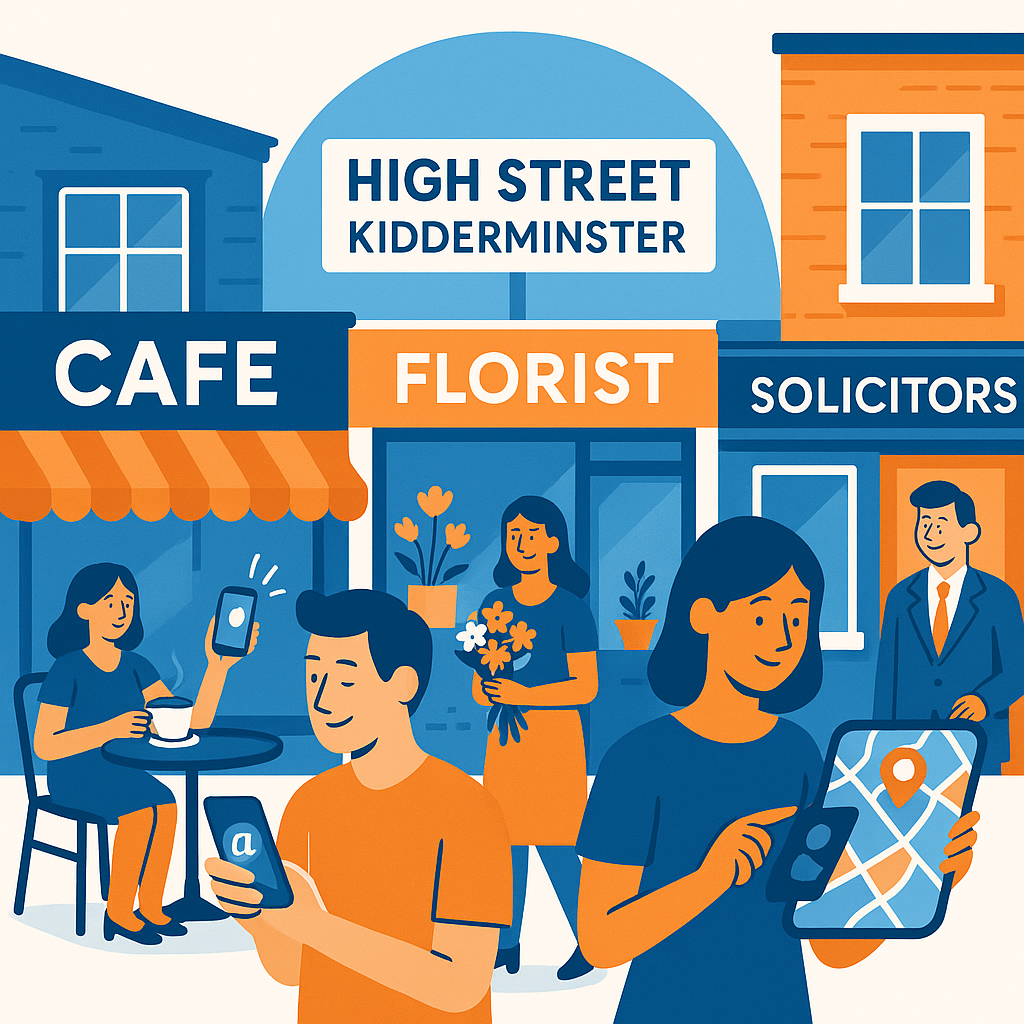
Local SEO has changed in ways that can feel slightly awkward if you have been following the same checklist for years. The 7 Local Search Ranking Factors That May Challenge Your Current Thinking are not just abstract ideas for agencies or national brands. They matter to the florist near Vicar Street, the café close to Kidderminster Town Hall, the family solicitor trying to appear for kidderminster solicitors, and the independent retailer wondering why a less established competitor keeps appearing above them in Google Maps.
For small High Street businesses in Kidderminster, local search can be a bit maddening. One week you are visible. The next, you seem to have slipped behind a business with fewer reviews, a messier website, or, frankly, a weaker reputation locally. It is tempting to assume Google has got it wrong. Sometimes it has, or at least it looks that way from the outside. But more often, the ranking signals are simply less obvious than they used to be.
The familiar advice still has value: keep your Google Business Profile accurate, earn reviews, build citations, add local content, and make sure your website is technically sound. None of that has disappeared. What has changed is the weighting, the context, and the way signals interact. A clean citation profile might not rescue a business with poor engagement. A beautiful website might not help if Google cannot see a strong local relationship between the business, its customers, and the place it claims to serve.
A quick local reality check
A Kidderminster business does not need to dominate the whole West Midlands. It usually needs to be trusted, relevant, and visible for searches happening around Comberton Hill, Worcester Street, Weavers Wharf, the Ringway, and nearby villages such as Stourport, Bewdley, Wolverley, and Cookley.
Why the 7 Local Search Ranking Factors That May Challenge Your Current Thinking matter now
A useful argument made by Whitespark in its discussion of local ranking factors is that many assumptions about local SEO need re-testing. That feels right. Local search has never been static, but the past few years have made old rules feel particularly brittle. The old model was fairly tidy: proximity, relevance, prominence, citations, reviews, links, and on-page optimisation. Do those things well and you usually moved in the right direction.
Today, those signals still exist, but they are messier. Google is interpreting behaviour, confidence, entity relationships, service intent, and sometimes even whether a business seems genuinely active. That is not always comfortable. It means a High Street shop with a simple website may outrank a slick competitor because it has stronger real-world signals. Or a service-area business with no shopfront may struggle, even though its website reads perfectly.
This article looks at seven ranking factors through a Kidderminster lens. Not because Kidderminster is unique in every way, but because local SEO is always easier to understand when you picture real streets, real searches, and real buying behaviour. Someone looking for a locksmith after work near Kidderminster Railway Station is not behaving like someone casually researching carpets from another county. Google knows that. Or it tries to.
- Local intent is becoming more specific, not less.
- Engagement signals can sometimes appear to override traditional optimisation.
- The quality of local proof often matters more than the quantity of local mentions.
- Search results are increasingly shaped by context, device, timing, and user behaviour.
- Small businesses may have an advantage when they look genuinely embedded in the town.
1. Proximity is powerful, but it is not the whole story
Conventional wisdom says the nearest business wins. In local SEO, proximity is undeniably important. If someone searches for "coffee near me" while standing outside Kidderminster shopping centres, Google will lean heavily towards nearby cafés. That is sensible. Nobody wants to be shown a café in Stourbridge if they are walking along the High Street and need a quick sandwich.
But proximity is not a magic key. A business can be physically close and still lose visibility if Google has weak confidence in its category, opening hours, customer sentiment, or website signals. I have seen this happen with small local firms where the address is correct, the map pin is correct, and yet the business barely appears. It feels unfair, but usually there is a reason hiding somewhere.
For Kidderminster businesses, the practical point is this: do not rely on being central. Being near the town centre, near Weavers Wharf, or close to a known landmark helps, but it will not compensate forever for thin content, inconsistent details, poor reviews, or a neglected Google Business Profile. Location gives you a seat at the table. It does not guarantee the best seat.
| Old assumption | What often happens now | Kidderminster action |
|---|---|---|
| Closest business ranks first | Google balances distance with trust, relevance, and engagement | Mention nearby areas, landmarks, services, and real customer needs naturally |
| Town centre address is enough | A central business can still be outranked by a better-known local competitor | Build reviews, photos, local links, and updated service pages |
| Service area pages solve everything | Generic pages often look weak unless they show genuine local usefulness | Create pages with practical Kidderminster-specific details, not copied templates |
A good way to think about proximity is that it narrows the field. It helps Google decide which businesses are possible candidates. After that, other signals decide which candidate looks most useful. That second part is where many High Street businesses either win or quietly fall away.
2. Your primary category may matter more than your website copy
This one can be hard to accept, especially if you have invested in a decent website. Your Google Business Profile primary category can carry enormous weight. A business that chooses the slightly wrong category may struggle for months, even if its website explains everything beautifully. Google is trying to classify you quickly, and the category is one of the clearest labels it has.
For example, a Kidderminster firm offering legal services might think of itself as a broad professional practice. But someone searching for kidderminster solicitors is expressing a very specific intent. If the primary category, services, website headings, and reviews all reinforce that solicitor identity, Google has more confidence. If the business profile is vague, the site talks about trusted advice, and the reviews mention helpful staff but not legal services, the signal is softer.
This does not mean you should stuff your profile with every category that seems remotely connected. That can backfire, or at least dilute the picture. The better approach is to choose the most commercially important and accurate primary category, then use secondary categories where they genuinely fit.
- Check the primary category used by businesses ranking well for your main local searches.
- Compare it with your own category, but do not copy blindly if it is not accurate.
- Add services inside your Google Business Profile using plain customer language.
- Make sure your website pages support the same core topic as the profile.
- Look at review wording and consider whether customers naturally mention the service you want to rank for.
The slightly uncomfortable truth is that a category change can sometimes do more than a long blog post. Not always, of course. But if the foundation is wrong, more content simply builds on a crooked base. It is one of those small settings that feels too simple to be important, which is probably why it gets missed.
3. Reviews are not just a star rating contest
Most business owners understand that reviews matter. The problem is that many still treat them as a numbers game: get more five-star reviews than the competitor and rankings should improve. Sometimes they do. But reviews have become more nuanced than that.
Google can read review content. It can identify themes, services, sentiment, and possibly even patterns that suggest whether the reviews are natural. A review that says great service is nice. A review that says the team repaired my engagement ring quickly after I visited their Kidderminster shop is far more informative. It confirms service, place, experience, and trust in one small piece of text.
This does not mean you should script reviews. Please do not. Apart from being risky, it sounds odd. Customers have their own way of describing things, and that variety is part of the value. What you can do is make it easier for customers to mention what they actually bought, where they visited, and what problem you solved.
Less useful review signal
Great company. Very helpful. Would recommend.
Stronger local review signal
Booked an eye test at their Kidderminster branch and the staff explained everything clearly. Easy to get to from the town centre too.
For High Street businesses, it also helps to reply to reviews in a human way. A response that says thank you for visiting our Kidderminster store to choose your new carpets may reinforce relevance without feeling forced. A response that repeats every keyword under the sun looks desperate. There is a line, and it is not always obvious, but customers can usually sense when a reply is written for Google rather than for them.
Also, a few imperfect reviews are not the end of the world. In some ways, a spotless profile with hundreds of identical five-star ratings can look less believable than a healthy mix. What matters is the overall pattern: recent reviews, specific experiences, sensible business replies, and evidence that people are still using the business.
4. Local links still matter, but not always the links agencies chase
Links have always been part of SEO, but local links are sometimes misunderstood. Small businesses are often told to chase high-authority backlinks from big websites. Those can be useful. Yet for local SEO, a modest link from a relevant local organisation may carry a kind of place-based credibility that a generic national directory does not.
A Kidderminster business might earn links from a local charity sponsorship, a Chamber of Commerce profile, a community event page, a school fundraiser, a local sports club, a supplier, or a nearby venue. None of these may look spectacular in a traditional SEO report. They may not have huge domain authority. But they help connect the business to the town.
This is where conventional wisdom can become too neat. A link from a national lifestyle blog may look stronger in a tool. But a link from a page about a Kidderminster Christmas market, a local business awards shortlist, or a community project can be more meaningful for local relevance. I would not reject either, obviously. Still, if your goal is to rank locally, local proof deserves more attention than it often gets.
- Sponsor a small local event and ask for a website mention.
- Join relevant local business groups that publish member profiles.
- Offer expert comments to local news sites or community blogs.
- Create a useful local guide that other Kidderminster organisations may reference.
- Partner with complementary businesses, such as a bridal shop linking to a local florist or photographer.
The important word here is relevant. Random link swaps with unrelated websites are not a strategy. A local link should make sense if a customer clicked it. If someone reads a page about Kidderminster home improvement services and clicks through to a local flooring company, that feels natural. If they click from an unrelated overseas coupon site, it does not.
5. Behaviour signals may be quietly reshaping the map pack
Behaviour signals are controversial because Google does not hand over a tidy list of exactly what it uses. But most people working in local SEO suspect that user behaviour plays some role, even if indirectly. Clicks, calls, direction requests, dwell time, photo views, bookings, and repeated brand searches all suggest whether people find a result useful.
Imagine two similar restaurants in Kidderminster. One has a slightly better optimised website. The other gets lots of searches by name, plenty of direction requests on Friday evenings, regular photo views, and customers clicking to check menus. Which one looks more alive? Which one looks more likely to satisfy a local searcher? It is not difficult to see why Google might pay attention to that pattern.
This does not mean you can game behaviour signals easily. In fact, trying to fake them is a poor idea. But you can improve the real customer journey so people naturally interact with your listing. Add good photos. Keep opening hours accurate. Make your phone number clickable. Add products or services. Use booking links where relevant. Make your website fast enough that people do not bounce back immediately in frustration.
Small behaviour improvements that add up
- Add fresh photos of your shopfront, team, products, and interior.
- Check holiday hours before bank holidays and local event periods.
- Make your main call-to-action obvious on mobile.
- Use Google Posts occasionally for offers, events, or seasonal services.
- Remove dead links and outdated pages that make visitors lose confidence.
For some Kidderminster High Street businesses, photos are a surprisingly underused asset. People want to know what the place looks like before they visit. Is there parking nearby? Is the entrance obvious? Does the shop look open and welcoming? It may sound basic, but a profile with current, useful images often feels more trustworthy than one with a single blurry logo uploaded three years ago.
6. Website content should prove local usefulness, not just mention the town
There is an old local SEO habit of creating pages for every nearby town with almost identical wording. Replace Kidderminster with Bewdley, replace Bewdley with Stourport, and so on. This might have worked tolerably well years ago. Now it often feels thin, and Google is better at spotting pages that exist only to catch a keyword.
A useful local page should answer questions that someone in that place might genuinely ask. If you are a tradesperson serving Kidderminster, talk about response times, parking restrictions, common property types, local call-out coverage, or examples of work completed in the area. If you run a shop, explain how people can find you, what nearby landmarks help, whether you are close to Kidderminster shopping centres, and what makes visiting worthwhile.
This is not about writing a tourist guide. A page for a dentist does not need three paragraphs about the history of carpet manufacturing, though a brief local reference can be charming if it fits. The real aim is to show that you understand the local customer. That is different from merely inserting Kidderminster ten times.
That final question is the awkward one. If another business could copy your page in five minutes, it is probably not strong enough. Add specifics. Add examples. Add service details. Add photos from real jobs or real displays, assuming you have permission. Even a short page can outperform a long one if it feels authentic and answers the practical questions people actually have.
For a small business owner, this may sound like more work. It is, a little. But it is also more useful work. Instead of producing endless generic posts, create a handful of pages that genuinely help your best local customers. Search engines are not perfect judges of usefulness, but they are getting better at recognising when a page has substance.
7. Consistency still matters, but prominence comes from real-world activity
Name, address, and phone number consistency used to dominate local SEO conversations. It still matters. If your opening hours are wrong, your old address appears on directories, or your phone number changes from page to page, you create confusion. Google dislikes confusion, and customers dislike it even more.
But citation consistency is not the same as prominence. A business can be listed accurately on dozens of directories and still look invisible in the real world. Prominence is built through mentions, reviews, links, searches, footfall, events, social proof, and customer activity. In other words, it comes from being talked about and chosen.
For Kidderminster High Street businesses, this is an encouraging point. You do not need to become a national brand. You need to become a recognisable local option. That might mean hosting a small event, collaborating with another shop, supporting a community cause, joining a local trail, or simply giving customers a reason to search for you by name.
Brand searches are easy to overlook. If people search for your business name plus Kidderminster, that is a strong sign that they know you exist and want you specifically. A generic search such as shoe shop near me is valuable, of course. But branded demand tells Google something different: this business has its own identity.
- Use consistent branding on your shopfront, website, Google profile, receipts, and social channels.
- Encourage customers to search your name when sharing recommendations, rather than only describing the service.
- Publish local stories that people might remember, such as staff milestones, charity work, or seasonal events.
- Keep your business information accurate across major UK directories, Apple Maps, Bing Places, and industry platforms.
- Avoid changing your business name on Google just to add keywords. It may work briefly, but it is risky and looks poor.
There is a mild contradiction here. Local SEO is technical, but local prominence is human. You need clean data, yes. You also need reasons for people to care. A perfectly consistent business that nobody mentions will struggle against a slightly less polished competitor that customers actively seek out. That may not feel fair, but it is quite close to how the real High Street works.
How Kidderminster businesses can turn these factors into a practical plan
The danger with ranking factors is that they become a list to obsess over rather than a plan to act on. A small business owner does not usually have time to debate every possible signal. You need a sensible order of work. What should be fixed first? What can wait? What is likely to move the needle?
Start with accuracy and clarity. Make sure your Google Business Profile is fully completed, your primary category is right, your opening hours are correct, and your website clearly explains what you do in Kidderminster. Then improve trust signals: reviews, photos, case studies, local links, and useful service pages. After that, work on local prominence through partnerships, events, PR, and repeat customer engagement.
| Priority | What to do | Why it matters |
|---|---|---|
| Week 1 | Audit Google Business Profile categories, services, hours, photos, and contact details | Fixes the basic trust and relevance signals Google sees first |
| Weeks 2-3 | Refresh key website pages with genuine Kidderminster details and clearer calls-to-action | Helps customers and search engines understand your local usefulness |
| Month 2 | Ask recent customers for honest reviews and reply naturally | Builds current proof, service relevance, and customer confidence |
| Month 3 | Seek local links and mentions from partners, events, suppliers, and community groups | Strengthens your connection to Kidderminster and surrounding areas |
Measurement should be practical too. Do not only track rankings from one location on one device. Local results shift depending on where the searcher is standing. Instead, monitor calls, direction requests, website clicks, booking enquiries, forms, and the search terms shown in your Google Business Profile performance data. Rankings are useful, but enquiries pay the bills.
If you do track rankings, check them from different parts of the town. A business might perform well near the Swan Centre but poorly towards Franche or Foley Park. That does not necessarily mean the SEO is failing. It may simply show where your local relevance is strongest. Over time, content, reviews, and prominence can help widen that radius, though some proximity limits will always remain.
Common mistakes that hold High Street businesses back
A few mistakes appear again and again. None of them are dramatic on their own, but together they can make a good business look weak online. The frustrating part is that many are easy to fix once noticed.
- Using a Google Business Profile category that is close but not quite right.
- Having old opening hours listed on Facebook, directories, or the website.
- Publishing local pages that only swap town names and add no useful information.
- Ignoring photos, especially shopfront and interior images.
- Replying to reviews with robotic, keyword-heavy responses.
- Chasing generic backlinks while ignoring local partnerships.
- Treating SEO as a one-off project rather than a steady local visibility habit.
Another mistake is assuming that bigger competitors always win. They often have advantages, yes. But small businesses can be more agile. They can update profiles quickly, ask customers personally for reviews, take authentic photos, join local events, and publish specific content without waiting for head office approval. That is not a small advantage. In local SEO, it can be the thing that makes a business feel real.
There is also a tendency to separate online and offline activity too sharply. A shop that runs a popular local workshop may think of it as customer service or community building, not SEO. But if that event earns mentions, photos, searches, links, and reviews, it becomes part of your local search footprint. The boundary is blurrier than it used to be.
Conclusion: local SEO is becoming more local, not less
The biggest lesson from the 7 Local Search Ranking Factors That May Challenge Your Current Thinking is that local SEO is no longer just a matter of ticking the standard boxes. Those boxes still matter, and it would be careless to ignore them. But Google is increasingly looking for signs that a business is genuinely relevant, trusted, active, and useful to people in a specific place.
For Kidderminster High Street businesses, that should be encouraging. You do not need the largest marketing budget in Worcestershire to compete. You need accurate information, clear categories, specific local content, natural reviews, useful photos, proper engagement, and a stronger connection to the town you serve.
Some of this is technical. Some of it is common sense. Some of it, honestly, is just being a good local business and making sure the internet can see it. That may sound too simple, but it is often where the real gains are. Local search keeps evolving, but the businesses that win are usually the ones that look trustworthy both online and when someone walks through the door.