
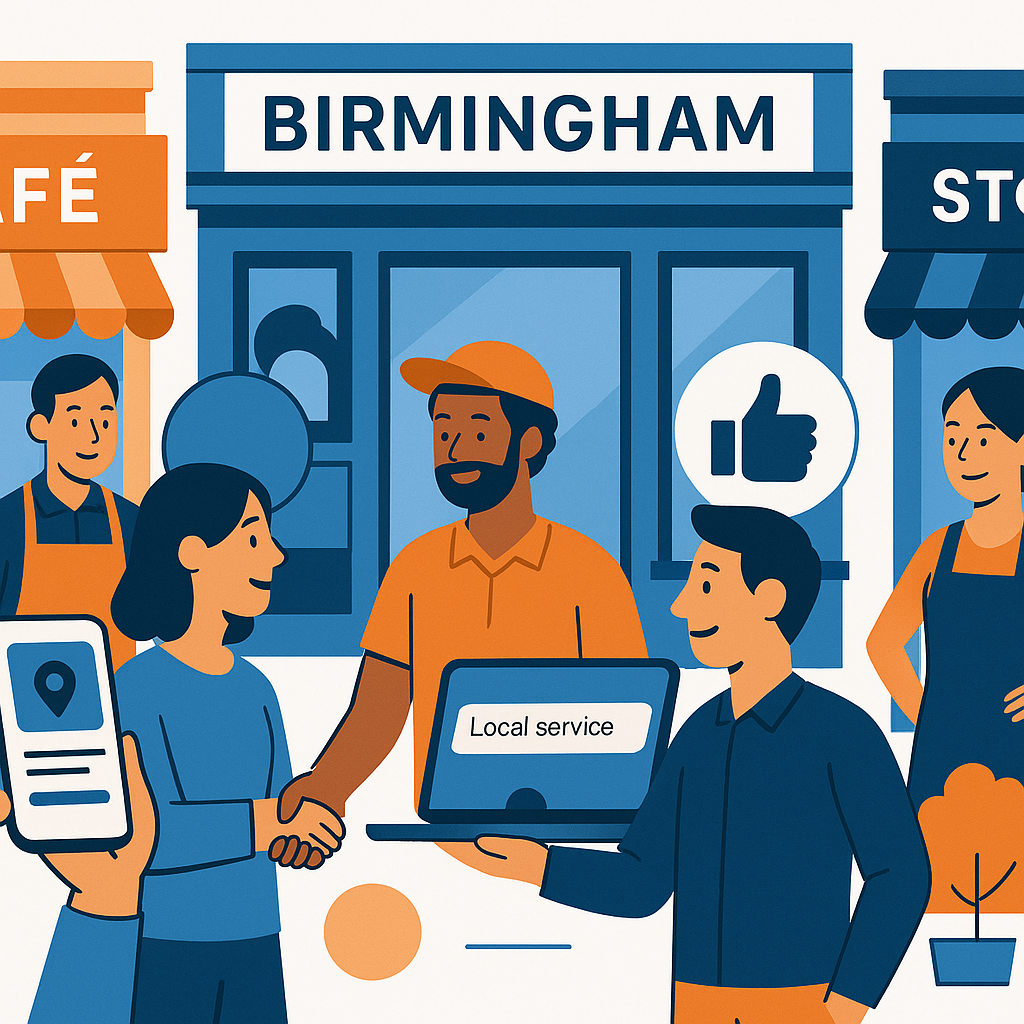
On-Page SEO for Birmingham Service Pages: A Step-by-Step Walkthrough sounds a bit technical at first, but it is really about helping local customers understand what you do, where you do it, and why they should trust you. For a small High Street business, that could mean someone in Moseley finding your plumbing service, a family in Sutton Coldfield booking your dental clinic, or a shop owner in Digbeth choosing your accountant after a quick search on their phone.
The tricky bit is that many local service pages look almost identical. They say the business is friendly, reliable, professional, and local. Which may all be true, of course. But Google, and more importantly real people, need clearer signals than that. A strong Birmingham service page should feel specific, useful, and grounded in the area without becoming awkwardly stuffed with place names.
Why on-page SEO matters for Birmingham High Street businesses
Local SEO is often talked about as if it starts and ends with Google Business Profile. That profile is important, no doubt. But your website still does a lot of the heavy lifting. It gives search engines context, gives customers confidence, and lets you explain your services in your own words rather than being squeezed into a small listing.
For Birmingham businesses, this matters because the city is not one neat market. Someone searching in Harborne may have different expectations from someone in Erdington, Kings Heath, Jewellery Quarter, or Solihull. Some people want a quick quote. Others want reassurance that you cover their area. Some just want to know if there is parking nearby, which sounds small, but I have seen it influence whether people bother to enquire.
Quick local SEO reality check
A Birmingham service page does not rank well just because it mentions Birmingham. It usually ranks because the page matches local intent, explains the service clearly, earns trust, and makes it easy for visitors to act.
On-Page SEO for Birmingham Service Pages: A Step-by-Step Walkthrough
Let’s walk through the main elements in a practical order. You do not need to fix everything in one afternoon. In fact, it is often better to improve one important service page properly than to lightly edit ten pages and hope for the best.
1. Start with the search intent
Before writing or editing a page, ask what the customer is actually trying to do. Are they comparing providers? Looking for emergency help? Trying to understand prices? Searching for a nearby specialist? A page for emergency locksmiths in Birmingham should feel very different from a page for wedding tailoring or bookkeeping.
Search your target phrase yourself and look at the pages already appearing. Not to copy them, but to understand the pattern. If most results include pricing guidance, service areas, FAQs, and reviews, that tells you something. Your page probably needs to answer those same basic questions, ideally in a clearer and more personal way.
2. Write a title tag that is clear, not clever
Your title tag is one of the strongest on-page signals. It is also what many people see in search results, so it should not read like an internal file name. A simple format usually works well: service, location, and business name if there is room.
| Page type | Weak title | Better title |
|---|---|---|
| Service page | Services | Boiler Repairs in Birmingham | Smith Heating |
| Area page | Birmingham | Accountants for Small Businesses in Birmingham |
| Specialist page | What We Do | Sports Massage in Birmingham City Centre |
Try to keep title tags readable. You may be tempted to add every nearby district, but that tends to look spammy. If you serve the whole city, say Birmingham. If a service is genuinely focused on a suburb or neighbourhood, use that instead.
3. Make the opening section useful straight away
The first few lines of a service page should do more than welcome people. Say what the service is, who it is for, and where you provide it. A visitor should not need to scroll halfway down the page to work out whether you can help.
For example, instead of writing, 'We are a trusted local company offering professional solutions', be more direct: 'We provide same-day appliance repairs across Birmingham, including Harborne, Edgbaston, Selly Oak, and nearby areas.' It is plainer, yes, but it is much more useful.
Build local relevance without keyword stuffing
This is where small businesses sometimes get nervous. They know they need to mention Birmingham, but they are not sure how often. There is no magic number. The better question is whether the location details help the reader.
Mentioning the areas you serve is helpful. Talking about nearby landmarks, transport links, parking, call-out coverage, or typical response times can also be useful. Repeating 'Birmingham plumber' in every other sentence is not. It reads badly, and these days search engines are better at spotting forced wording.
- Add a short service area section, especially if you cover several parts of Birmingham.
- Include real local details, such as nearby neighbourhoods, road access, or appointment options.
- Use natural variations, like 'across Birmingham', 'in the city centre', or 'serving South Birmingham'.
- Avoid creating dozens of thin pages that only swap one area name for another.
- If you have a physical High Street location, make your address and opening hours easy to find.
A good test is to read the page aloud. If the location wording sounds like something you would actually say to a customer, it is probably fine. If it sounds like it was written for a machine, soften it.
Structure the page so people can scan it
Most visitors will not read every word. That is not an insult to your writing; it is just how people behave online, particularly on mobile. They scan headings, glance at prices, look for proof, and decide whether to call. Your page structure should support that.
Use one clear H1, then H2s and H3s to divide the page into sections. Keep paragraphs fairly short. Add bullets where they make sense. If you offer several versions of a service, consider using a small comparison table rather than burying everything in a long block of text.
Clear service summary
Explain what you do in plain English within the first screen.
Local proof
Mention areas served, reviews, case studies, and genuine Birmingham details.
Strong next step
Make it obvious how to call, book, visit, or request a quote.
Add trust signals that feel real
Trust matters in local search. People are often inviting you into their home, trusting you with their health, or paying for advice they cannot easily judge themselves. A thin page with a stock photo and a contact form may not be enough.
Use reviews, accreditations, trade memberships, guarantees, years in business, and before-and-after examples where relevant. For a High Street business, photos can be especially powerful. A real shopfront, treatment room, workshop, or team photo gives the page a sense of place. It does not have to be overly polished. Sometimes a slightly ordinary photo feels more believable than a glossy image that could be from anywhere.
If your page could belong to a business in Manchester, Bristol, or Leeds with only the city name changed, it probably needs more local character.
Case studies are useful too, even short ones. Something like, 'We recently helped a café near New Street improve its extraction system before a busy weekend' gives a specific signal. It also helps future customers picture the sort of work you handle.
Optimise images, links, and the small technical bits
On-page SEO is not only copywriting. The behind-the-scenes details matter, though they do not need to become a full technical project. Start with image file sizes. Large images can slow a page down, which is frustrating on mobile. Compress them before uploading, and use descriptive file names where practical.
Alt text should describe the image naturally. If it is a photo of your Birmingham High Street salon interior, say that. Do not turn every alt tag into a keyword dumping ground. Internal links are another easy win. Link from your homepage, related blog posts, and other service pages to your key Birmingham service pages. Use anchor text that makes sense, such as 'commercial cleaning in Birmingham' or 'book a boiler service'.
- Check that the page loads quickly on mobile.
- Write a unique meta description that encourages clicks.
- Use descriptive URLs, such as /boiler-repairs-birmingham/ rather than /page-12/.
- Add internal links from relevant pages on your site.
- Include schema markup for local business details if your website setup allows it.
These small things rarely transform rankings overnight. Still, they stack up. And when several competitors have weak pages, tidy technical basics can give you a quiet advantage.
Use FAQs to answer local buying questions
FAQs are often treated as filler, but they can be genuinely helpful when written around real customer concerns. Think about the questions people ask over the phone. Do you charge call-out fees? Do you cover evenings? Is there disabled access? Can customers park nearby? Are quotes free? These are not glamorous SEO questions, but they influence enquiries.
For Birmingham service pages, FAQs can also cover area-specific details. A mobile mechanic might explain whether they cover the Clean Air Zone. A city-centre clinic might mention the nearest tram stop. A solicitor may clarify whether appointments can be held online as well as in the office.
Useful FAQ prompts
What areas do you cover? How quickly can you attend? Do you offer free quotes? Where are you based? What happens after someone submits an enquiry?
Measure what happens after the page goes live
Publishing the page is not the finish line. Give it a few weeks, then look at what is happening. Google Search Console can show which queries are bringing impressions and clicks. Analytics can show whether visitors stay, call, or disappear after a few seconds. It is not always perfectly clear, and local rankings can wobble, but patterns usually appear.
If a page gets impressions but few clicks, the title and meta description may need work. If it gets traffic but no enquiries, the offer, proof, or call to action might be weak. If nobody reaches the page at all, you may need stronger internal links or more supporting content.
I would avoid changing everything at once. Adjust one or two elements, then watch the result. It feels slower, admittedly, but it is easier to understand what helped.
Conclusion: make your Birmingham page genuinely useful
The best local service pages are not just written for algorithms. They help a real person decide whether your business is the right fit. They explain the service, show local relevance, answer awkward questions, and make the next step simple.
On-Page SEO for Birmingham Service Pages: A Step-by-Step Walkthrough is really a reminder to slow down and build pages with intent. For small High Street businesses, that means using plain language, adding local detail, showing trust, and keeping the page easy to use. Do that consistently, and your website has a much better chance of turning local searches into local customers.