
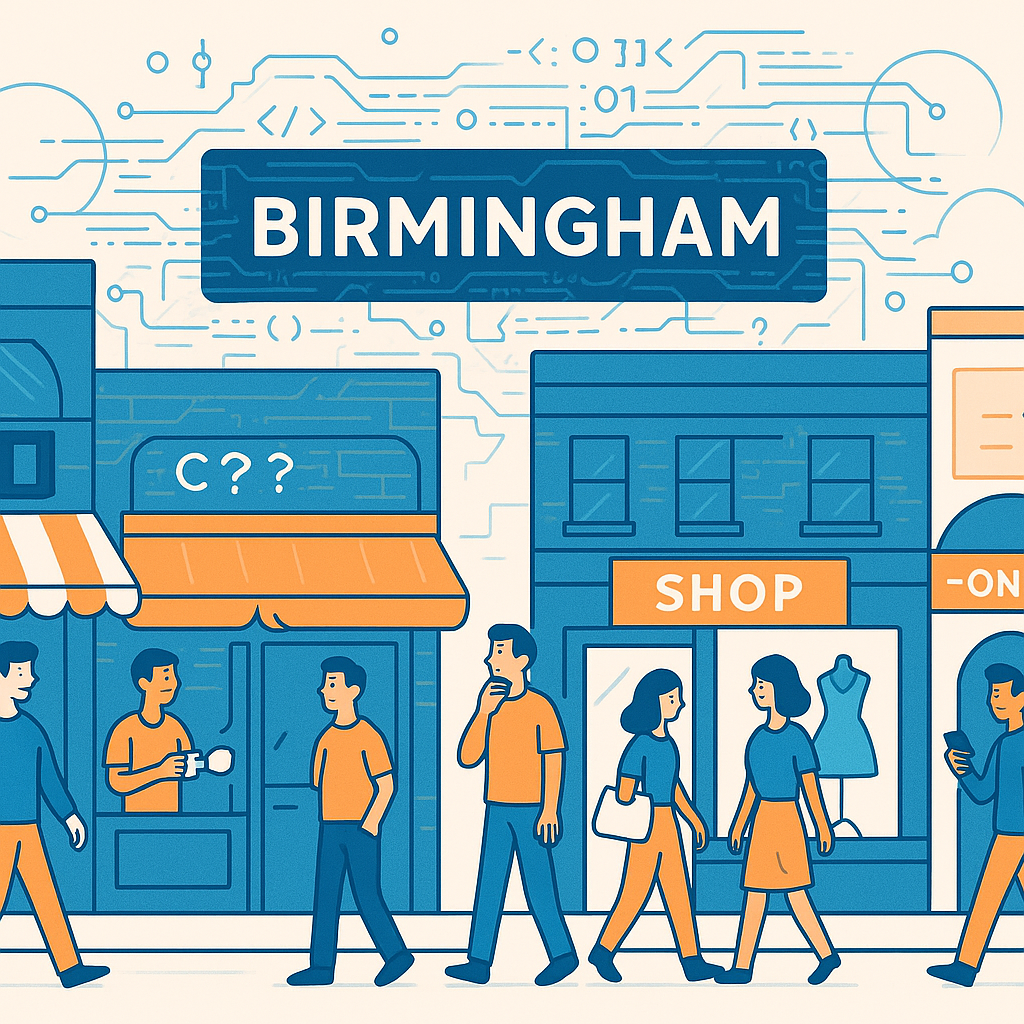
If you run a small High Street business, it is easy to assume SEO is mostly about backlinks, Google reviews, or whether your Google Business Profile looks tidy. Those things matter, of course. But many of the On-Page SEO Mistakes That Are Costing Birmingham Businesses Rankings happen directly on the website itself, often in places nobody checks after the site goes live.
I have seen this with local businesses more than once. A decent café in Moseley, a tradesperson covering Solihull and Sutton Coldfield, a small shop in Harborne. The business is real, trusted, and often better than the competitors ranking above it. But the website gives Google very little confidence about where the business is, what it does, and who it serves. That is frustrating, but also quite fixable.
Local SEO is not magic. It is a set of signals. Your pages, headings, titles, service descriptions, internal links, and contact details all help search engines understand your business. When those signals are vague or missing, rankings suffer. Not always overnight, and not always dramatically, but enough to lose calls, enquiries, bookings, and footfall.
Quick reality check
For a Birmingham High Street business, on-page SEO is not just about adding keywords. It is about making every important page clear, locally relevant, useful, and easy for both people and search engines to understand.
On-Page SEO Mistakes That Are Costing Birmingham Businesses Rankings
The biggest on-page issue is usually not one huge technical disaster. It is more often a collection of small, slightly neglected things. A vague page title here. A thin service page there. A contact page that says “we cover the local area” but never actually mentions Birmingham, Edgbaston, Digbeth, Kings Heath, or wherever the business operates.
Google is clever, but it is not a mind reader. If your website does not clearly explain your services and your location, it has to make assumptions. And in competitive local searches, assumptions rarely beat clear, well-structured content.
One common mistake is using the same general wording across every page. For example, a beauty salon might have separate pages for facials, waxing, nails, and brows, but each page uses almost identical text. The page might technically exist, but it does not give search engines or customers a strong reason to rank or trust it.
- Page titles that only say “Home” or “Services” instead of describing the business and location
- Headings that sound nice but do not include the actual service people search for
- Service pages with only two or three sentences of content
- No mention of Birmingham areas, nearby landmarks, or real service coverage
- Duplicate content copied across multiple location or service pages
- Missing internal links between related pages
None of these mistakes seems dramatic on its own. Put together, though, they create a website that feels unfinished from an SEO point of view. It may look fine to a customer, especially if the design is modern, but Google is reading structure, relevance, and intent more than it is admiring the colour palette.
Weak title tags and meta descriptions
Title tags are still one of the most important on-page SEO elements. They tell Google what the page is about, and they also influence whether someone clicks when your website appears in search results. Yet plenty of local business websites use titles that are too short, too generic, or stuffed with awkward keywords.
A page title like “Home | ABC Ltd” does not do much. Something like “Independent Florist in Birmingham | Wedding & Funeral Flowers” is far more useful. It gives the business type, location, and service context in a natural way. Not perfect for every florist, perhaps, but you get the idea.
Meta descriptions do not directly guarantee higher rankings, despite what some people still say. But they can improve click-through rates, and that matters. If a customer sees a clear, useful description that matches what they searched for, they are more likely to visit your site instead of a competitor’s.
| Page element | Weak example | Better local SEO example |
|---|---|---|
| Title tag | Services | Emergency Plumbing Services in Birmingham |
| H1 or main heading | What We Do | Reliable Boiler Repairs for Birmingham Homes |
| Meta description | Welcome to our website. Contact us today. | Need a local electrician in Birmingham? We provide inspections, repairs and installations for homes and small businesses. |
Thin service pages that do not answer real questions
Many small business websites have a services page that lists everything in one place. This can be fine for users, up to a point, but it often limits SEO potential. If you offer several distinct services, each one may deserve its own page with proper detail.
Let’s say you run a dental practice in Birmingham. A single page mentioning check-ups, teeth whitening, hygienist appointments, Invisalign, emergency dentistry, and implants is probably trying to do too much. Someone searching for “emergency dentist Birmingham” has different concerns from someone researching cosmetic whitening. They need different information.
Good service pages do not need to be enormous, but they should be useful. Explain what the service includes, who it is for, common problems, rough process, location coverage, and what someone should do next. If pricing is too variable, say so. People appreciate clarity, even when the answer is “it depends”.
- What does the service include?
- Who is it suitable for?
- Do you offer it across Birmingham or only in certain areas?
- How quickly can customers book or get a response?
- What makes your approach different from a larger chain or out-of-town provider?
- What should the customer bring, prepare, or expect?
This is where local High Street businesses can actually do well. You know your customers. You know the questions they ask at the counter, over the phone, or by email. Use that knowledge on the page. It sounds obvious, but a lot of websites hide their best real-world knowledge and publish bland brochure copy instead.
Ignoring Birmingham-specific relevance
Local relevance is more than adding “Birmingham” ten times to a page. In fact, that can read badly and look a bit desperate. The better approach is to write naturally about where you are, what areas you serve, and how customers actually find you.
For a High Street business, location detail is a trust signal. If you are near the Bullring, say so. If your clients come from Jewellery Quarter, Selly Oak, Erdington, Perry Barr, or Acocks Green, mention that where it makes sense. If parking is difficult, explain the nearest car park. If you are close to a train station, include that too. It helps people, and it helps search engines connect your business with the local area.
There is a balance, though. You do not need a separate page for every suburb unless there is a genuine reason and enough unique content. Dozens of near-identical location pages can become a problem. A page titled “Plumber in Harborne” and another titled “Plumber in Edgbaston” with the same text swapped out is not a strong strategy. It may have worked years ago. It is shaky now.
Better local detail
Mention nearby areas, routes, parking, landmarks, appointment options and genuine customer scenarios.
Avoid this
Repeating “Birmingham” unnaturally or publishing cloned pages for every nearby suburb with no useful differences.
Poor internal linking and hidden important pages
Internal links are easy to overlook because they are not very glamorous. But they help Google understand which pages matter and how your services connect. They also help visitors move around the site without getting lost, which is still important, even if everyone talks mostly about algorithms.
If your best service page is only accessible through a tiny footer link, it is not being given much importance. If your blog posts mention services but never link back to the relevant service page, that is a missed opportunity. If your homepage talks about “our treatments” or “our solutions” but does not link clearly to each page, people may simply leave.
Good internal linking feels helpful. A Birmingham accountant writing about Making Tax Digital should naturally link to their bookkeeping or VAT services page. A local gym writing about beginner strength training should link to personal training sessions or membership options. It does not have to be forced.
Forgetting mobile users and page experience
A lot of local searches happen on mobile. Someone is walking through town, sitting on the bus, comparing options during lunch, or trying to call before closing time. If your website is slow, cramped, or difficult to use on a phone, you are probably losing customers before SEO even gets a chance to work.
This is not only about passing a technical speed test. Real experience matters. Can people tap your phone number? Is the address easy to find? Are opening hours visible? Do images load quickly? Does the booking form work without pinching and zooming? I know these sound like basic things, but basic things are often where small business websites fall down.
- Open your website on your own phone, not just a desktop computer.
- Try to find your main service, address, phone number and opening hours within 30 seconds.
- Check whether buttons are easy to tap with one thumb.
- Test your contact form and make sure the enquiry actually arrives.
- Compress large images, especially homepage banners and gallery photos.
There is also a trust issue here. A slow or awkward website can make a perfectly good business feel less established. That may not be fair, but it is how people behave online. First impressions are quick, and sometimes a bit unforgiving.
Missing schema, NAP details and trust signals
NAP stands for name, address and phone number. For local SEO, these details should be consistent across your website and other listings. If your footer shows one phone number, your contact page shows another, and your Google Business Profile has an old address, it creates confusion.
Schema markup can also help search engines understand your business details. LocalBusiness schema, opening hours, address information, reviews, FAQs, and service details may all support stronger local visibility. It is not a magic ranking button, and anyone promising that is probably overselling it, but it is a useful layer of clarity.
Trust signals matter too. Birmingham customers want to know you are legitimate. Add your address if you have premises. Show opening hours. Include genuine photos where possible. Mention accreditations, insurance, professional memberships, payment options, and local experience. A small independent business can feel more trustworthy than a national chain if the website reflects real people and real service.
Small business advantage
Local companies often have stronger community knowledge than bigger competitors. Put that on the page. Real photos, specific service areas, staff expertise and practical customer information can all help build confidence.
Over-optimising pages until they sound unnatural
There is another side to this. Some businesses go too far. They hear that keywords matter, then every paragraph becomes stiff and repetitive. “Best Birmingham hairdresser Birmingham city centre hair salon” is not a sentence anyone wants to read.
Modern SEO still uses keywords, but the writing has to sound human. Use the terms people search for, yes, but mix them naturally with related phrases. A page about “solicitors in Birmingham” might also mention legal advice, family law, conveyancing, commercial contracts, appointments, consultations, and local clients. That gives context without turning the page into a keyword list.
A useful rule is to read the page out loud. If it sounds odd, it probably is odd. If you would feel embarrassed saying the sentence to a customer in person, rewrite it. That test is not very scientific, admittedly, but it works surprisingly well.
How Birmingham businesses can start fixing on-page SEO
You do not need to rebuild your entire website straight away. In many cases, a sensible clean-up can make a noticeable difference. Start with your most valuable pages: homepage, main service pages, contact page, and any location pages that already bring traffic or enquiries.
Look at each page from two angles. First, would a potential customer understand exactly what you offer and how to take the next step? Second, would Google understand the service, location, and purpose of the page? If the answer to either question is uncertain, the page probably needs work.
- Rewrite vague title tags so they include the main service and Birmingham where appropriate
- Improve main headings so they clearly match the search intent
- Expand thin pages with useful, specific information
- Add local details without keyword stuffing
- Link related pages together using natural anchor text
- Check mobile usability, forms, calls-to-action and page speed
- Make contact details consistent across the site
It can feel like a lot, especially when you are already running the business day to day. But on-page SEO improvements are usually within your control. You are not waiting for newspapers to mention you or for customers to leave reviews. You can improve the website page by page.
Conclusion
The On-Page SEO Mistakes That Are Costing Birmingham Businesses Rankings are often hiding in plain sight: unclear titles, thin pages, weak local signals, poor internal links, and websites that do not work well on mobile. None of it is especially glamorous, but it matters.
For small High Street businesses, this is actually good news. You do not always need a huge marketing budget to compete locally. You need clear pages, useful content, accurate business information, and a website that reflects the real value of what you offer. Start there, tidy up the obvious gaps, and your chances of earning better local visibility in Birmingham become much stronger.