
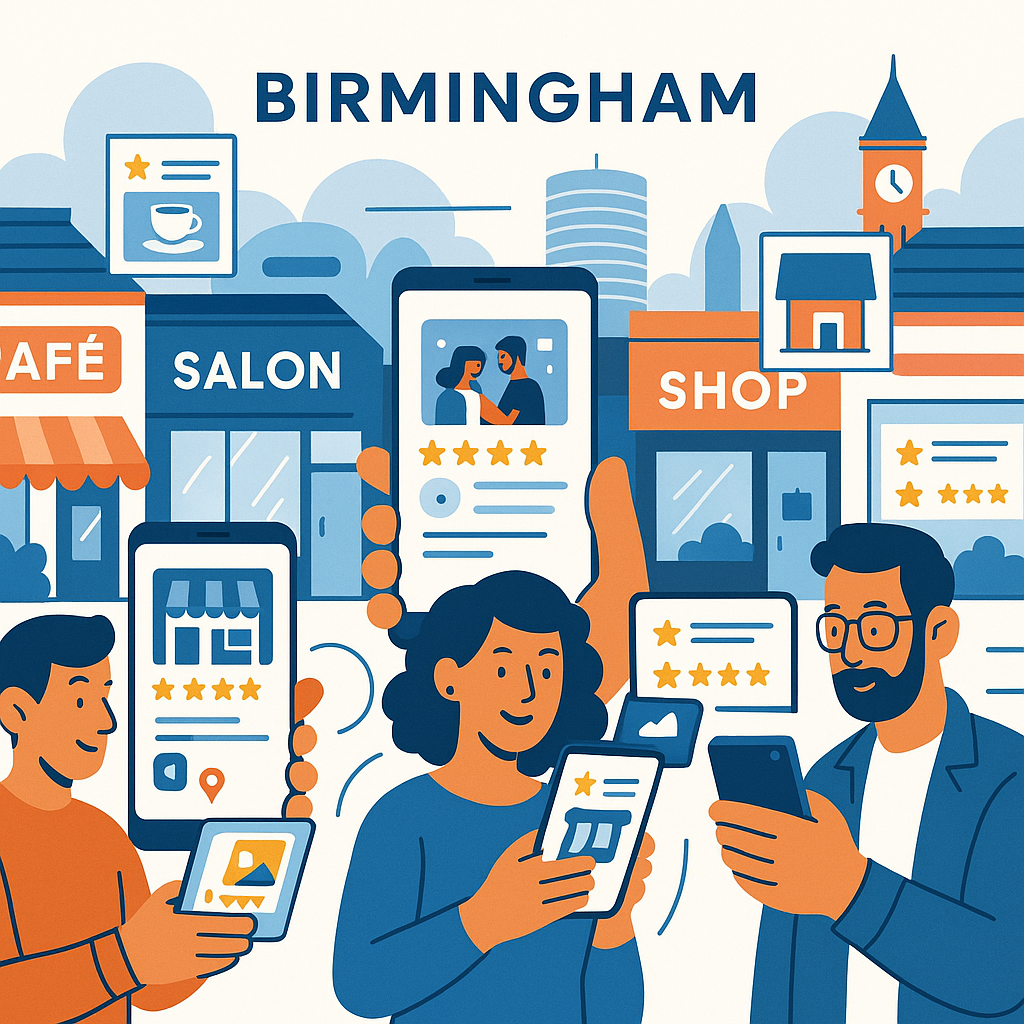
If you run a shop, café, salon, clinic, trades business or office on a Birmingham high street, knowing How to Optimise Your Google Business Profile for Birmingham Searches can make a surprisingly big difference. Not in a vague, marketing-fluff sort of way, but in the very practical sense of showing up when someone nearby searches “coffee near me”, “accountant in Jewellery Quarter”, “best barber Moseley” or “emergency plumber Birmingham”.
For many small businesses, Google Business Profile is the first impression people see. Often before your website. Sometimes instead of your website, if we are being honest. Your opening hours, reviews, photos, directions, phone number and services are all sitting there in the search results, quietly helping people decide whether to visit you or keep scrolling.
The good news is that local SEO is not only for large companies with agencies and endless budgets. A well-maintained Google Business Profile can help a small High Street business compete in a specific neighbourhood, especially in a city like Birmingham where local intent is strong and people search by area, landmark, road name and postcode.
Why Google Business Profile matters for Birmingham High Street businesses
Birmingham is not one simple search area. Someone in Harborne may not want results from Erdington. A customer in Digbeth might search differently from someone in Sutton Coldfield. Even within the city centre, people use smaller place names like Colmore Row, Chinese Quarter, Mailbox, New Street, Five Ways or Jewellery Quarter. Google tries to match searchers with businesses that are relevant, nearby and trusted.
That is where your Google Business Profile comes in. It gives Google structured information about your business, and it gives potential customers confidence. If your profile is complete, active and consistent, it has a better chance of appearing in the local pack, Google Maps and ordinary search results.
I think a lot of business owners underestimate how often people make snap decisions from these profiles. A blurry shopfront photo, old Christmas opening hours in March, or three unanswered reviews can send the wrong signal. It may not feel fair, but that is how people behave when they are comparing options quickly on a phone.
Quick local SEO reality check
For a High Street business, your Google Business Profile is not just a listing. It is a mini landing page, a trust signal, a map marker and a customer service channel all at once.
How to Optimise Your Google Business Profile for Birmingham Searches
The first step in How to Optimise Your Google Business Profile for Birmingham Searches is to treat your profile as something living, not something you set up once and forget. Google wants accurate, useful information. Customers want the same thing, just with less patience.
Start with the basics. Your business name should match your real-world signage and branding. Do not stuff it with keywords such as “Best Birmingham Hairdresser Cheap Cuts City Centre” unless that is genuinely your business name, which, hopefully, it is not. Keyword stuffing can look spammy and may cause issues with Google’s guidelines.
Your address, phone number and website should be completely consistent across your Google profile, website, social media pages and directory listings. This is often called NAP consistency: name, address and phone number. It sounds a bit dull, and perhaps it is, but small inconsistencies can confuse search engines. “Road” in one place and “Rd” in another usually is not a disaster. A different phone number or outdated address, though, can be.
- Use your exact trading name, not a keyword-loaded version.
- Add your full Birmingham address, including postcode.
- Choose the most accurate primary category for your business.
- Add secondary categories only when they genuinely apply.
- Check that your phone number, website and opening hours are current.
- Write a clear business description that mentions your services and local area naturally.
Your category choice is especially important. If you run a florist in Kings Heath, “Florist” should probably be your primary category, not “Gift shop” just because you sell cards and candles too. Google leans heavily on categories when deciding which profiles to show for a search.
Use Birmingham locations naturally, not awkwardly
Local relevance matters, but it needs to feel natural. Mentioning Birmingham is useful. Mentioning Birmingham fifteen times in a paragraph is not. Your profile should help people understand where you are and what areas you serve. That might include neighbourhoods, nearby landmarks or service areas.
For example, a dental practice in Edgbaston could mention that it serves patients from Edgbaston, Harborne, Bearwood and Birmingham city centre. A boutique near the Bullring might refer to being a short walk from New Street Station. A tradesperson could list service areas such as Solihull, Moseley, Selly Oak and Sutton Coldfield if those are genuinely covered.
The trick is to write for humans first. A customer should read your description and think, “Yes, this sounds relevant to me.” Google can usually pick up the local clues without you forcing them into every sentence.
Complete every useful section of your profile
A half-filled profile can still appear on Google, but it does not inspire much confidence. Fill in as much as you reasonably can. Add services, products, attributes, appointment links, menus, booking options and accessibility details where relevant.
Opening hours deserve special attention. Birmingham shoppers and customers often search while already out and about. If your profile says you are open and they arrive to find the shutters down, that frustration can turn into a bad review. It sounds basic, but keeping bank holiday hours updated is one of those little things that makes a business feel reliable.
Add services with short descriptions. If you are an independent optician, list eye tests, contact lens fittings, children’s eye care and designer frames. If you are a solicitor, list conveyancing, wills, family law or commercial advice. Google may use these details to match your profile to more specific searches.
Do this
Add specific services, clear opening hours, current photos and genuine local information.
Avoid this
Do not leave old details, duplicate profiles, keyword-stuffed names or unanswered customer questions.
Photos help people trust you before they visit
Photos are easy to overlook, especially when you are busy running the business. But they matter. People want to know what your place looks like, where the entrance is, whether the environment feels professional, and sometimes whether they will feel comfortable walking in.
For High Street businesses, include a clear exterior photo so people can recognise your premises. This is especially useful on streets where shops are packed closely together, or where parking and entrances are a bit awkward. Add interior photos, team photos, product images and examples of your work. Keep them realistic. Over-polished stock-style images can sometimes feel less trustworthy than a decent phone photo of the actual place.
Try to upload new photos regularly. It does not have to be every day. Once or twice a month is often enough to show that the business is active. Seasonal displays, new products, updated menus, team moments or before-and-after examples can all work well.
Reviews are local SEO fuel, but they need handling properly
Reviews influence both search visibility and customer decisions. A business with recent, detailed reviews often feels more credible than one with a higher rating but no new feedback for two years. Birmingham customers, like anyone else, look for patterns. Are staff friendly? Is parking easy? Are appointments on time? Is the food consistent? Do people mention the same positive points again and again?
Ask for reviews in a simple, low-pressure way. You can send a follow-up email, include a link on receipts, add a QR code at the till or ask regular customers in person. Do not offer rewards for positive reviews, and do not ask staff or family to fake them. It is risky, and people can usually sense when reviews are not genuine.
- Ask soon after a positive customer experience.
- Make the review link easy to find and use.
- Encourage honest feedback rather than only five-star praise.
- Reply to every review, including short ones.
- Respond to negative reviews calmly and professionally.
Your replies do not need to be long. In fact, slightly shorter replies often feel more natural. Thank the person, mention something specific if you can, and avoid sounding like a template. If someone complains, acknowledge the issue and invite them to contact you directly. You are not only replying to that person; you are showing future customers how you handle problems.
A thoughtful review response can be as persuasive as the review itself. People notice when a business sounds human.
Use posts, updates and questions to stay active
Google Business Profile allows you to publish updates, offers and events. Not every business uses this feature, which is partly why it can help you stand out. You might post about a sale, a new service, seasonal opening hours, a local event, a workshop or a limited-time menu.
These posts are not a replacement for your website or social media, but they add freshness to your profile. A small retailer in Birmingham could promote late-night shopping near Christmas. A restaurant could mention pre-theatre dining if it is near the Hippodrome or Alexandra Theatre. A gym could promote a January membership offer for people nearby.
The questions and answers section is also worth watching. Anyone can ask a question, and sometimes anyone can answer. That is useful but slightly unnerving. Check it regularly and answer common questions yourself. Things like parking, disabled access, delivery options, appointment requirements and returns policies are all worth clarifying.
Connect your profile with your wider local SEO
Your Google Business Profile works best when the rest of your online presence supports it. Your website should clearly show your Birmingham location, contact details, opening hours and services. If you serve several areas, consider creating useful location pages, but avoid thin, copy-and-paste pages that only swap one place name for another.
Local citations can help too. These are mentions of your business on directories, industry sites, local business groups and chamber of commerce pages. Again, consistency matters. If your business has moved premises, changed number or rebranded, tidy up the old listings where possible. It is not glamorous work. It can be a bit tedious, actually. But it helps build a cleaner local footprint.
Links from local organisations can also be valuable. Sponsoring a community event, joining a traders’ association, collaborating with nearby businesses or being featured in local press may all lead to relevant local mentions. You should not do these things only for SEO, but the visibility benefits are real.
Small business tip
Search your own business name and a few local phrases once a month, such as “your service + Birmingham” or “your service + your neighbourhood”. Do it in an ordinary browser window and note what appears. It is not perfect data, but it gives you a useful customer-eye view.
Track what is working, but do not obsess over every movement
Google Business Profile provides performance insights, including calls, website clicks, direction requests and search terms. These can help you understand how people find you. For example, if direction requests rise after adding new photos and updating your services, that may suggest your profile is doing more of its job.
Still, local rankings can move around. They vary by searcher location, device, competition, time and wording. A café may rank differently for someone standing outside Moor Street than for someone searching from Northfield. So yes, track your results, but do not panic over every small change.
Look for broader trends. Are calls increasing? Are more people asking for directions? Are reviews growing steadily? Are customers mentioning that they found you on Google? Those real-world signals are often more useful than staring at one ranking report.
Common mistakes to avoid
Some Google Business Profile mistakes are easy to fix once you notice them. Others can linger for months and quietly damage your visibility or credibility. The most common one is neglect. A profile is created, verified and then left alone. Over time, the business changes but the listing does not.
- Using an old address after moving premises.
- Choosing vague or incorrect business categories.
- Ignoring negative reviews or replying defensively.
- Uploading no photos, or only using generic stock images.
- Creating multiple profiles for the same location without a valid reason.
- Forgetting to update bank holiday and seasonal opening hours.
- Writing a business description that sounds like it was made only for search engines.
Another mistake is trying to target all of Birmingham at once. For some businesses, that makes sense. For many High Street businesses, it is better to be strongly visible in a smaller local area than barely visible everywhere. A bakery in Stirchley does not need to pretend it is the top choice for every person in the West Midlands. It needs to be highly relevant to people nearby and to those willing to travel for what it offers.
Conclusion: make your profile useful, local and alive
Local SEO is not about tricking Google. At least, it should not be. For small Birmingham High Street businesses, it is about making your business easier to find, easier to trust and easier to choose. A complete, accurate and active Google Business Profile helps with all three.
If you only do a few things this week, check your categories, refresh your photos, update your services, reply to reviews and make sure your contact details match everywhere. These are not dramatic changes, but they add up. And in local search, small improvements often matter more than people expect.
Ultimately, How to Optimise Your Google Business Profile for Birmingham Searches comes down to being specific, consistent and genuinely helpful. Show where you are, what you do, why customers trust you and how people can take the next step. That is what Google is trying to understand, and it is what your next customer wants to know too.