
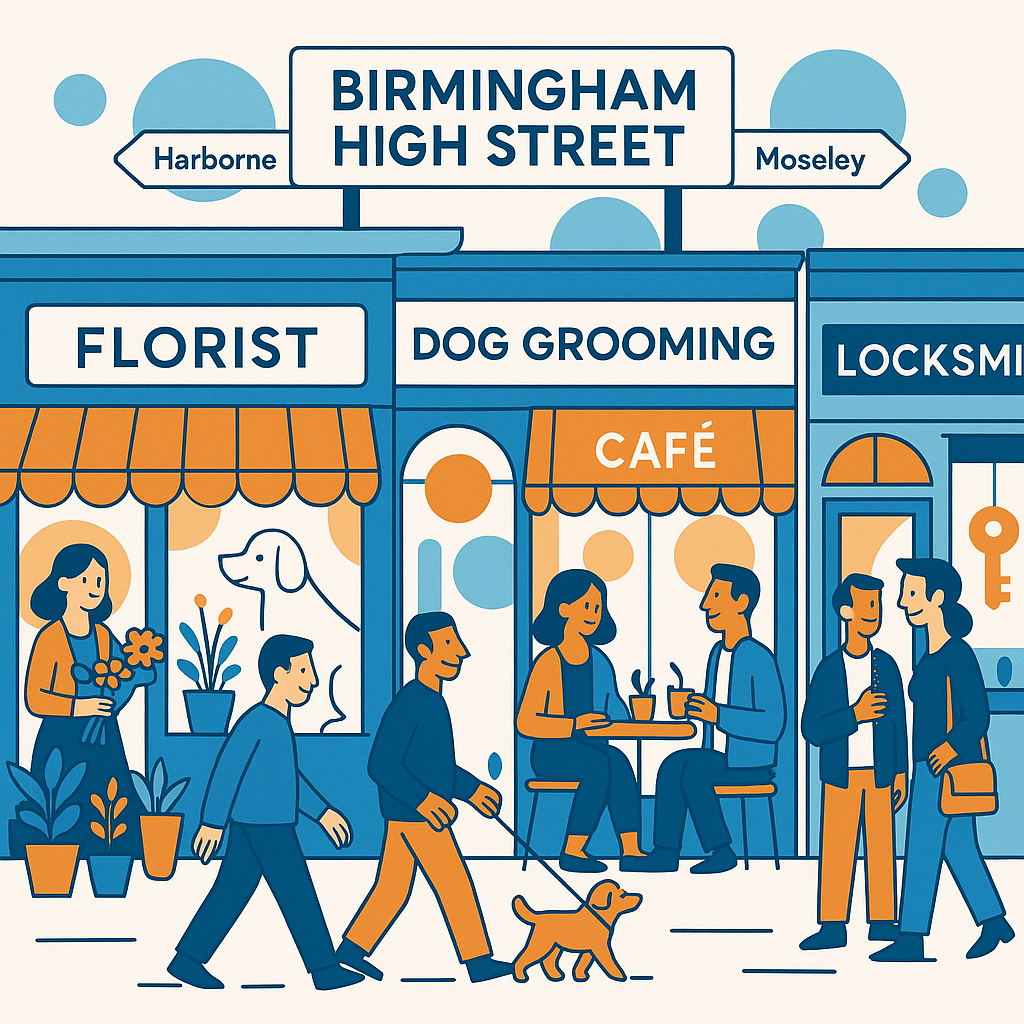
If you run a small High Street business and want to know How to Optimise Service Area Pages for Birmingham Suburbs and Postcodes, the trick is not to create dozens of thin, copy-and-paste pages with a different place name dropped in. That used to be common, and to be fair, it probably still works here and there for a short while. But for a proper local SEO strategy, especially in a city as varied as Birmingham, your pages need to feel useful, specific and believable.
Birmingham is not one neat market. Someone searching in Harborne may have slightly different expectations from someone in Erdington, Moseley, Sutton Coldfield, Kings Heath, or Northfield. The same applies to postcodes. A B13 search does not always mean the same intent as a B24 or B30 search. So your service area pages should reflect how people actually think about where they live, shop, work and look for local help.
This matters whether you are a plumber, accountant, locksmith, dog groomer, florist, solicitor, beauty salon, estate agent, or any other service-led High Street business. Done well, these pages can help you appear for more local searches, reassure customers that you genuinely cover their area, and send stronger signals to Google about where you operate.
How to Optimise Service Area Pages for Birmingham Suburbs and Postcodes: The Basics
The first thing to understand is that a service area page is not just a location page with a map slapped on it. It should answer a local customer’s immediate question: “Do they serve my area, and are they a good choice for me?” That sounds simple, but a lot of pages miss it. They talk about the business in general terms, mention “Birmingham” several times, then move on.
A good suburb or postcode page should include the service, the area, why the area matters, what customers in that area commonly need, and what makes your business a sensible option. It does not need to be poetic. In fact, too much polish can feel a bit strange. But it should be distinct enough that a customer in Selly Oak feels the page was written with Selly Oak in mind, not simply generated from a template.
Quick local SEO test
Read one of your service area pages and remove the suburb or postcode name. If the page could still apply to any part of the UK, it is probably too generic. Add real local context, practical details and proof that you actually serve that part of Birmingham.
I usually think of these pages as half SEO asset and half customer reassurance page. Yes, they need the right keywords. But they also need to lower friction. If someone is searching for an emergency electrician in Bournville, they probably do not want a history lesson. They want to know if you cover Bournville, how quickly you can get there, what types of jobs you handle, and whether you look trustworthy.
Choose Suburbs and Postcodes Based on Real Demand
One slightly tempting mistake is to build a page for every Birmingham suburb you can name. It feels thorough. It also creates a lot of work and, if you are not careful, a lot of weak pages. Start with the places where you already get enquiries, where you want more work, or where your services genuinely make commercial sense.
For a small High Street business, proximity still matters. If your shop is in Kings Heath, it makes sense to target Moseley, Stirchley, Bournville, Selly Park and maybe parts of Edgbaston before stretching across the whole city. Of course, some businesses travel widely. A roofing firm or mobile therapist may cover a wider patch. Still, your site should not pretend every area is equally important if it is not.
- Check your enquiries and invoices to see where customers already come from.
- Look in Google Search Console for suburb and postcode queries you are already appearing for.
- Ask staff which areas customers mention most often on phone calls.
- Prioritise nearby areas where you can provide a quick, reliable service.
- Avoid creating pages for places you would only serve reluctantly or at a high extra cost.
You can also group areas sensibly. For example, a page covering “plumbing services in South Birmingham” might link to more specific pages for Kings Heath, Moseley and Bournville. Or a Birmingham-wide page could act as a hub, with suburb pages beneath it. There is no single perfect structure, honestly. The right answer depends on how many services you offer, how competitive your market is, and how much content you can maintain properly.
| Page type | Best used for | Example |
|---|---|---|
| City-wide service page | Core Birmingham searches and main services | Emergency Locksmiths in Birmingham |
| Suburb page | High-value local areas with enough search demand | Boiler Repairs in Harborne |
| Postcode page | Areas where people commonly search by postcode | Mobile Hairdresser B30 |
Write Local Content That Does Not Feel Forced
Local relevance is where many service area pages either become genuinely helpful or start to sound ridiculous. You do not need to mention every landmark in Birmingham. In fact, that can feel forced. A sentence like “We proudly serve customers near the Bullring, Cadbury World, Cannon Hill Park and Spaghetti Junction” may technically be local, but it does not always help the reader.
Instead, use details that relate to the service. A pest control company might talk about older terraced housing in parts of Balsall Heath or student lets in Selly Oak. A solicitor might mention helping clients near Birmingham city centre, Jewellery Quarter offices, or family homes in Sutton Coldfield. A cleaner might refer to end-of-tenancy cleans around Edgbaston and Harborne. The details should earn their place.
It is also worth using natural variations. People might search for “dentist near Moseley”, “Moseley dental practice”, “B13 dentist”, or “private dentist south Birmingham”. Your writing should include these sorts of phrases where they fit, but not in a stiff way. Google is much better than it used to be at understanding context, so repeating the same phrase again and again is usually unnecessary and, frankly, a bit unpleasant to read.
Good local SEO copy sounds like a helpful member of staff explaining where you work and what you do, not like a spreadsheet of keywords turned into paragraphs.
For each page, try to include a short introduction, a clear service description, practical area information, proof or trust signals, FAQs, and a strong call to action. You can keep the structure similar from page to page, but the substance should change. That is the awkward part. It takes longer, but it is usually where the results come from.
Use Postcodes Carefully, Especially in Birmingham
Birmingham postcodes can be useful, but they can also be messy. Some postcode areas cover more than people expect. B1 suggests the city centre, while B13 is commonly associated with Moseley, B14 with Kings Heath and Yardley Wood, B17 with Harborne, and so on. But boundaries are not always tidy in real life, and customers do not always use postcodes in a technically precise way.
If you create postcode-focused pages, make sure they are useful and not just doorway pages. A “services in B13” page, for example, should explain which parts of B13 you cover, how your service works there, and what customers can expect. You might mention Moseley, parts of Billesley or neighbouring areas where relevant, but do not overcomplicate it.
- Use postcodes where customers genuinely search that way.
- Mention related suburbs naturally, not as a long keyword list.
- Make clear whether call-out fees, delivery charges or appointment times vary by area.
- Link postcode pages to broader Birmingham and suburb pages where helpful.
- Review performance regularly and remove or improve pages that attract no traffic or enquiries.
There is a mild contradiction here, I suppose. You want to be specific enough for Google and customers, but not so specific that your site becomes bloated. A small business website with 90 near-identical postcode pages can look less trustworthy than one with 10 strong pages. Quality beats quantity, even if the phrase is overused.
Add Trust Signals That Prove You Are Local
Service area pages work better when they include evidence. Anyone can say they cover Solihull, Erdington, Bearwood or Acocks Green. Customers are more likely to believe you if the page includes reviews, case studies, photos, local examples, or practical information that could only come from actually working in the area.
For High Street businesses, your physical location can be an advantage. If you are based on or near a known shopping street, say so. Mention nearby parking if customers visit you. Mention public transport if it matters. A beauty clinic in Harborne, a repair shop in Stirchley, or a florist in Sutton Coldfield can use those local details to build confidence.
Local reviews
Add testimonials from customers in named Birmingham areas where you have permission to do so.
Real photos
Use team, shopfront, van or project images rather than generic stock photos whenever possible.
Area notes
Mention opening hours, call-out times, delivery zones or appointment availability for that area.
Case studies are especially useful. They do not have to be long. Something like “We recently helped a landlord near Kings Norton with an urgent boiler repair before new tenants moved in” adds far more authenticity than another paragraph saying “we are reliable and professional”. Obviously, avoid sharing private details, and keep it GDPR-friendly.
Get the On-Page SEO Foundations Right
Once the page is genuinely useful, tidy up the basics. Your title tag should include the service and location, ideally in a way that still reads naturally. Your H1 should be clear. Your meta description should give people a reason to click. Internal links should connect related services and locations, rather than leaving pages isolated.
For example, a page for “Emergency Plumber in Sutton Coldfield” could link to your main plumbing services page, your boiler repair page, and perhaps other nearby service area pages such as Erdington or Great Barr. This helps users move around the site and helps search engines understand the relationship between your pages.
- Include the target area in the title tag, H1, intro and at least one subheading if it feels natural.
- Add a clear phone number or enquiry button above the fold.
- Use schema markup where appropriate, such as LocalBusiness or Service schema.
- Optimise image file names and alt text without stuffing keywords.
- Make sure the page loads quickly on mobile, because many local searches happen on phones.
- Keep your business name, address and phone number consistent across the site and local citations.
Do not forget Google Business Profile either. Strictly speaking, service area pages live on your website, but your profile, reviews, categories and posts all support your local visibility. If your website says one thing and your Google profile says another, it weakens the overall picture.
Avoid Common Service Area Page Mistakes
The biggest mistake is duplication. Swapping “Moseley” for “Harborne” in the same 700 words is not a strategy. It may create indexable pages, but it does not create much value. Another common issue is over-optimisation, where the location phrase appears in almost every sentence. Nobody speaks like that, and customers notice even if they cannot quite explain why the page feels off.
Another problem is targeting areas you cannot realistically serve. This might bring traffic, but it can also bring wasted enquiries and disappointed customers. If your response time to Sutton Coldfield is two hours but your page implies you are just around the corner, that mismatch can hurt trust. Better to be clear.
A small warning
Do not create hundreds of low-quality suburb and postcode pages just because competitors seem to be doing it. It may work briefly, but it often leaves you with a messy site that is harder to improve later.
Also, keep an eye on cannibalisation. If you have a Birmingham page, a South Birmingham page, a Kings Heath page and a B14 page all targeting almost the same phrase, Google may struggle to decide which one to show. Sometimes pages need merging. It can feel like a step backwards, but it often strengthens the site.
Conclusion: How to Optimise Service Area Pages for Birmingham Suburbs and Postcodes
Learning How to Optimise Service Area Pages for Birmingham Suburbs and Postcodes is really about balancing local detail with usefulness. You want enough Birmingham-specific content to show relevance, enough service detail to answer the customer’s question, and enough trust signals to make someone feel comfortable getting in touch.
Start with the suburbs and postcodes that matter most to your business. Write pages that sound like they were created by someone who knows the area, not by someone filling in blanks. Add reviews, examples, internal links and clear calls to action. Then check the data, improve what is working, and trim what is not.
For small High Street businesses, this is one of those SEO jobs that looks simple at first and then gets more nuanced. But that is also the opportunity. Many local competitors will still be using thin, generic pages. If yours are genuinely helpful, locally grounded and easy to act on, they stand a much better chance of bringing in the right Birmingham customers.