
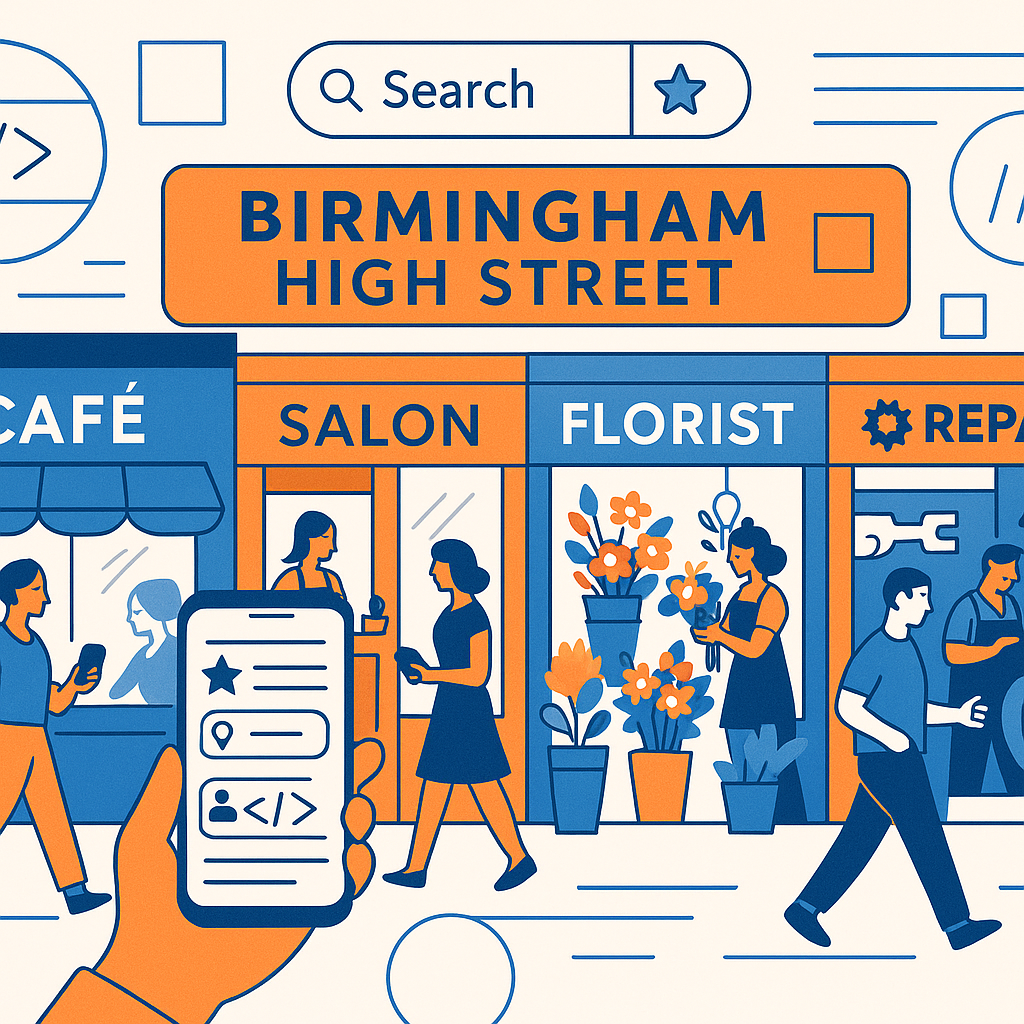
The Power of Schema Markup for Birmingham Local Businesses is easy to underestimate, mostly because it sits quietly in the background of a website. It is not as visible as a new homepage design or as familiar as Google reviews. Still, for a small High Street business trying to be found by people nearby, schema markup can be surprisingly useful. It helps search engines understand who you are, what you offer, where you are based, and why your business might be relevant to someone searching in Birmingham.
If you run a café in Moseley, a salon in Harborne, a florist in Sutton Coldfield, or a repair shop near the Bullring, you already know how competitive local search can be. People search quickly, compare options quickly, and often make decisions before they have even visited your site. Schema markup will not magically put you at number one overnight. That would be too neat, and frankly not true. But it can give Google clearer signals, and in local SEO, clarity matters more than many people realise.
What Schema Markup Actually Means
Schema markup is a type of structured data added to your website code. In plain English, it labels important information so search engines can read it properly. Your visitors may never see it, but Google, Bing, and other platforms can use it to understand your business in more detail.
For example, your website might say you are open Monday to Saturday, based in Birmingham, and offer same-day appointments. A human can read that easily. Search engines can usually work it out too, but schema removes some of the guesswork. It tells them, in a standard format, that this text is your business address, this bit is your phone number, these are your opening hours, and these are your customer reviews.
Simple way to think about schema
Your website content tells customers what you do. Schema markup tells search engines what that content means. It is a bit like adding neat labels to a stockroom; everything becomes easier to understand and easier to find.
The most common format is called JSON-LD. It is usually placed in the code of your page, often by a developer, SEO specialist, or sometimes through a WordPress plugin. If that sounds a little technical, it is. But the idea behind it is not complicated.
The Power of Schema Markup for Birmingham Local Businesses
The Power of Schema Markup for Birmingham Local Businesses comes from how local search results are built. Google is constantly trying to match searchers with the most relevant nearby result. When someone searches for “best barber near New Street Station” or “emergency plumber Birmingham”, Google needs to decide which businesses are credible, close, open, and suitable.
Schema markup supports that process. It can reinforce your name, address, phone number, service area, opening times, pricing information, ratings, and more. When those details match your Google Business Profile and other online listings, your local presence looks more consistent. And consistency is one of those boring SEO words that genuinely matters.
Birmingham makes this even more important. It is not a tiny market. A business in Kings Heath may not be competing with every shop in the West Midlands, but it might be competing with several similar businesses within a two-mile radius. Search engines rely on a mix of location, relevance, prominence, and user behaviour. Schema is not the whole story, but it helps with the relevance part in a tidy and measurable way.
- It helps search engines identify your business type more accurately.
- It supports rich results, such as review stars, FAQs, opening hours, or event details.
- It can improve how your pages appear in local organic search results.
- It strengthens consistency between your website and Google Business Profile.
- It may increase click-through rates by making search snippets more useful.
I think the biggest benefit, especially for smaller High Street businesses, is not always ranking. It is trust. If your listing looks clear, complete, and current, people are more likely to click. A search result with opening hours, reviews, and useful business details feels less risky than one that looks vague.
Why High Street Businesses Should Care About Local SEO
High Street businesses live and die by local intent. Someone looking for a bakery, optician, estate agent, accountant, gym, or independent clothes shop in Birmingham is often ready to take action. They may want directions, a phone number, an appointment, or reassurance that you are open today. Local SEO helps you appear at that exact moment.
The old habit was to walk past a shop, look through the window, and decide whether to go in. That still happens, of course. But now people often check you online first, even if they are standing a few streets away. They scan photos, reviews, opening times, and location details. If your online presence is thin or confusing, they may choose someone else without thinking too much about it.
| Local SEO element | How schema can help |
|---|---|
| Business details | Clarifies your name, address, phone number, website, and opening hours. |
| Products and services | Helps search engines understand what you sell or provide locally. |
| Reviews | Can support review-related rich results when implemented correctly. |
| Events | Useful for workshops, tastings, classes, markets, and in-store promotions. |
| FAQs | Makes common answers clearer, such as parking, bookings, delivery, and returns. |
Schema is best viewed as part of your wider local SEO setup. Your Google Business Profile, citations, reviews, website content, mobile speed, and local links all matter. Schema supports these things rather than replacing them. It is a supporting actor, but a good one.
Useful Types of Schema for Birmingham Businesses
There are many schema types, and not every business needs all of them. In fact, adding too much irrelevant schema can make things messy. A simple, accurate setup is usually better than trying to mark up every sentence on your website.
For most local businesses, LocalBusiness schema is the starting point. From there, you can use more specific types where appropriate. A restaurant might use Restaurant schema. A dentist could use Dentist schema. A legal firm could use LegalService. The closer the schema type matches your business, the clearer the signal.
- LocalBusiness schema for core business information.
- Organisation schema for brand details, logo, and official profiles.
- Product schema for specific items sold in-store or online.
- Service schema for trades, professional services, and appointment-based businesses.
- FAQPage schema for common questions customers ask before visiting.
- Review or AggregateRating schema where it follows Google’s guidelines.
- Event schema for local events, open days, classes, launches, or seasonal activities.
A local bakery in Stirchley, for instance, might use LocalBusiness schema, opening hours, product information for celebration cakes, and event schema for a Christmas tasting evening. A physiotherapist in Edgbaston might focus on LocalBusiness, MedicalBusiness or relevant service schema, FAQs about appointments, and reviews if handled correctly.
The phrase “handled correctly” is doing a bit of work there. Review schema, in particular, has rules. You should not mark up reviews in a way that misleads users or tries to manufacture star ratings where they should not appear. Google updates these rules now and then, so it is worth checking rather than assuming.
How Schema Can Improve Search Visibility
Schema markup can improve search visibility in a few different ways. First, it gives search engines more structured information. That can help them interpret your pages and connect them with relevant searches. Second, it can make your search listings more attractive when rich results appear. Third, it can support voice search and AI-driven search experiences, where structured information is often easier to use.
Think about a person searching on a phone while walking through Birmingham city centre. They do not want to dig through five pages to find out whether you are open. They want the answer immediately. If your information is marked up clearly, and it matches your Google Business Profile, there is a better chance that your details are shown accurately.
Before schema
Search engines may still understand your page, but some details can be vague, duplicated, or interpreted inconsistently.
After schema
Key details are labelled in a standard format, giving search engines a clearer understanding of your local business.
Will schema guarantee rich snippets? No. Google decides what to show, and sometimes it ignores perfectly valid markup. That can be frustrating. But valid schema still gives your site a cleaner technical foundation, and that is rarely a bad thing.
Common Schema Mistakes to Avoid
One common mistake is adding schema once and forgetting about it. Businesses change opening hours, phone numbers, services, prices, and locations. If your schema says one thing and your contact page says another, you create confusion. This is especially common after Christmas hours, bank holidays, relocations, or a rebrand.
Another mistake is copying generic schema from a template without adapting it properly. I have seen examples where a Birmingham business accidentally left in an old postcode, the wrong business category, or even another company name. It sounds careless, but it happens more often than people admit.
- Do not mark up information that is not visible or accurate on the page.
- Do not use the wrong business type just because it sounds more impressive.
- Do not fake reviews, ratings, prices, or availability.
- Do not forget to update schema when your opening hours or services change.
- Do not assume a plugin has done everything correctly without testing it.
The safest approach is to keep schema honest, specific, and aligned with your actual page content. It should describe your business, not exaggerate it.
How to Get Started Without Overcomplicating It
If you use WordPress, there are SEO plugins that can add basic schema markup. Some are quite good. But plugins vary, and the default settings may not be enough for a business that relies heavily on local customers. It is worth reviewing what has actually been added rather than assuming it is all sorted.
Start with the basics: your business name, address, telephone number, opening hours, logo, website URL, social profiles, and business type. Make sure these match your Google Business Profile. Then look at your key pages. Your homepage may need LocalBusiness schema. Service pages may benefit from Service schema. A page answering common questions may suit FAQ schema.
Quick practical tip
Run your pages through Google’s Rich Results Test or the Schema Markup Validator. These tools will not tell you whether your SEO strategy is perfect, but they can spot errors in your structured data.
You do not need to tackle everything in one afternoon. In fact, it is probably better not to. Start with the pages that matter most: homepage, contact page, main service pages, and any page that already attracts local search traffic. Then build from there.
Schema, Google Business Profile, and Real-World Trust
Schema markup works best when it supports a real, trustworthy local presence. If your Google Business Profile is neglected, your reviews are weak, and your website content is thin, schema will not cover that up. It may help Google understand the site, but it cannot create credibility out of nothing.
For Birmingham businesses, trust often comes from local signals. Mentioning the areas you serve, showing real photos, keeping your opening hours updated, collecting genuine reviews, and publishing useful local content all help. Schema simply adds structure around those signals.
There is also a customer experience angle. Accurate opening hours reduce wasted journeys. Clear service information reduces unnecessary phone calls. Good FAQ markup can answer simple questions before someone contacts you. Small things, perhaps, but small things often decide whether a person chooses your business or the one three streets away.
Conclusion: Making Schema Part of Your Local SEO Strategy
The Power of Schema Markup for Birmingham Local Businesses is not about chasing a technical trend for the sake of it. It is about making your website easier for search engines to understand and easier for local customers to trust. For small High Street businesses, that can be a practical advantage.
Schema will not replace good reviews, helpful content, strong service, or an accurate Google Business Profile. It sits alongside them. But when implemented properly, it can help your local SEO work harder by clarifying your business details, improving your search appearance, and supporting the signals Google already uses.
If you are a Birmingham business owner, the best next step is simple: check whether your website already has schema, test it, and make sure it reflects your real business. It is not the flashiest part of digital marketing. Still, it might be one of those quiet improvements that helps more nearby customers find you when they are ready to buy, book, visit, or call.