
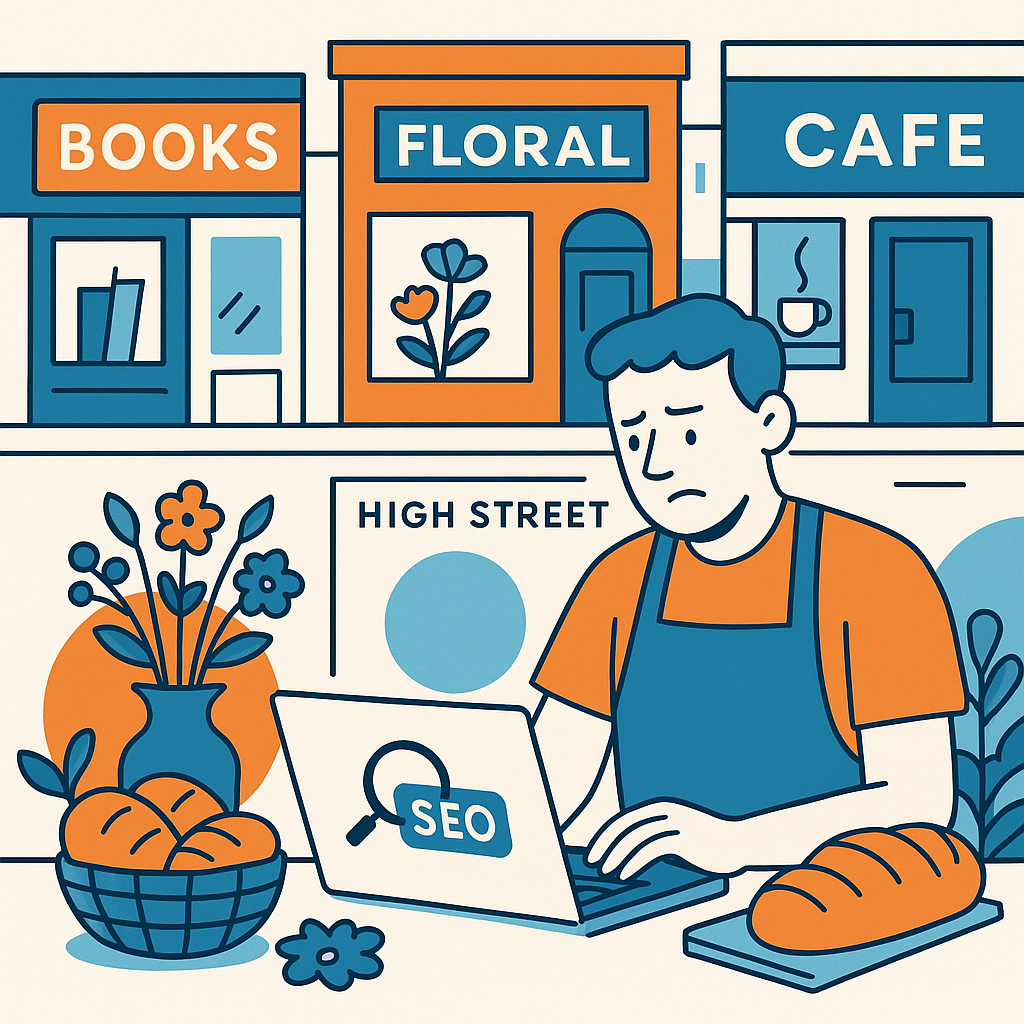
If you have searched for Ultra-Practical Local SEO Tasks AI Can Help You With, you are probably not looking for a grand theory of digital marketing. You want to know what can actually be done this week, preferably without hiring a big agency or spending evenings staring at your Google Business Profile. Fair enough. AI can be useful for small High Street businesses, especially when time is tight. But it is not always the best choice. Sometimes it speeds things up. Sometimes it produces bland, slightly odd content that does not sound like your shop, your team, or your town.
There is a sensible argument, made by local SEO specialists, that AI is best used for repetitive, practical tasks rather than strategy. I agree with that, mostly. The trap is assuming that because AI can do something, it should. For a small bakery in Leeds, a florist in Cheltenham, or a locksmith in Cardiff, local SEO still depends heavily on trust, accuracy, local knowledge, and a bit of human common sense. AI can assist with the donkey work. It should not be allowed to run the whole show.
Quick takeaway
Use AI for drafts, lists, summaries, research prompts, and admin-heavy SEO jobs. Keep humans in charge of local judgement, customer tone, service accuracy, and anything that affects reputation.
Why AI Feels So Tempting for High Street SEO
Most small businesses do not have a marketing department. They have the owner, perhaps a manager, and someone who knows how to post on Facebook when there is a quiet half hour. Local SEO then becomes another item on a list that already includes stock, staff, bills, suppliers, and customers who walk in at exactly the wrong moment.
So yes, AI looks attractive. Ask it for a service page, a list of local keywords, or a few ideas for Google Posts, and it will produce something in seconds. Compared with a blank page, that feels like progress. And sometimes it is progress. A rough draft is better than nothing, especially if your website has not been updated since 2019.
But local SEO is not only about having more words on a page. It is about whether those words help a real person choose you over the business three streets away. That is where AI starts to wobble. It can describe a cafe, but it does not know that your regulars come in after the school run. It can write about emergency plumbing, but it does not know which villages you actually cover, or which jobs you quietly prefer not to take.
Ultra-Practical Local SEO Tasks AI Can Help You With
There are still plenty of Ultra-Practical Local SEO Tasks AI Can Help You With, provided you treat the output as a starting point. The best uses are usually boring ones. That may not sound exciting, but boring tasks are often what stop small businesses from doing local SEO consistently.
- Turning a messy list of services into clearer website page ideas.
- Drafting Google Business Profile posts based on offers, events, or seasonal reminders.
- Creating first drafts of FAQs from real customer questions.
- Summarising reviews to spot common themes, such as speed, friendliness, parking, or value.
- Rewriting overly formal website copy so it sounds clearer and more natural.
- Generating title tag and meta description options for local service pages.
- Building checklists for citation clean-ups, image optimisation, and content updates.
Notice the pattern. AI is useful when you already know the facts and need help shaping them. It is much less useful when you need to decide what is true, what matters locally, or what a customer will trust. I have seen AI produce a perfectly polished description of a business that was technically fine and yet completely lifeless. It read like every other company in the county.
| Local SEO task | Good use of AI? | Human check needed |
|---|---|---|
| Drafting service page copy | Yes, for a first draft | Check services, areas, pricing hints, and tone |
| Choosing target locations | Only partly | You know travel times, demand, and profitable areas better |
| Responding to reviews | Yes, with caution | Make replies specific, warm, and never defensive |
| Writing local guides | Sometimes | Add real local details, photos, and experience |
Where AI Gets Local SEO Wrong
AI tends to be confident even when it is guessing. That is a problem in local SEO, because tiny details matter. A wrong opening time, an invented service area, or a page that promises same-day appointments when you cannot always offer them may not just hurt rankings. It can annoy customers. And annoyed customers leave reviews.
The other issue is sameness. If every accountant, dog groomer, and kitchen fitter uses the same prompts, their websites begin to sound strangely similar. Friendly team. Competitive prices. Years of experience. Proudly serving the local area. None of those phrases are wrong, exactly, but they rarely persuade anyone.
Small High Street businesses often have advantages that AI cannot invent convincingly. Maybe you remember customers by name. Maybe you stock a product because locals kept asking for it. Maybe your shopfront is near the market square, and people use you as a landmark. Those things can support local SEO because they create specificity. Search engines like useful information, but people like recognition. They want to feel they have found someone nearby who understands the place.
The safest rule is simple: let AI help you write faster, but do not let it decide who you are.
A Better Workflow: AI Drafts, Humans Decide
A more realistic approach is to build a small workflow. Nothing fancy. You can use AI to gather options, then use your own judgement to choose, edit, and add the local detail. This works particularly well if you are short on time but still care about sounding like a real business rather than a brochure.
- Write down the facts first: services, areas covered, opening times, common questions, parking details, and anything customers mention often.
- Ask AI to organise those facts into page ideas, FAQs, post topics, or review response templates.
- Remove anything generic, exaggerated, or inaccurate.
- Add local proof: nearby landmarks, neighbourhood names, staff experience, photos, examples, and genuine customer concerns.
- Read it aloud before publishing. If it sounds like no one in your business would say it, edit again.
That last step sounds almost too simple, but it catches a lot. AI writing often looks acceptable on screen until you hear it. Then the stiffness appears. For a High Street business, that matters. Your website and Google profile are not academic documents. They are more like a conversation at the counter, just online.
Let AI handle
Draft outlines, summarise reviews, suggest FAQs, create post variations, tidy rough notes, and spot missing on-page basics.
Keep human control over
Promises, prices, sensitive review replies, local claims, brand voice, service areas, and anything legally or commercially important.
Local Content Still Needs Local Memory
One of the more underrated parts of local SEO is memory. Not technical memory, but the kind a business builds by being in the same place for years. You know which questions come up before Christmas, which services spike after bank holidays, which nearby streets are hard to park on, and what customers misunderstand about what you sell.
That information can become excellent content. A shoe repairer might write about caring for leather boots in wet British weather. A hair salon might explain the difference between a quick fringe trim and a full restyle appointment. A solicitor might clarify what local clients should bring to a first consultation. AI can help shape these ideas, but the useful part comes from the business itself.
The same applies to photos. AI can suggest image captions or alt text, but it cannot replace real photos of your premises, team, products, vans, treatment rooms, displays, or recent work. For local trust, slightly imperfect real images often beat glossy generic ones. I know this sounds basic, but many small sites still rely on stock photos that could belong to any business anywhere.
Practical AI Prompts for Small Business Owners
If you do use AI, give it facts rather than vague instructions. A prompt like write me a local SEO page will usually produce mush. A better prompt gives context, audience, services, tone, and restrictions. You do not need to become a prompt engineer. Just be specific.
Example prompt
We run an independent opticians in Norwich. Our customers are mostly families, older adults, and people who prefer personal service over chains. Create five FAQ ideas for our website about eye tests, glasses repairs, and choosing frames. Keep the tone clear, local, and not salesy. Do not invent prices or medical claims.
That kind of prompt gives AI boundaries. It also reminds you to check the output carefully. If you are in a regulated sector, such as health, legal, finance, or anything involving safety, be extra cautious. AI can make risky statements sound very polished. Polished is not the same as correct.
Measuring Whether AI-Assisted SEO Is Actually Helping
The aim is not to publish more for the sake of it. The aim is to get more relevant local visibility and, ideally, more good enquiries. So keep measurement simple. Check whether your Google Business Profile views, calls, direction requests, website clicks, and enquiry quality are improving. Look at rankings if you want, but do not obsess over one keyword on one day.
Also listen to customers. If people mention that they found an answer on your website, that is a good sign. If they keep asking questions your pages supposedly answer, the content may be unclear. AI will not always notice that. Your front desk, shop floor, or phone conversations will.
Conclusion: Use AI, But Stay Local
AI is not the enemy of small business SEO. Used well, it can save time, reduce procrastination, and help owners tackle the dull jobs that often get ignored. There are many Ultra-Practical Local SEO Tasks AI Can Help You With, from drafting FAQs to summarising reviews and tidying up service page ideas.
But for a High Street business, the strongest local SEO still comes from being genuinely local. Your knowledge, your customers, your photos, your service limits, your tone, and your reputation cannot be outsourced completely to a tool. Let AI carry some of the workload, by all means. Just keep your hands on the steering wheel.