
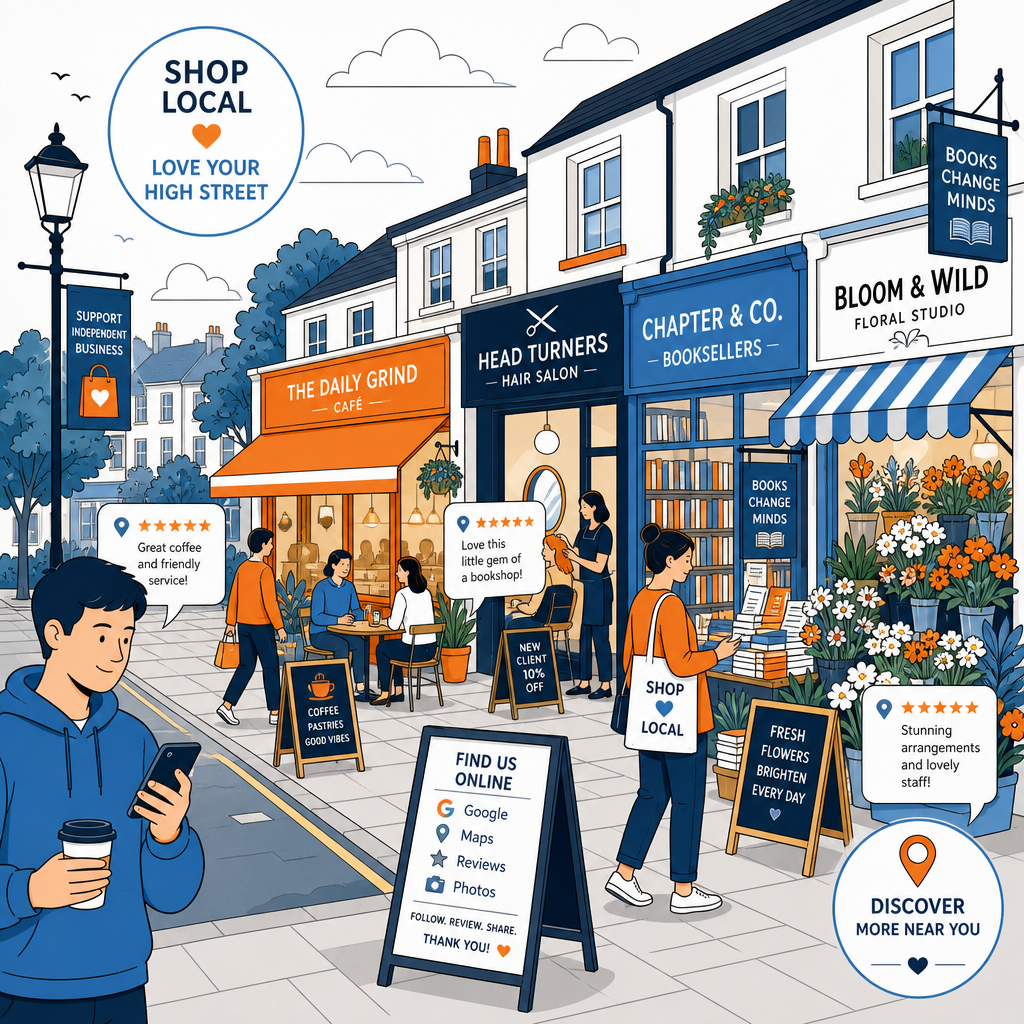
The sexiest SEO in the world might sound like a bold claim for something involving Google Business Profiles, directory listings and opening hours. For a small High Street business, though, local SEO has a certain charm. It puts your shop, café, salon or independent service in front of people who are already nearby and looking for what you sell. There is no distant audience to persuade. Someone in town needs a product, notices your listing, checks the reviews and walks through the door.
That simple journey is where local search earns its place. A well-run profile can bring in a customer on a wet Tuesday afternoon, when passing footfall feels thin and a social media post has disappeared from view. I have always liked that immediacy. The work feels connected to real streets, real businesses and the slightly unpredictable rhythm of a town centre.
Why local search matters on the High Street
When people search for a nearby business, they often have a clear purpose. They might type “hairdresser near me”, “independent bookshop in York” or “emergency plumber Leeds”. Google uses location, relevance and prominence to decide which businesses appear in the local results. Those results often include the map pack, the map-based listings shown near the top of the page.
This gives small businesses a useful opening. You do not need the biggest marketing budget in the area. You need accurate information, clear services and signs that customers trust the business. Reviews matter here, along with photos, recent updates and a website that confirms what the listing promises.
Start with your Google Business Profile
Your Google Business Profile is one of the most important local SEO assets you have. It appears in Google Search and Maps, so it often becomes the first impression people get of your business. The profile should carry the same name, address and phone number used across your website and other listings. Small details can create friction when they differ from place to place.
Choose the most accurate primary category. Add secondary categories where they fit. A florist who also offers wedding arrangements has useful detail to share, while a café serving breakfast can describe that service in its profile. Avoid adding every possible category. Relevance carries more weight than a long list.
- Use a clear business description that explains what you sell and where you serve.
- Add current opening hours, holiday hours and contact details.
- Upload bright, recent photographs of the exterior, interior, products and team.
- Add services or products with short descriptions and prices where suitable.
- Publish occasional updates about seasonal stock, events, workshops or availability.
- Answer customer questions in a calm and useful way.
Photos deserve more attention than they usually receive. A picture of the entrance can help someone find you from the pavement. Product images give a visitor a reason to choose your business. A few ordinary, honest photographs often feel more reassuring than polished stock images that could belong anywhere.
Build trust through reviews and local details
Reviews sit close to the point of purchase. People read them while deciding whether to visit, book or call. A steady flow of genuine reviews gives potential customers a sense of how the business operates. Ask for feedback after a successful visit, perhaps through a short message or a card at the till. Keep the request polite and easy to follow.
A thoughtful response to a review can help too. Thank the customer for specific feedback. If someone raises a concern, respond with care and move the detail away from the public thread when a private conversation makes sense. Future customers are reading the response as well. They are learning how you treat people when the interaction becomes slightly awkward.
| Local signal | What to check | How it helps |
|---|---|---|
| Business details | Name, address, phone and opening hours | Reduces confusion before a visit |
| Reviews | Recent, detailed and responded-to feedback | Builds confidence in your service |
| Local website content | Town, neighbourhood and service information | Shows relevance to nearby searches |
| Images | Recent, recognisable photographs | Helps customers recognise and choose you |
Make your website useful for nearby customers
Your Google listing needs a strong website behind it. The site should tell visitors what you do, where you are, when you open and how they can contact you. Put that information where people can find it quickly. A mobile visitor may be standing outside the shop, carrying shopping bags and trying to decide whether you are open.
Create pages for important services when each service deserves its own explanation. A wedding florist may have pages for bridal bouquets, venue flowers and consultation appointments. A joiner might describe kitchen fitting, bespoke furniture and repair work. Each page can answer a specific question and include useful local details without repeating the same phrase throughout.
Mention the places you serve naturally. A café in Harrogate can talk about nearby parking, local events and the walk from the station. A tradesperson covering several towns can explain travel areas and call-out arrangements. These details help people and give search engines more context. They also make the website sound like it belongs to a real business rather than a page assembled for a keyword.
Earn local links and community attention
Links from respected local websites can support your visibility. Think about the places where your business already has a relationship. A town guide, chamber of commerce, local newspaper, charity, school or event organiser may have a reason to mention you. Sponsoring a junior sports team or hosting a community workshop can create a story people want to share.
This work feels more natural when it starts with participation. Write a short guide to a local event. Provide expert advice for a neighbourhood publication. Let a community group use your meeting space for an evening. The link may come later, or it may not. The connection still gives your business a stronger presence in the place where it trades.
A manageable monthly routine
- Check your profile hours and contact details.
- Add two or three fresh photographs.
- Ask a few recent customers for an honest review.
- Publish one useful local update.
- Look at calls, website visits and direction requests in your profile insights.
Measure visits, calls and enquiries
Local SEO can feel vague when you only watch rankings. Look at the actions that connect with trading. Google Business Profile insights can show searches, calls, website visits and requests for directions. Your website analytics can reveal which pages people view before they contact you. Ask customers how they found you as well. A simple question at the till sometimes reveals what software misses.
Expect the pattern to change through the year. A garden centre may see searches rise in spring. A gift shop can become busier before December. A restaurant may receive more mobile searches in the evening. Record what happens, then give attention to the pages and profile updates that match those moments.
Avoid chasing every SEO task at once. Fix the inaccurate opening hours first. Add the missing service page next. Then improve photographs or review requests. Small businesses have stock to order, staff to manage and customers to serve. A useful local SEO plan should fit around that reality.
Why this may be the sexiest SEO in the world
The phrase sounds playful because local SEO is often overlooked. It lacks the drama of a national campaign or a technical website rebuild. Its results can appear in ordinary moments: a new customer mentions Google, a fuller appointment book arrives, someone walks in after checking the map. Those moments have a direct connection to the work.
For a small High Street business, visibility close to home has a particular value. You can improve it through accurate information, useful content, good photographs, kind service and regular attention. The process takes patience, although the steps are clear enough to begin this week. Update the profile, check the website and ask one satisfied customer for a review. That is a modest start for what may be the sexiest SEO in the world.