
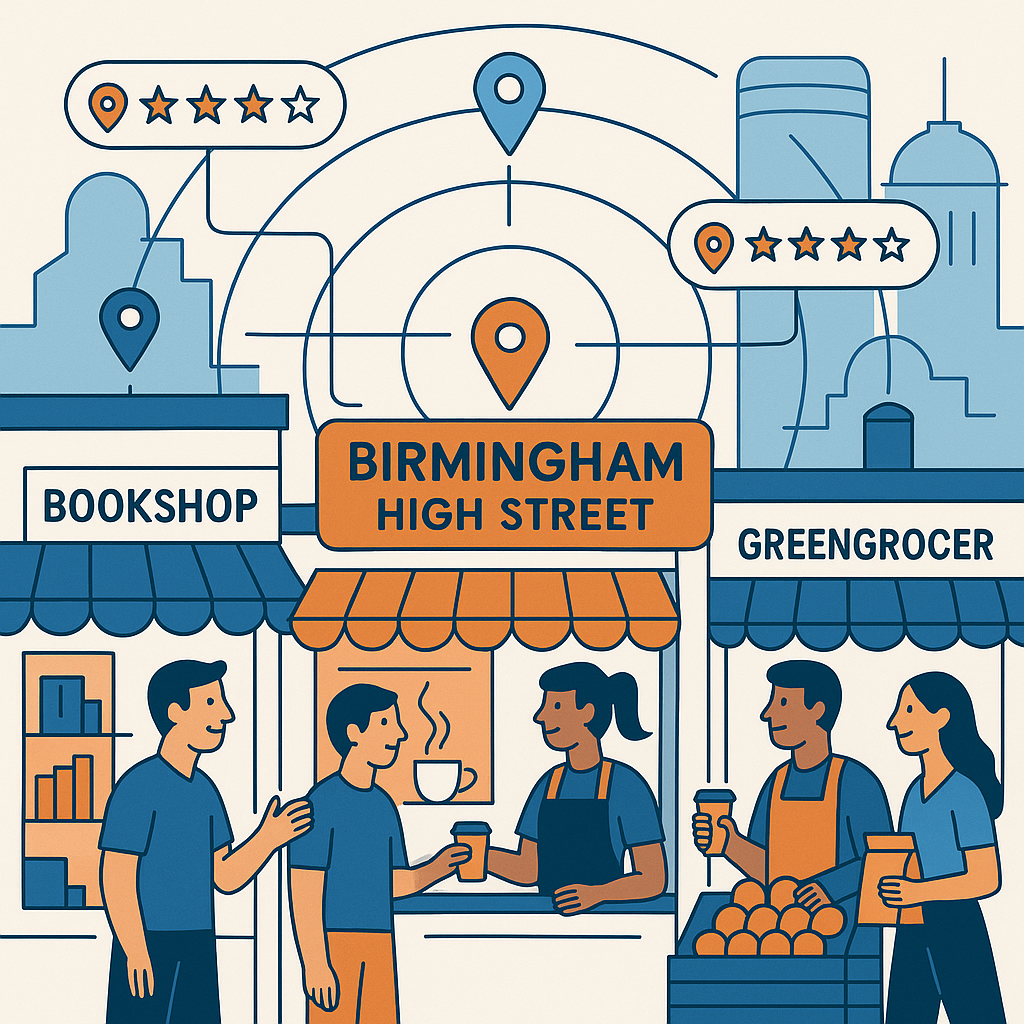
If you run a shop, café, salon, clinic, estate agency, repair service, or any other small High Street business, you have probably wondered What Google's Local Search Algorithm Actually Looks for in Birmingham. It can feel slightly mysterious. One day you appear near the top of the map results, the next day a competitor from two streets away seems to be everywhere. But local SEO is not magic, even if Google does not publish a neat checklist with exact scores.
At its simplest, Google wants to show searchers the most useful local result at that moment. Someone searching for “best coffee near New Street Station” needs something different from someone searching “emergency plumber Kings Heath” or “wedding florist Jewellery Quarter”. The algorithm is trying to judge relevance, distance, and trust. That sounds tidy, although in real life it gets a bit messy.
For Birmingham businesses, the local picture is especially interesting because the city is not one single search area. People search by neighbourhood, postcode, landmark, station, shopping area, and sometimes just by “near me”. A business in Moseley is not competing in quite the same way as one in Digbeth, Sutton Coldfield, Harborne, Erdington, or the city centre. Google knows this, more or less.
What Google's Local Search Algorithm Actually Looks for in Birmingham: the three big signals
Google’s local ranking system is often described through three main factors: relevance, distance, and prominence. These are not the only things that matter, but they are a good place to start. I think most small business owners get into trouble when they focus on only one of them, usually reviews, and ignore the rest.
The local SEO triangle
| Signal | What it means | Birmingham example |
|---|---|---|
| Relevance | How closely your business matches the search | A barber listed clearly as a barber in Harborne |
| Distance | How close you are to the searcher or searched area | A café near Bullring for someone in the city centre |
| Prominence | How well-known and trusted your business appears | Reviews, links, mentions, and local press coverage |
Relevance is about clarity. If Google cannot confidently understand what you do, where you do it, and who you serve, it will be cautious about showing your business. That means your Google Business Profile, website pages, categories, services, reviews, and even photos should all point in the same general direction. Not robotically, but consistently.
Distance is the one business owners dislike because you cannot optimise your way around geography entirely. If your bakery is in Stirchley, you may appear for searches in Stirchley, Bournville, and parts of Selly Oak. You probably will not dominate “bakery near Colmore Row” unless there are very few decent alternatives or your brand is unusually prominent.
Prominence is the slightly fuzzy one. It includes reviews, links, directory mentions, media coverage, brand searches, and general online reputation. Google is asking, in its own machine-like way, “Does the wider web seem to recognise this business?”
Your Google Business Profile does more work than most people realise
For many High Street businesses, the Google Business Profile is now more visible than the actual website. People see your opening hours, phone number, reviews, photos, directions, and services before they ever click through. Sometimes they never click through at all. That can feel frustrating, but it also means a properly maintained profile can bring enquiries without a polished website doing all the heavy lifting.
The basics matter more than they sound like they should. Your name, address, and phone number should be accurate. Your opening hours should be correct, including bank holidays. Your main category should be the best possible match, not the broadest one you can find. A dental practice should not choose vague healthcare categories if there is a more precise option. A restaurant should choose the cuisine or format that best reflects what people actually search for.
- Use the most accurate primary category available, then add sensible secondary categories.
- Write a clear business description without stuffing it with every Birmingham district you can think of.
- Add your core services or products, using plain language customers would use.
- Upload recent photos of the shopfront, interior, team, products, menu, or work examples.
- Keep special opening hours updated, especially around Christmas, Easter, bank holidays, and match days if relevant.
- Respond to questions and reviews, even briefly, because neglected profiles tend to look neglected.
Photos are easy to overlook. I have seen small shops with genuinely lovely premises, but their Google profile still shows a blurry image from 2018 or, worse, a random street view angle of a delivery van. Google may use photos to understand the business, but customers definitely use them to decide whether they trust you. For a High Street business, that first impression is not a small thing.
Quick win
Take five fresh photos this week: outside, inside, best-selling item, team member, and a detail shot. Add them to your profile.
Common mistake
Choosing a broad category because it sounds bigger. Google rewards accuracy more than ambition here.
Local relevance is built on your website, not just your map listing
A lot of local SEO advice makes it sound as if the Google Business Profile is everything. It is important, yes, but your website still gives Google context. It can explain your services in more detail, show proof, answer customer questions, and connect your business to specific Birmingham locations in a way that feels natural.
For a small High Street business, the website does not need to be huge. In fact, a clean five-page site is often better than a sprawling one full of thin, half-written pages. What matters is that each important service or product has enough information to be understood. A local optician, for example, might have separate pages for eye tests, children’s glasses, contact lenses, and designer frames. A solicitor might need pages for conveyancing, wills, probate, and family law.
Location language should be present, but not forced. Mention your area, nearby landmarks, transport links, parking, or the communities you serve where it is genuinely useful. If you are near Snow Hill Station, say so. If customers visit you from Bearwood, Edgbaston, and Quinton, that may be worth mentioning. But a paragraph listing forty suburbs is not especially helpful, and it reads badly too.
Service-area businesses need to be extra clear
Not every local business has a shopfront. Plumbers, electricians, cleaners, mobile beauty therapists, and locksmiths may work across several areas. Google can still rank these businesses locally, but the website needs to explain the service area clearly. It should not pretend there is an office in every postcode. That old tactic is risky and, honestly, customers can usually tell.
A better approach is to create helpful area pages only where you have a real reason to do so. For instance, a heating engineer based in Northfield might have strong pages for Northfield, Longbridge, Rubery, and Selly Oak if they regularly work there. Each page should include useful details, not just swapped-out place names.
Reviews influence rankings, but not in the simple way people think
Reviews matter. That part is obvious. But it is not just a case of “most reviews wins”. Google appears to look at quantity, quality, recency, wording, star rating, and sometimes the authority of the reviewer. More importantly, customers read reviews in a surprisingly detailed way. A business with 72 thoughtful reviews may look more convincing than a competitor with 300 generic ones.
For Birmingham High Street businesses, review language can support local relevance. If customers naturally mention “great hairdresser in Kings Heath” or “easy to find near the Custard Factory”, that can help Google understand context. You should not tell customers what to write, and you definitely should not fake reviews. But you can ask for honest feedback and make it easy for people to leave it.
- Ask shortly after a successful visit or job, while the experience is fresh.
- Send a direct Google review link by email, SMS, or WhatsApp if appropriate.
- Avoid offering discounts or rewards in exchange for reviews.
- Reply to positive reviews with a genuine thank you, not a copied template every time.
- Respond calmly to negative reviews. Future customers are watching your tone.
A steady trickle of honest reviews usually looks more natural, and more useful, than a sudden burst of twenty reviews after two years of silence.
There is also the issue of review freshness. If your last review is from 2021, people may wonder whether you are still operating in the same way. Google may wonder too. You do not need reviews every day, unless you are a very busy restaurant or takeaway perhaps, but a recent pattern helps.
Citations, directories, and local mentions still have a role
Citations are online mentions of your business name, address, and phone number. Years ago, local SEO was heavily focused on getting listed in as many directories as possible. That has calmed down, thankfully. Still, accurate listings on trusted UK directories and local platforms can support confidence in your business information.
The key word is accurate. If one site lists your old phone number, another has a previous address, and a third calls you by an outdated trading name, the web starts to look confused. Google is good at resolving some inconsistencies, but why make it work harder?
Small business check: Search your business name plus your postcode. Look for old directory listings, duplicate profiles, or wrong opening hours. Fixing these is not glamorous, but it can remove a surprising amount of friction.
Local mentions can be even better than standard directories. A link or mention from a Birmingham community website, a local newspaper, a charity partner, a business improvement district, a neighbourhood blog, or an events page can all add prominence. These are not always easy to get, but they tend to be more meaningful because they reflect real-world involvement.
Proximity in Birmingham is complicated by neighbourhood behaviour
Birmingham search behaviour is not always tidy. People may search by district, but they also search by route and routine. Someone who lives in Erdington but works near Five Ways might search for a dry cleaner near work. A student in Selly Oak may search for a dentist near university rather than near home. A shopper in the Bullring wants results within walking distance, not necessarily the most famous business in the city.
This is why ranking reports can be misleading. You might rank first from your own shop, fifth from half a mile away, and invisible from the other side of Birmingham. That does not always mean your SEO is broken. It may simply mean Google is personalising results based on the searcher’s location and intent.
For High Street businesses, the practical answer is to build strength around your true local area first. Own your patch before trying to rank across the whole city. A jeweller in the Jewellery Quarter has a very different local opportunity from a gift shop in Solihull or a café in Stirchley. Trying to be “Birmingham-wide” too early can dilute the message.
Content that helps local customers make decisions
Content for local SEO does not have to mean weekly blog posts about generic topics. In many cases, the most useful content is practical and specific. Customers want to know what you offer, how much it might cost, whether they need an appointment, how to get there, where to park, what areas you cover, and what makes you different.
A Birmingham florist might write about wedding flower delivery to venues around Edgbaston and the city centre. A bike repair shop could explain same-day puncture repairs for commuters using the canal paths. A restaurant could publish a clear pre-theatre dining page for people going to the Hippodrome or Symphony Hall. These pages are useful first, SEO-friendly second. That order matters.
Content ideas for Birmingham High Street businesses
- “How to find us from New Street Station”
- “Parking near our shop in Moseley”
- “Same-day appointments in Harborne”
- “A guide to choosing the right service for your home in Sutton Coldfield”
- “What to bring to your first appointment”
You do not need to overdo it. A few genuinely helpful pages can outperform a pile of thin content. I know that sounds almost too simple, but local SEO often rewards clarity and usefulness more than cleverness.
Technical trust signals should not be ignored
Technical SEO sounds like something only large companies need, but small local websites can lose enquiries through basic problems. If your website is slow, hard to use on mobile, missing contact details, or blocked from being indexed, Google has less reason to trust it. Customers have less patience too.
Mobile usability is especially important for local searches. Many people are walking, travelling, or making a quick decision. They want tap-to-call buttons, directions, clear opening hours, and pages that load without drama. If they have to pinch and zoom, or dig through a menu to find your address, they may simply go back to Google and choose someone else.
- Make sure your website uses HTTPS.
- Place your address and phone number somewhere easy to find.
- Add an embedded map or clear directions page where useful.
- Use LocalBusiness schema markup if your developer can add it properly.
- Check that important pages are indexable by Google.
- Compress large images so pages load quickly on mobile data.
Schema markup is not a magic ranking button. Nothing is, unfortunately. But it can help search engines understand your business details more confidently. For local businesses, that extra clarity is usually worth having.
Conclusion: What Google's Local Search Algorithm Actually Looks for in Birmingham
So, What Google's Local Search Algorithm Actually Looks for in Birmingham is not one single trick. It looks for a business that seems relevant to the search, close enough to be useful, and prominent enough to trust. That judgement comes from your Google Business Profile, website, reviews, citations, links, photos, content, and the real-world signals that show your business is active.
For a small High Street business, the best approach is usually steady rather than dramatic. Keep your profile accurate. Ask for reviews consistently. Make your website clear and local. Fix confusing listings. Add useful information that helps people choose you. Build relationships in your part of Birmingham, online and offline.
You may not outrank every competitor across the entire city, and that is probably not the right goal anyway. But you can become more visible to the people nearby who are already looking for what you sell. In local SEO, that is often where the real money is.