
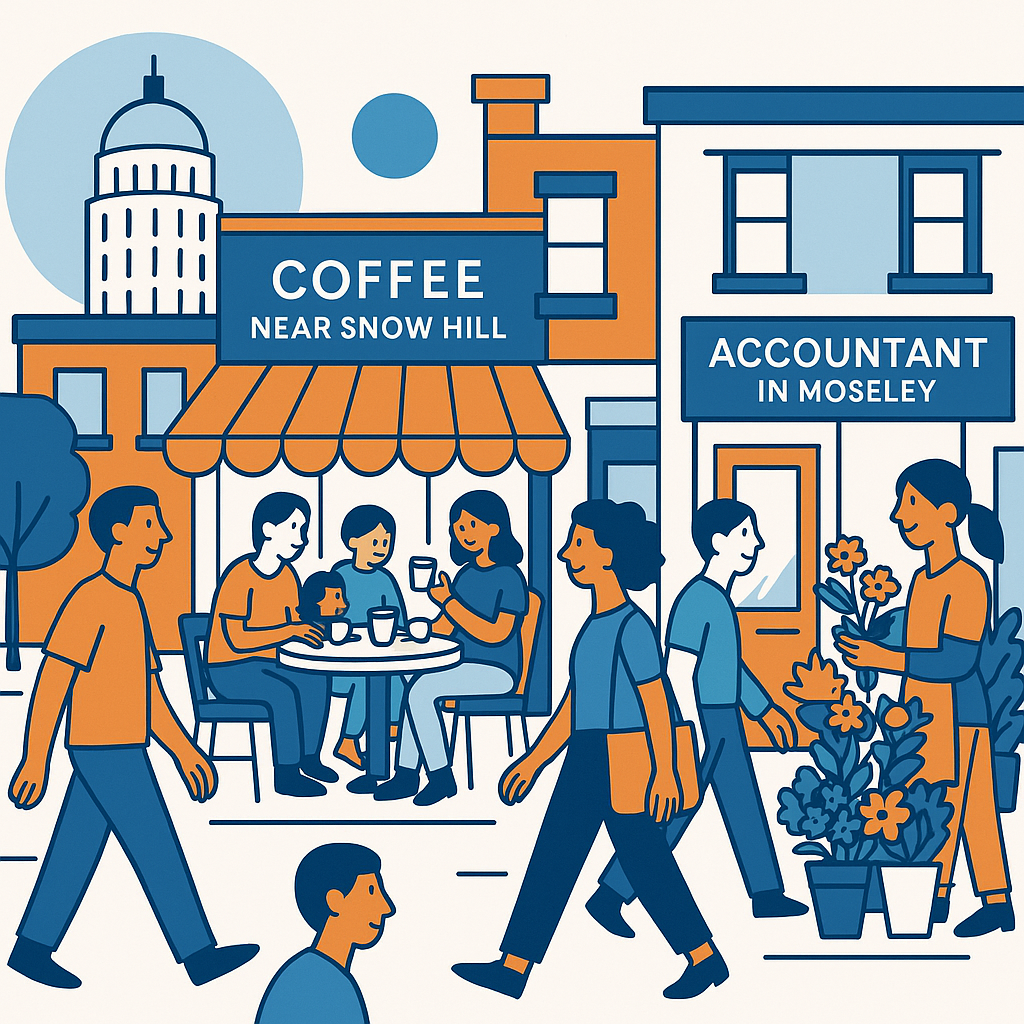
Why Hyperlocal Content Beats Generic Pages for Birmingham SEO is not just a catchy SEO phrase. It is, honestly, one of the more practical things a small High Street business can understand if it wants more local customers from Google. A generic page saying “we serve Birmingham” might have worked years ago, perhaps, but today people search in much more specific ways. They look for “coffee near Snow Hill”, “accountant in Moseley”, “wedding florist Jewellery Quarter”, or “phone repair Kings Heath open now”. Google notices that detail. More importantly, customers do too.
For small Birmingham businesses, this matters because the city is not one single, neat market. It is a collection of neighbourhoods, shopping streets, commuter routes, local habits, and very different customer expectations. Someone in Harborne may not respond to the same message as someone in Digbeth. A family looking for a dentist near Sutton Coldfield has a different mindset from a student searching around Selly Oak. This is where hyperlocal content becomes genuinely useful, not just for rankings but for relevance.
What hyperlocal content actually means
Hyperlocal content is content written for a very specific place, audience, or search moment. It is not just swapping the word “Birmingham” into a page title and calling it local SEO. That sort of thing still happens a lot, and you can usually spot it within ten seconds. The page feels thin, slightly bland, and often says nothing that proves the business knows the area.
A stronger hyperlocal page might mention nearby landmarks, parking issues, transport links, local events, well-known roads, shopping areas, or the kinds of problems local customers tend to have. A hair salon near the Bullring could talk about appointments before a night out in the city centre. A locksmith in Erdington might mention common callouts around terraced homes and flats. A café in Stirchley might write about weekend footfall, cyclists, families, and independent shopping nearby. These details are small, but they create trust.
Quick example
A generic page says: “We offer bike repairs in Birmingham.” A hyperlocal page says: “We repair commuter bikes for riders travelling through Kings Heath, Moseley and Cannon Hill Park, with quick checks available before the morning ride into the city centre.” The second one feels more real because it is.
Why Hyperlocal Content Beats Generic Pages for Birmingham SEO
Why Hyperlocal Content Beats Generic Pages for Birmingham SEO comes down to intent. Search engines are trying to match people with the most useful result, not merely the page with the right city name repeated three times. If your page reflects the actual local context, it gives Google more signals to work with. It also gives visitors more reasons to stay, click, call, or visit.
Generic pages often try to cover too much at once. They use broad phrases like “professional services across Birmingham” or “trusted by customers throughout the West Midlands”. There is nothing wrong with those phrases in small doses, but they do not say much. They are like a shop window with the lights on but no products displayed. Hyperlocal content, by contrast, gives a clearer reason for someone nearby to choose you.
There is another point that is easy to overlook. Birmingham is competitive. Whether you run a bakery, estate agency, solicitor’s office, barber shop, opticians, gym, clinic, or repair service, you are probably not the only option. Broad Birmingham SEO terms can be crowded and expensive to win. More specific local searches may have lower volume, yes, but they often bring people who are closer to buying. I would rather attract 40 people looking for exactly what I offer nearby than 400 people vaguely browsing from anywhere.
| Generic local page | Hyperlocal Birmingham page |
|---|---|
| Mentions Birmingham in a broad way | Mentions specific areas, streets, landmarks or customer situations |
| Feels similar to many competitor pages | Feels written by someone who knows the local area |
| Targets broad, competitive searches | Targets specific searches with stronger buying intent |
| Often has weak conversion value | Builds confidence before the customer calls or visits |
How Birmingham customers actually search
People rarely search like marketers imagine they do. They do not always type perfect service keywords. They search in fragments, questions, and little urgent phrases. “Best dry cleaner near Colmore Row.” “Dog groomer open Saturday Bearwood.” “Where to print documents near New Street.” Some searches are typed quickly on a phone while walking down the street. Others happen at home, late in the evening, when someone is comparing options.
This is especially true for High Street businesses because location affects the decision so heavily. A customer might choose the second-best rated option if it is five minutes closer, easier to park near, or on their route home. Convenience is a major part of local SEO, even though it does not always appear in keyword tools.
- A parent may search for a children’s shoe shop near Solihull before the weekend.
- An office worker might look for a same-day phone repair shop near Snow Hill or New Street.
- A homeowner could search for a plumber in Kings Norton after spotting a leak.
- A student may look for affordable printing, dentists, gyms, or cafés around Selly Oak.
- A couple planning a move might compare estate agents in Harborne, Moseley, or Sutton Coldfield.
Each of those searches carries a little bit of context. If your content reflects that context, your business feels like the obvious local answer. Not always, of course. Reviews, opening hours, prices, and proximity still matter. But content can tip the balance.
The problem with “one city page for everything”
A lot of small business websites have one main location page. It might be called “Birmingham Services” or “Serving Birmingham and the West Midlands”. The page lists every service, adds a map, includes a few testimonials, and hopes for the best. This is understandable. Business owners are busy, and nobody really wants to spend evenings writing neighbourhood pages after a full day on the shop floor.
But one broad city page can only do so much. It may rank for branded searches or very low-competition terms, but it is unlikely to answer the more specific searches happening across the city. Worse, it can feel impersonal. If every visitor lands on the same general page, nobody feels especially spoken to.
That does not mean you need hundreds of near-identical pages. In fact, please do not do that. Thin location pages can look spammy, and they are not pleasant to read. A better approach is to create fewer, stronger pages based on real areas you serve, real customer needs, and real reasons someone would choose you there.
Avoid
Creating 30 copied pages where only the area name changes. Customers notice. Google usually does too.
Do instead
Write genuinely useful pages for the areas, streets, or customer groups that matter most to your business.
What to include on a strong hyperlocal page
A good hyperlocal page should still be simple. It does not need to sound like a council report or a tourist guide. The best pages usually feel practical. They answer the questions a local customer might have before getting in touch: are you nearby, do you understand what I need, can I visit easily, do you serve my area, and why should I trust you?
- A clear service and location focus, such as emergency electrician in Edgbaston or bridal alterations in the Jewellery Quarter.
- Useful local references, including nearby roads, stations, car parks, shopping areas, or landmarks where relevant.
- Details that help people take action, such as opening times, booking options, callout areas, accessibility, or parking advice.
- Real examples of work, common customer requests, or short case studies from that part of Birmingham.
- Photos that feel authentic, ideally of your premises, team, local area, or completed work.
- Internal links to related services and nearby location pages, without overdoing it.
The trick is to keep it useful rather than forced. If you are writing about a shop in the city centre, mentioning New Street Station may be genuinely helpful. If you are a tradesperson covering Northfield, Longbridge, and Rubery, those place names help customers understand your coverage. But dropping in every Birmingham district alphabetically is not helpful. It reads oddly, and it rarely convinces anyone.
Hyperlocal content supports Google Business Profile too
Your website and Google Business Profile should work together. For many High Street businesses, the Google map listing is where the customer first notices you. They see your reviews, photos, opening hours, and location before they ever visit your website. But your website still matters because it gives depth. It can explain services, answer questions, and support the local relevance Google is already trying to understand.
If your Google Business Profile says you are a florist in Kings Heath, but your website only has a broad “Birmingham florist” page, there is a slight mismatch. Not a disaster, but a missed opportunity. A page about wedding flowers, sympathy flowers, or same-day bouquets in Kings Heath gives Google and customers a more complete picture.
Local SEO is not just about being found in Birmingham. It is about being found by the right person in the right part of Birmingham at the right moment.
This also helps with reviews. If customers mention local areas in their reviews, and your website talks about those same areas naturally, the whole online presence starts to feel more consistent. I would not try to script reviews, obviously, but encouraging genuine feedback from local customers can reinforce the message.
Ideas for Birmingham High Street businesses
If you are not sure where to start, begin with the areas that already bring you customers. Look at your receipts, booking forms, delivery records, enquiry emails, or even conversations at the counter. You may find patterns. Maybe many customers come from Bournville because parking is easier near you. Maybe office workers from the business district pop in at lunchtime. Maybe weekends bring people from surrounding suburbs.
Once you spot those patterns, you can turn them into content that feels natural rather than invented. A small independent retailer could write a guide to gift shopping near a particular High Street. A café could create a page for remote workers looking for good coffee and Wi-Fi near a station. A clinic could answer questions from patients travelling in from surrounding suburbs. It does not all have to be sales-heavy. Sometimes a useful local guide does more to build trust than another service page.
Content prompts to try
- “How to find us from [local station or landmark]”
- “Best time to visit our shop if you are coming from [area]”
- “Common [service] questions from customers in [neighbourhood]”
- “A local guide to choosing [product or service] in [part of Birmingham]”
Measuring whether it is working
Hyperlocal SEO can feel a bit slow at first. You publish a page, wait, tweak, and then wonder if anyone has noticed. That is normal. Local search results shift gradually, especially if your competitors have been around for years. Still, there are a few signs that the work is starting to pay off.
- More impressions in Google Search Console for neighbourhood or “near me” style queries.
- More calls, direction requests, or website clicks from Google Business Profile.
- Longer time on page from visitors landing on local content.
- More enquiries mentioning a specific area, road, station, or local reference.
- Improved rankings for less competitive, high-intent Birmingham searches.
Do not judge everything by broad rankings like “best shop Birmingham” or “solicitor Birmingham”. Those terms are tempting, but they are not the whole story. Smaller, more specific searches may quietly bring in better customers. And in the real world, better customers matter more than prettier ranking reports.
Conclusion: Why Hyperlocal Content Beats Generic Pages for Birmingham SEO
Why Hyperlocal Content Beats Generic Pages for Birmingham SEO is really about relevance. Generic pages speak to everyone and, as a result, often connect deeply with nobody. Hyperlocal content speaks to the person who is nearby, ready to act, and looking for signs that your business understands their area and their need.
For small High Street businesses, that is a big advantage. You may not have the budget of a national chain or the domain authority of a huge directory, but you do have local knowledge. You know the streets, the regulars, the awkward parking spots, the busy times, the shortcuts, the questions people ask before buying. Put that knowledge on your website in a clear and useful way, and your SEO becomes less generic, more human, and much more likely to bring in the Birmingham customers you actually want.