
Building Long-Term Visibility and Authority: Why SEO Is an Asset, Not an Expense
There's this moment that happens with SEO—usually around month eight or nine—where something clicks. You've been investing consistently, watching your rankings slowly improve, seeing traffic gradually increase. And then suddenly you realise: this is working. Not just working for this month, but building something that'll keep working.
That's when SEO stops feeling like a cost and starts feeling like an asset. And honestly, that shift in perspective changes everything about how you approach your marketing.
The Asset vs Expense Mindset
I think one of the biggest mistakes businesses make is treating all marketing as an expense. You spend money, you get results, the money's gone. Next month, you spend more money, you get more results. It's transactional. It's a treadmill.
But not all marketing works that way. Some marketing builds assets—things that continue generating value long after the initial investment.
SEO is an asset. Your rankings are an asset. Your optimised content is an asset. Your domain authority is an asset. The links you've earned are assets. They don't disappear when you stop paying. They keep working for you.
Compare that to most advertising. You pay for a radio ad, it plays, it's gone. You pay for a Facebook ad, it runs, it stops. You pay for a Google Ad, someone clicks, you've paid. The value is consumed immediately. There's nothing left over.
With SEO, every pound you invest adds to something that persists. You're not just buying traffic—you're building a traffic-generating machine that gets more efficient over time.
What "Long-Term" Actually Means
Let's be clear about timescales here, because I think this is where people get frustrated with SEO. When we say "long-term," we're talking about:
The SEO Compounding Timeline
SEO isn't a switch you flick; it's an engine you build.
Foundation Building
Technical fixes and content optimization. You might not see traffic yet, and it feels like you're spending money for nothing. This is the "Trust Gap" phase.
Early Results
Ranking for low-competition keywords. You're seeing proof that the strategy works, but you haven't hit the break-even point quite yet.
Acceleration
The compound effect kicks in. Rankings for high-value keywords improve significantly. This is usually where you see a Positive ROI.
Compounding Returns
Your domain authority is established. New content ranks faster and your "Cost per Client" plummets as traffic flows consistently without extra spend.
The key thing to understand is that each phase builds on the previous one. You can't skip to year two. You have to go through the foundation phase. But once you're through it, you've got something valuable.
The Authority Component (And Why It Matters More Than You Think)
Here's something that doesn't get talked about enough—SEO isn't just about rankings. It's about building authority in your market.
When you consistently create quality content, when you earn links from reputable sites, when you rank highly for important keywords, something happens. Google starts trusting your site more. Your domain authority increases. And that authority makes everything else easier.
New pages you publish rank faster. You compete more effectively for difficult keywords. You're more resilient to algorithm updates. You've built a reputation with Google, and that reputation has value.
But it goes beyond Google. Your customers see it too. When someone searches for "Birmingham accountant" and you're consistently in the top three results, that visibility creates trust. They might not consciously think "this company ranks well, therefore they must be good," but subconsciously, that's exactly what happens.
Visibility equals credibility. Ranking highly signals authority. And authority drives business.
The Compounding Effect in Practice
Let me give you a real example of how this compounds. Say you write a blog post about "how to choose a solicitor for house buying." You optimise it properly, it ranks on page one for that keyword. That post brings in 50 visitors per month.
That's nice. But here's where it gets interesting.
Six months later, you write another post about "conveyancing costs explained." Because your site now has more authority (partly from that first post), this new post ranks faster and higher. It brings in 80 visitors per month.
A year in, you write a post about "common conveyancing problems." Your domain authority is even higher now. This post ranks in the top three almost immediately. It brings in 120 visitors per month.
You've written three posts. But you're not getting 50 + 80 + 120 = 250 visitors per month. You're getting more, because the authority you've built makes everything perform better. Your first post is now bringing in 75 visitors per month because your whole site has more authority. Your second post is up to 100 visitors.
That's compounding. Each piece of work you do makes all your previous work perform better. You're not just adding—you're multiplying.
Why This Matters for Business Stability
I think one of the underappreciated benefits of SEO is the stability it provides. Most marketing channels are volatile. Ad costs fluctuate. Social media algorithms change. Referral sources dry up.
But once you've built strong SEO, it's remarkably stable. Your rankings might move up or down a position or two, but you don't suddenly drop from position 3 to position 30 overnight. Your traffic doesn't vanish because Facebook changed their algorithm or Google increased their ad prices.
This stability matters more than you might think, especially for small businesses. When you know you're going to get 200 qualified visitors per month from organic search, you can plan. You can forecast. You can make business decisions with confidence.
Compare that to relying entirely on paid advertising, where your traffic is directly tied to your ad spend, and your ad costs can increase at any time. Or social media, where an algorithm change can cut your reach by 80% overnight. SEO provides a foundation that other marketing channels can't match.
The Snowball Effect
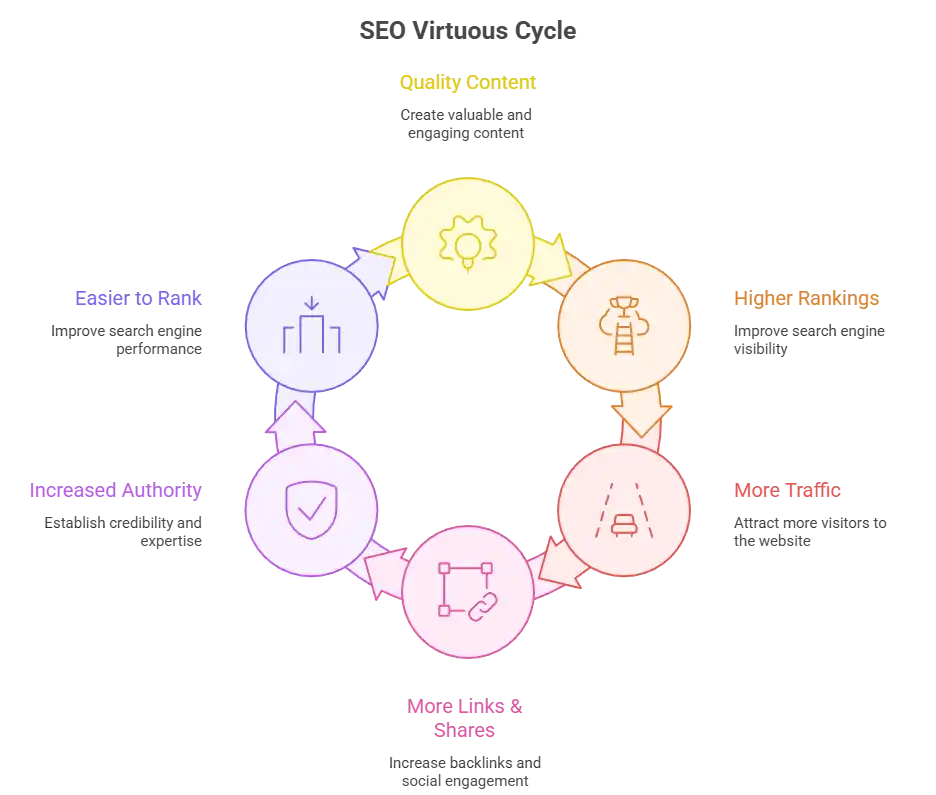
There's this phenomenon with SEO where success breeds success. It's like a snowball rolling downhill—it starts small, but as it rolls, it picks up more snow, gets bigger, and rolls faster.
When you start ranking for one keyword, you get traffic. That traffic leads to links (people reference your content). Those links increase your authority. That authority helps you rank for more keywords. Those rankings bring more traffic. That traffic leads to more links. And so on.
It's a virtuous cycle. But—and this is important—it only works if you stick with it long enough for the cycle to start. If you give up after three months because you're not seeing results yet, you never get to experience the snowball effect.
Perhaps the hardest part of SEO is having faith that the snowball will start rolling. Because in those early months, it genuinely feels like you're pushing a boulder uphill. But once it tips over the peak and starts rolling downhill, the momentum is remarkable.
Building vs Renting Your Visibility
Here's an analogy that I think captures the difference between SEO and other marketing channels: SEO is like buying property, while most advertising is like renting.
When you rent, you pay every month, and you get a place to live. Stop paying, and you're out. You build no equity. You own nothing. The money's gone.
When you buy, you pay every month too (mortgage), but you're building equity. Eventually, you own the property. Even if you stop making improvements, you still own it. It has value. You can sell it if you want.
SEO is buying. You invest money consistently, but you're building equity in your online visibility. Eventually, you "own" those rankings in the sense that they're yours and they persist. They have value. If you sold your business, those rankings would be part of what you're selling.
Paid advertising is renting. You pay, you get visibility, you stop paying, the visibility disappears. You've built nothing. There's no equity. The money's gone.
I'm not saying renting is always bad—sometimes it makes sense. But if you're building a business for the long term, you want to own assets, not just rent them.
The Resilience Factor
One thing I've noticed about businesses with strong SEO is their resilience. When economic conditions get tough, when budgets get cut, when things get uncertain, these businesses have a cushion.
They can reduce their marketing spend because they've got organic traffic that keeps coming. They're not entirely dependent on paid advertising that requires constant feeding. They've built something that can weather storms.
I saw this during the pandemic. Businesses that relied entirely on paid advertising had to make brutal choices—keep spending and burn through cash, or cut spending and watch their customer pipeline dry up immediately.
Businesses with strong SEO had options. They could reduce their SEO investment to maintenance levels and still get customers. They had breathing room. They could survive lean periods without their entire marketing engine shutting down.
That resilience has value. It's hard to quantify, but it's real. It's the difference between being fragile and being robust.
The Competitive Moat (Again)
I mentioned this in another context, but it's worth emphasising here—SEO creates a competitive moat that gets wider over time.
If you've been investing in SEO for three years and you rank well for dozens of important keywords, a new competitor can't just show up and outrank you tomorrow. They'd need to invest heavily for months or years to catch up. Even with unlimited budget, they can't buy their way to the top instantly.
Your established authority, your accumulated links, your aged domain, your comprehensive content—these are barriers to entry that protect your market position. The longer you invest in SEO, the higher those barriers become.
This is the opposite of paid advertising, where a competitor with deeper pockets can outbid you tomorrow and take your visibility. There's no moat. It's just a bidding war.
What This Means for Your Business Strategy
If you accept that SEO builds long-term assets rather than just generating short-term traffic, it changes how you think about your marketing strategy.
You stop asking "what's my ROI this month?" and start asking "what am I building?" You stop comparing SEO to paid advertising on a month-by-month basis and start thinking about cumulative value over years.
You start seeing your SEO investment as similar to other business investments—equipment, training, systems. You don't expect your new computer to pay for itself in month one. You expect it to provide value over years. SEO is the same.
This mindset shift is crucial. Because if you're constantly evaluating SEO on short-term metrics, you'll probably give up before it really starts working. But if you understand you're building an asset, you'll have the patience to see it through.
The Exit Value
Here's something that doesn't get discussed much—if you ever want to sell your business, strong SEO significantly increases its value.
A business that gets 80% of its customers from paid advertising is risky for a buyer. What if ad costs increase? What if the buyer doesn't manage the campaigns as well? The customer pipeline is fragile.
A business that gets 80% of its customers from organic search is much more attractive. Those rankings are an asset that transfers with the business. The customer pipeline is robust and doesn't require constant spending to maintain.
I've seen businesses valued significantly higher because of their strong organic presence. It's not just about current revenue—it's about the sustainability and transferability of that revenue. SEO provides both.
The Reality Check
Look, I don't want to oversell this. SEO isn't magic. It's not guaranteed. It requires consistent effort and investment. Some markets are more competitive than others. Some businesses will see faster results than others.
But the fundamental principle holds: SEO builds assets that compound over time. It creates long-term visibility and authority that persists beyond your immediate investment. It provides stability and resilience that other marketing channels can't match.
If you're building a business for the long term—and I assume you are—then investing in SEO isn't just smart marketing. It's smart business. You're not just buying traffic. You're building something that has lasting value.
And that, I think, is worth the patience and investment it requires.