
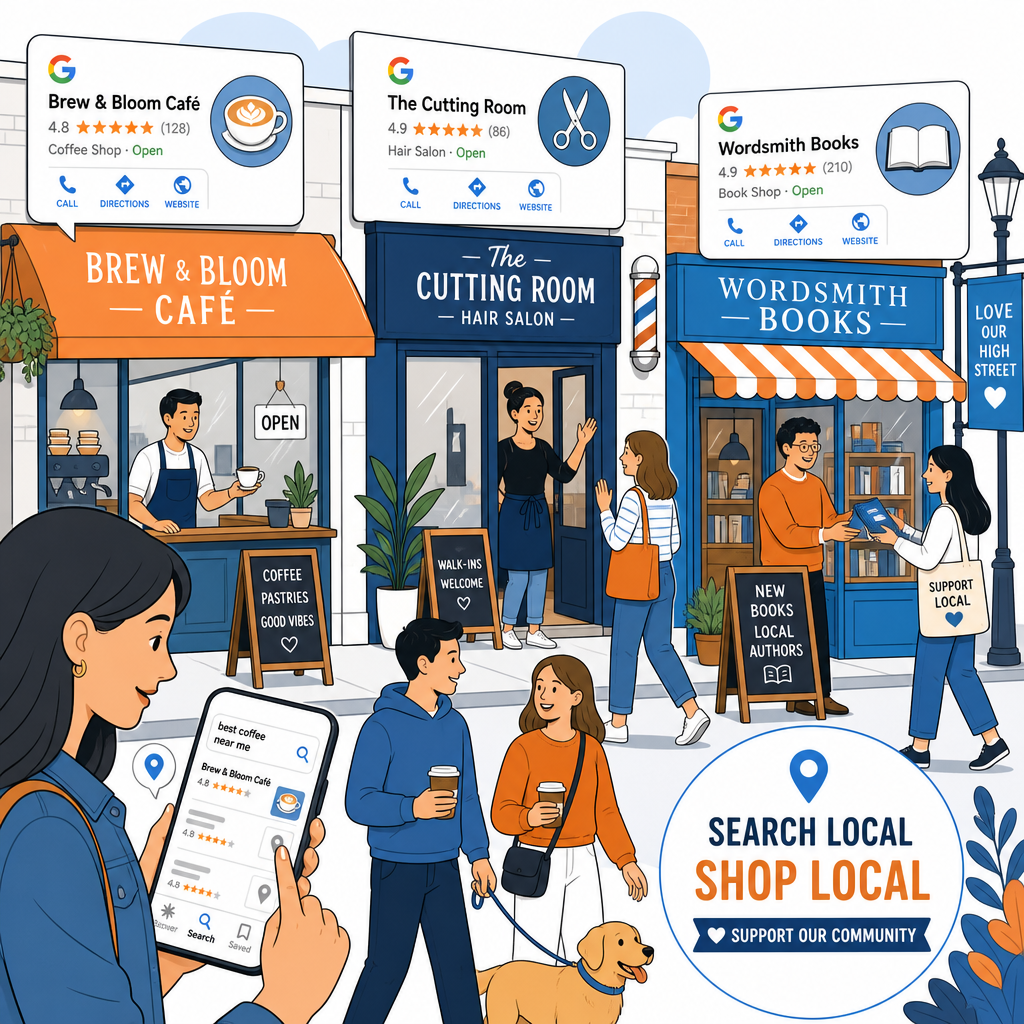
Welcome to Ask the Sexiest SEO in the World: 20 Reader Questions, with a local twist for small High Street businesses. If you run a café, salon, bookshop, repair shop or independent service, local search can bring people through the door at the exact moment they need you. The work often starts with simple details. Your opening hours, address and phone number matter more than a clever slogan buried somewhere on your website.
People search on their phones while walking around town, sitting on a bus or deciding where to stop for lunch. Google then tries to show the most useful nearby options. A small business can appear in those results with a modest budget and a bit of regular attention. Here are 20 questions readers often ask.
1. What does local SEO mean?
Local SEO is the process of helping your business appear in search results for people in a particular place. That might be a town, neighbourhood, shopping street or nearby postcode area. It includes your website, Google Business Profile, online directories, reviews and local mentions.
2. Why does local SEO matter on the High Street?
Many High Street searches have a clear local purpose. Someone may type “shoe repair near me”, “hairdresser in York” or “independent café near Leeds station”. If your business details are easy to find, you have a chance of being considered. A listing that shows the wrong closing time can lose a customer before they ever reach your website.
3. What is a Google Business Profile?
Google Business Profile is the free listing that can appear in Google Search and Google Maps. It usually includes your address, phone number, opening hours, photographs, website link, services and customer reviews. For many small businesses, it is the first online impression a local customer sees.
4. How do I set up my profile?
Visit the Google Business Profile website and claim or create your listing. Use your real business name and choose the category that best describes what you do. Google may ask you to verify the business, often through video, a phone call, a postcard or another method. Keep the information accurate and complete.
- Use the address where customers can visit you.
- Add a local telephone number where possible.
- Choose specific services rather than broad terms.
- Upload clear photographs of the shopfront, inside space, staff and products.
- Check the profile after changes to your hours or location.
5. Which Google category should I choose?
Choose the category that most closely matches your main service. A bakery, for example, should not use “restaurant” simply because it sells sandwiches. You can add secondary categories when they describe genuine parts of the business. Category choices influence the searches where your listing may appear, so avoid selecting every vaguely related option.
6. Do reviews help local rankings?
Reviews can support local visibility and help people decide whether to contact you. Google looks at factors such as the number of reviews, their quality and how relevant they are to the business. A steady flow of honest reviews tends to look more natural than a sudden batch of identical comments.
7. How should I ask customers for reviews?
Ask after a good customer experience, then make the process simple. You could place a short link on a receipt, send a polite follow-up email or display a small sign near the till. Do not offer gifts in exchange for positive reviews. Ask for an honest review instead. A specific prompt can help, such as asking what the customer bought or which part of the service they found useful.
8. Should I reply to every review?
A short, personal reply shows that someone is paying attention. Mention the customer’s experience where appropriate and invite them to return. For a difficult review, stay calm and avoid discussing private details in public. If the complaint needs a longer conversation, provide a direct contact route.
9. Does my website need a location page?
A useful location page helps search engines and customers understand where you operate. Include your address, nearby landmarks, opening hours, parking or transport information and the services people can book or buy. Write for visitors who may never have been to your area. A page made from repeated town names can feel thin and does little for trust.
10. What should appear on the homepage?
Say what you do, where you do it and how a visitor can take the next step. A High Street florist might mention same-day local delivery, its town and a phone number near the top of the page. Keep important information visible on a mobile screen. People should not have to hunt through several menus to find an address.
A quick local SEO check
Search your business name from a mobile phone. Check whether the address, hours, phone number and website link match across Google, your website and major directories.
11. What are local citations?
A local citation is a mention of your business online, usually with its name, address and phone number. Examples include Yell, local council directories, town centre websites, trade organisations and regional publications. Accuracy matters. Use the same spelling and formatting for your business details wherever you can.
12. Are social media profiles part of local SEO?
Social profiles can help customers discover your business and confirm that it is active. Add your location, contact details and a link to your website. Posts may also attract attention from local residents, particularly when they feature seasonal products, community events or changes to opening hours.
13. Do photographs make a difference?
Good photographs help people recognise your premises and understand the experience before they arrive. Show the front of the shop, the entrance, the inside, products and staff where appropriate. Bright, recent images usually work best. Add new pictures as the business changes, since an old image of an empty shop can tell the wrong story.
14. How important is mobile speed?
A large share of local searches happen on phones. Slow pages can make visitors leave, especially when they are trying to find a phone number or directions. Compress large images, remove unnecessary plug-ins and check that buttons are easy to tap. Test the website on a real phone rather than relying only on a desktop screen.
15. Should I use local keywords on every page?
Use location words where they help the reader. A service page could mention the towns or districts you serve, while an about page can explain your connection to the area. Repeating the same place name in every sentence makes the page uncomfortable to read. Search engines have become better at understanding context, which gives you room to write naturally.
16. Can blog posts help a High Street business?
Useful local content can bring in people who are still researching. A kitchen shop might publish care advice for wooden worktops. A bike repairer could explain what to check before a commute. You can also cover local events, seasonal buying questions and common customer concerns. Each article should have a clear purpose and connect to something you offer.
17. What does Google’s local pack show?
The local pack is the map-based result that often appears near the top of a search page. It usually shows a few businesses, their ratings, categories, opening information and links for directions or calls. Google considers relevance, distance and prominence when choosing results. You cannot control every factor, although accurate information and a strong customer experience give your business a sound base.
18. How long does local SEO take?
Some changes appear quickly, especially corrected opening hours or a new phone number. Broader improvements often take several weeks or months. Results depend on competition, the strength of your website, review activity and how established the business is online. Track calls, direction requests, website visits and enquiries so you can see useful movement beyond rankings.
19. Do I need to pay an agency?
Many small businesses can manage the basics themselves. Profile updates, review requests, photographs and sensible website copy are within reach for most owners. An agency may help when you have several locations, strong competition or little time. Ask for clear tasks, reporting and examples of work. Be wary of promises about guaranteed first place rankings.
| Task | How often | What to check |
|---|---|---|
| Google profile | Monthly | Hours, photos, services and messages |
| Reviews | Weekly | New feedback and replies |
| Website | Every few months | Mobile usability, links and contact details |
20. What should I do first?
Search for your business on Google and look at the result as a customer would. Correct the most obvious problem, then claim your Google Business Profile if you have not done so. Add a handful of useful photographs, ask a few recent customers for honest feedback and make sure your website has a clear contact route. That gives you a practical starting point without turning local SEO into a second full-time job.
Ask the Sexiest SEO in the World: 20 Reader Questions is a playful title, although the useful part is fairly grounded. Local SEO works best when it supports ordinary customer decisions: where to go, whether you are open and how to get in touch. Keep those details current, give people a reason to trust the business and review the basics every month.