
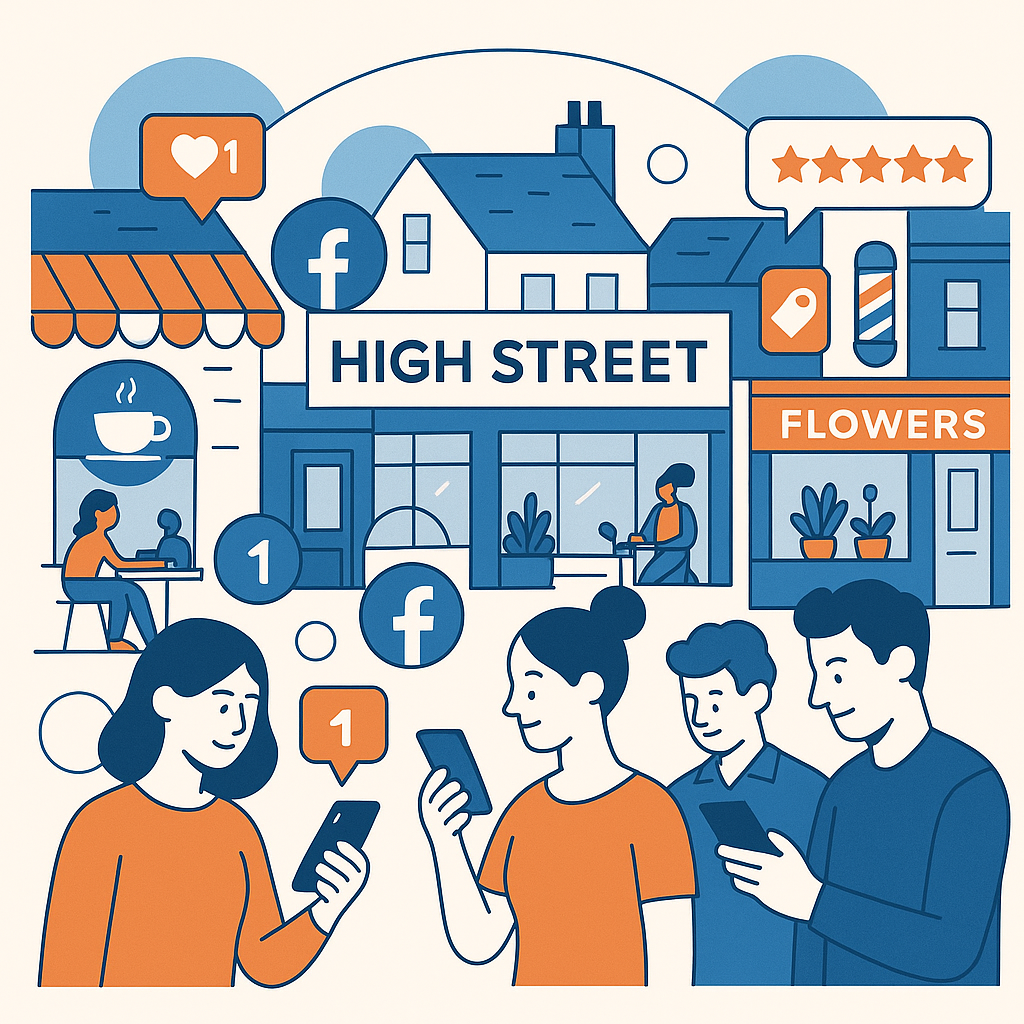
If you have been reading about the 23 Local Developments You Need to Know About From Q2 2026, you will have noticed a clear theme: local search is no longer just about having a Google Business Profile and hoping for the best. For small High Street businesses, social media now sits uncomfortably close to local SEO. Not always as a direct ranking factor, perhaps, but as something that shapes visibility, trust, clicks, reviews, and the little moments that make someone choose your shop, salon, café, clinic, or service over the one around the corner.
This is especially true in the UK, where local buying decisions can be quite specific. People search for “best coffee near me”, but they also check Instagram to see whether the place looks friendly. They Google a florist, then look at recent Facebook posts to see if it is still active. They search for a barber in town, then judge the business by photos, replies, reviews, and the general feeling of being up to date. It is not always logical. But it is very human.
Why Social Media Matters More in Local Search Than It Used To
Local SEO used to feel a bit tidier. You optimised your website, claimed your listings, collected reviews, and made sure your name, address, and phone number matched everywhere. Those things still matter. In fact, they matter a lot. But the search journey has become messier. Customers jump between Google, TikTok, Instagram, Facebook, Apple Maps, local directories, review sites, and sometimes WhatsApp groups before making a decision.
Whitespark’s local search coverage has been making a similar point: local visibility is being influenced by more platforms, more signals, and more customer behaviours than many small businesses realise. Their Q2 2026 local developments round-up highlights how quickly things are shifting around Google, reviews, AI, maps, and discovery. Social media is part of that wider shift, even when it is not labelled neatly as “SEO”.
For a High Street business, social media can support local SEO in a few practical ways. It can send branded searches to Google. It can encourage reviews. It can make people click your website from your profile. It can keep your opening hours, offers, and services fresh in people’s minds. And, less technically but just as importantly, it can prove you are still open, still relevant, and still worth visiting.
Quick thought for High Street businesses
Your social profiles may not replace your website or Google Business Profile, but they often act as a trust check. If your last post was from 2022, customers may quietly wonder whether everything is still running as normal.
23 Local Developments You Need to Know About From Q2 2026 and the Social Search Shift
The phrase 23 Local Developments You Need to Know About From Q2 2026 might sound like an industry update for SEO specialists, but there is a useful message in it for everyday business owners too. Local search is becoming more connected. Google is testing and changing features. AI-generated answers are shaping what people see first. Reviews are under greater scrutiny. Maps and local packs keep evolving. And customers are using social platforms as search engines in their own right.
That last point is easy to underestimate. A 24-year-old looking for a nail salon may not start on Google. They might search Instagram or TikTok first. Someone choosing a Sunday lunch spot may look at Google reviews, then check Facebook for recent photos. A parent choosing a local dance class may ask in a community group, then Google the business name. These are all local search behaviours, even if they do not happen entirely inside Google.
So, does posting on social media directly improve your Google rankings? Usually, not in a simple “post three times and rank higher” sort of way. That would be too convenient. But social media can increase the signals around your business: brand searches, website visits, review activity, engagement, local mentions, and customer confidence. Those things can feed into your overall online presence.
| Social activity | Local SEO benefit | High Street example |
|---|---|---|
| Posting new products or services | Encourages branded searches and website visits | A boutique shares a new spring collection and people search the shop name |
| Responding to comments and messages | Builds trust before customers click or call | A café confirms dog-friendly seating in a Facebook reply |
| Sharing customer photos | Supports social proof and review generation | A hairdresser reposts a client’s finished style with permission |
| Promoting local events | Creates local relevance and community mentions | A bookshop posts about late-night opening during a town market |
How Social Signals Influence Trust, Clicks, and Reviews
Trust is a slippery word in SEO, but small businesses know exactly what it means. It is the feeling a customer gets when they see recent photos, sensible replies, consistent opening hours, and other people saying good things. Social media helps with that. It gives your business a pulse.
Imagine two local bakeries. Both appear in Google Maps. Both have similar star ratings. One has an Instagram feed showing fresh bread from this morning, staff behind the counter, and a quick note about Saturday opening. The other has a logo, three old posts, and no recent updates. Even if their Google rankings are similar, the first bakery feels safer to choose. Maybe that is unfair, but customers make quick judgements.
Reviews are where social media and local SEO overlap most clearly. A happy customer who follows you on Instagram is easier to prompt for a Google review later. A customer who sees you responding warmly to feedback may feel more comfortable leaving their own. A local Facebook recommendation can lead to a Google search, then a call, then a review. None of this is perfectly trackable, which can be frustrating, but it is still real.
- Ask for reviews after positive social interactions, but do it naturally and without pressure.
- Share review snippets on social media to remind people that feedback is welcome.
- Reply to both positive and negative comments in a calm, practical tone.
- Use the same business name across social profiles, your website, and your Google Business Profile.
- Link from social profiles to the most useful local page on your website, not always just the homepage.
One small caution: do not turn every post into a review request. People notice. A better approach is to make review generation part of a wider habit of helpful communication. Say thank you. Show the work. Answer questions. Then, now and again, invite feedback.
What Small High Street Businesses Should Actually Post
This is where many business owners get stuck. They know they should post, but they do not want to dance on video or spend half the day making content. Fair enough. Most local businesses do not need a complicated social media strategy. They need consistency, clarity, and enough personality to feel genuine.
For local SEO purposes, useful posts often beat polished posts. A slightly imperfect photo of today’s lunch special may do more than a beautifully designed graphic that says very little. A short update about bank holiday opening hours is not glamorous, but it prevents confusion. A quick post showing where to park nearby can be surprisingly useful, especially in town centres where parking is always a bit of a conversation.
Post idea
Show what is new this week: stock, menus, appointments, treatments, classes, or seasonal services.
Local relevance
Mention nearby streets, markets, events, landmarks, or town centre updates where it feels natural.
Trust builder
Introduce staff, answer common questions, or explain how your service works for first-time customers.
A good local content mix might include practical updates, customer stories, behind-the-scenes moments, local collaborations, and answers to common questions. If you run a bike repair shop, post about puncture repairs, cycle routes, locks, and servicing before winter. If you run a beauty salon, post about patch tests, appointment availability, aftercare, and gift vouchers. If you run a solicitor’s office, perhaps keep it more formal, but you can still explain local services clearly and humanly.
Make Your Profiles Consistent With Your Local SEO Basics
Social media will not rescue poor local SEO foundations. If your Google Business Profile has the wrong opening hours, your website loads slowly, or your address is inconsistent across directories, posting more often will not fix the whole problem. It may help around the edges, but it is not a substitute for the basics.
The simplest thing to check is consistency. Your business name should be the same everywhere, unless there is a good reason it cannot be. Your address should match how it appears on your website and Google profile. Your phone number should be clickable on mobile. Your opening hours should be kept up to date, especially around bank holidays, Christmas, Easter, local events, and staff holidays.
Also think about links. Many businesses send every social click to the homepage, which is fine, but not always ideal. If you have a page for “wedding flowers in York”, “emergency plumber in Bristol”, or “children’s shoes in Leeds”, link to that page when the post is about that service. It helps customers land in the right place, and it reinforces the connection between your social activity and your local website content.
- Check your Google Business Profile details against your website and social profiles.
- Update social bios with your town, service area, and main offer.
- Use local language naturally, such as neighbourhood names or nearby landmarks.
- Add website links to relevant pages where possible.
- Review your photos every few months and remove anything badly outdated.
Do You Need to Be on Every Platform?
No. In fact, trying to be everywhere can make things worse. A neglected profile can create doubt. For most small High Street businesses, it is better to manage one or two platforms properly than five platforms badly. The right choice depends on your customers, your sector, and what you can realistically maintain.
Instagram works well for visual businesses: food, fashion, interiors, fitness, hair, beauty, gifts, and hospitality. Facebook still matters for community recommendations, local groups, older audiences, events, and service businesses. TikTok can be powerful for discovery, though it takes a different rhythm and may not suit everyone. LinkedIn is more useful for professional services, B2B firms, recruiters, accountants, consultants, and commercial property businesses.
Google itself should not be forgotten. Google Posts, photos, Q&A, services, products, and review replies are closer to the point of local search than most social content. They may not feel as exciting as Instagram, but they appear when someone is already considering you. That is valuable.
The best social platform for local SEO is usually the one your customers already check before they decide to visit, call, book, or buy.
Measuring the Impact Without Getting Lost in Data
You do not need a giant dashboard to understand whether social media is helping your local SEO. A few simple checks can tell you enough. Are more people searching your brand name? Are website visits from social increasing? Are customers mentioning posts when they come in? Are reviews growing steadily? Are calls, bookings, or direction requests improving?
The tricky part is attribution. Someone might see your Facebook post on Monday, search your business on Wednesday, and visit on Saturday. Analytics may not connect those dots neatly. That is normal. Local marketing has always involved a bit of common sense alongside data. I think business owners sometimes know more than their reports do, especially when they are speaking to customers face to face.
Simple monthly check
Look at Google Business Profile calls, website clicks, direction requests, review count, branded searches, and your top social posts. You are looking for patterns, not perfection.
Conclusion: Social Media Is Now Part of the Local SEO Picture
The main lesson from 23 Local Developments You Need to Know About From Q2 2026 is that local search keeps widening. It is not just one ranking factor, one platform, or one quick fix. For small High Street businesses, social media has become part of the same ecosystem as Google, reviews, maps, websites, and word of mouth.
You do not need to overcomplicate it. Keep your details consistent. Post useful local updates. Show that your business is active. Encourage reviews in a natural way. Link people to the right pages. Reply like a real person. Some of this sounds basic, and perhaps it is, but basic work done consistently tends to beat grand strategies that never quite happen.
Social media may not be the whole answer to local SEO, but it can make your business easier to trust, easier to find, and easier to choose. On a competitive High Street, that can make a real difference.