
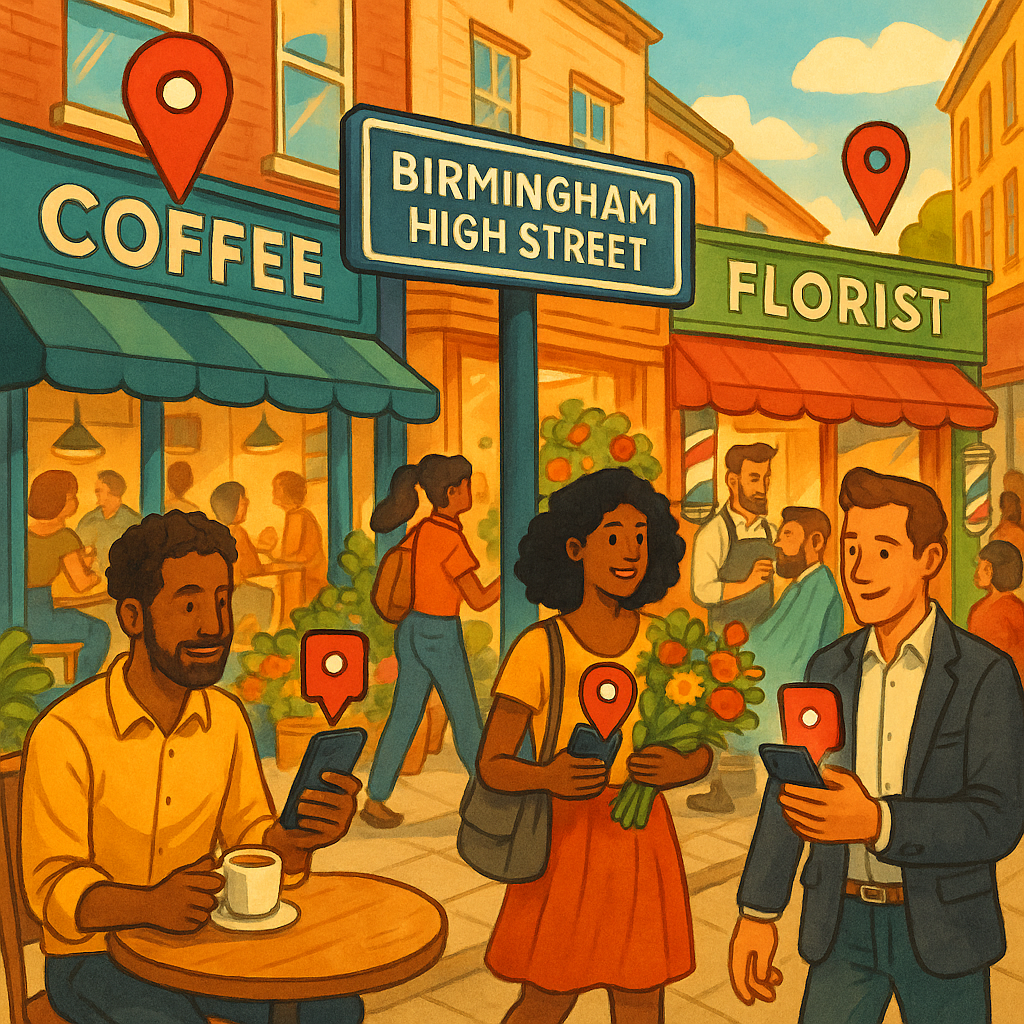
If you run a small High Street business, local search optimisation Birmingham is not just another marketing phrase to file away for later. It is, in a very practical sense, how nearby customers find you when they need something quickly. A coffee shop in Moseley, a florist in Harborne, a barber in Digbeth, a repair shop near Snow Hill; all of them depend, at least partly, on being visible when someone searches on Google Maps or types “near me” into their phone.
And the slightly awkward truth is that people rarely look very far. They might glance at the top three map results, skim a few reviews, check opening times, and make a decision in under a minute. It feels casual from the customer’s side, but for the business, there is quite a lot going on behind that little map listing.
Local SEO is about improving your chances of appearing in those moments. It is not magic, and it is not usually instant. But for Birmingham SMEs, especially those serving a defined local area, it can be one of the most useful and cost-effective ways to attract people who are already looking for what you offer.
Why local search optimisation Birmingham matters for High Street businesses
Birmingham is a busy, varied city. That sounds obvious, but it matters. A customer in Sutton Coldfield may not want to travel to Kings Heath for a quick appointment. Someone in the Jewellery Quarter searching for lunch probably wants somewhere within walking distance. Local intent is specific, and Google tries to match people with businesses that are nearby, relevant, and trustworthy.
For small businesses, that is both good and slightly intimidating. You do not necessarily need to outrank a national chain across the whole UK. You just need to show up well in your patch. A local bakery does not need to dominate searches in Manchester or Bristol. It needs to be visible to people around its shop, commuters passing through, and perhaps locals planning where to buy a birthday cake this weekend.
A simple way to think about local SEO
Local SEO helps Google understand three things: where your business is, what you offer, and why customers should trust you. If those signals are clear and consistent, you are in a much better position to appear when nearby people search.
The businesses that tend to do well locally are not always the ones with the biggest budgets. Often, they are the ones that keep their information accurate, respond to reviews, publish useful local content, and make it easy for people to choose them. It is basic work in some ways, but basic does not mean unimportant.
Start with your Google Business Profile
For most High Street SMEs, the Google Business Profile is the heart of local search. It is the listing that appears in Google Maps and often in the local pack, which is the set of map results shown near the top of search results. If this profile is incomplete, outdated, or a bit neglected, it can quietly hold you back.
At minimum, your profile should include your correct business name, address, phone number, opening hours, website link, business category, services, photos, and a clear description. That sounds like a checklist, and yes, it is. But many small businesses still have Christmas opening hours showing in March, old phone numbers, or photos from six years ago. I have seen it more than once, and it always feels like an easy win being missed.
- Use your real business name, not a keyword-stuffed version of it.
- Choose the most accurate primary category, then add relevant secondary categories.
- Keep opening hours updated, especially around bank holidays.
- Add recent photos of your shopfront, team, products, or workspace.
- List key services so Google and customers understand what you provide.
- Use the updates or posts feature when you have offers, events, or seasonal news.
Photos are worth mentioning separately. People like to see where they are going, particularly if they are visiting for the first time. A clear shopfront photo can help someone recognise your business on the street. Product photos, before-and-after examples, or images of your team can also make the listing feel alive rather than abandoned.
| Profile element | Why it matters | Quick action |
|---|---|---|
| Opening hours | Customers need confidence before travelling. | Check them monthly and before holidays. |
| Reviews | They influence trust and click-throughs. | Ask happy customers politely and respond to all reviews. |
| Photos | They make your business feel current and real. | Upload fresh images every few weeks. |
Make your website locally relevant
Your website still matters. Some business owners assume that because Google Business Profile is so visible, the website is secondary. In a way, yes, the profile may get the first click. But your website supports your local authority, gives customers more detail, and helps search engines understand your services properly.
A good local SME website does not need to be huge. It does need to be clear. Your address, phone number, service area, opening hours, and main services should be easy to find. If customers have to pinch and zoom on a mobile screen or hunt through a confusing menu, they may simply leave. That sounds harsh, but it is how people behave online.
Service pages can be especially useful. Instead of having one general page that says you do everything, create separate pages for your main offers. A Birmingham electrician might have pages for emergency callouts, fuse board upgrades, landlord certificates, and lighting installation. A beauty salon might have pages for brows, nails, waxing, and facials. Each page gives Google more context and gives customers a better answer.
Local references help too, as long as they are natural. Mention the areas you serve, nearby landmarks, transport links, or common customer needs in Birmingham. Do not force place names into every sentence. That quickly reads badly. But if you genuinely serve Edgbaston, Solihull, Bearwood, or the city centre, say so in a way that feels helpful.
Reviews, reputation, and trust signals
Reviews are one of the most visible trust signals in local search. Most people will not read every review, but they will notice the average rating, the number of reviews, and whether recent customers seem happy. A business with 4.7 stars and regular comments often feels safer than one with two reviews from 2019, even if the second business is actually excellent.
Asking for reviews can feel uncomfortable at first. Many small business owners worry it sounds pushy. Usually, it does not, if you ask at the right moment. After a successful job, a pleasant appointment, or a repeat purchase, a simple request is enough. You might say, “If you were happy with everything, a quick Google review would really help us.” That is human, not aggressive.
Responding matters as well. Thank positive reviewers properly, even if it is brief. For negative reviews, stay calm and professional. Future customers often judge the response as much as the complaint. A defensive or sarcastic reply can do more damage than the original review, which is annoying, but true.
Good review habits
Ask consistently, reply politely, and keep the tone personal. A steady trickle of genuine reviews usually looks more natural than a sudden burst.
Avoid this
Do not buy reviews, offer rewards for positive ratings, or copy and paste the same reply every time. People can usually tell.
Build local citations and consistent business details
A citation is any online mention of your business name, address, and phone number. Directories, local business listings, chamber of commerce pages, supplier websites, and industry platforms can all count. The point is not to appear on every directory in existence. Some are low quality and not worth the bother. The point is consistency.
If your business is listed as “Ltd” in one place, “Limited” in another, with an old address somewhere else and two different phone numbers floating around, search engines may be less confident. Customers may be confused too. It is not glamorous work, but tidying citations can help strengthen your local presence.
For Birmingham businesses, look for reputable local and industry-specific opportunities. Local press mentions, partnerships with nearby charities, sponsorship of community events, or listings on relevant trade bodies can all support visibility. A link from a respected local organisation is usually far more valuable than a random directory nobody uses.
Create content that answers local questions
Content does not have to mean writing endless blog posts that nobody reads. For a small business, useful content is often practical and specific. Think about the questions customers ask in person or over the phone. Those questions can become website pages, FAQs, short guides, or Google Business Profile updates.
A bike repair shop could write about getting a bicycle serviced before commuting along Birmingham’s canal routes. A solicitor might explain what local clients need to bring to an initial appointment. A restaurant could publish a page about private dining near New Street or pre-theatre meals close to the Hippodrome. It does not need to be literary. It needs to be useful.
- Write down ten questions customers regularly ask.
- Group them by service or customer need.
- Create a short, clear answer for each one.
- Add local detail where it genuinely helps.
- Review the content every few months so it stays accurate.
This kind of content can help you appear for more detailed searches. It also reassures customers before they contact you. Sometimes people are not ready to call. They want to understand prices, process, parking, delivery areas, appointment times, or what happens next. If your website answers those things better than a competitor’s, that can be enough.
Do not ignore mobile experience
Local searches often happen on mobile. Someone is walking through Birmingham city centre, sitting on a bus, waiting at a station, or quickly checking options during a lunch break. If your website loads slowly or the phone number is hard to tap, you lose people. Not always, but often enough for it to matter.
A mobile-friendly site should load quickly, use readable text, have clear buttons, and make contact details obvious. A click-to-call button can be surprisingly useful. So can embedded maps, simple enquiry forms, and clear directions. It is easy to overcomplicate websites, but local customers usually want the basics first: can you help, are you nearby, are you open, and can they trust you?
Measure what is working, but keep it realistic
SEO reporting can become overwhelming if you let it. Rankings, impressions, clicks, calls, direction requests, website visits, conversions; there is a lot to watch. For a small business, it is better to focus on a few meaningful signs rather than staring at charts every day.
Google Business Profile insights can show how people find your listing and what actions they take. Google Analytics and Search Console can show website visits and search queries. Call tracking can help, although some SMEs prefer not to use different phone numbers because consistency matters. There is a balance to strike.
A sensible monthly review might look at whether calls have increased, whether more people request directions, which pages get visits, and which search terms are bringing people in. You may not see dramatic changes every month. Local SEO is usually cumulative. Small improvements add up, then suddenly you realise the phone is ringing a little more often.
Final thoughts on local search optimisation Birmingham
For SMEs, local search optimisation Birmingham is really about being easier to find, easier to trust, and easier to choose. It is not about tricking Google or stuffing your website with place names. The best results usually come from doing the simple things well and doing them consistently.
Claim and improve your Google Business Profile. Keep your details accurate. Ask for reviews without making it awkward. Build a website that explains what you do and where you do it. Add genuinely useful local content. Make sure everything works properly on mobile. None of this is wildly glamorous, perhaps, but it is the sort of steady work that helps a High Street business compete.
Birmingham customers are already searching. Some are ready to buy today, some are comparing options, and some are just trying to find a business they feel comfortable contacting. If your local presence gives them confidence at that exact moment, you have a much better chance of turning a search into a visit, a phone call, or a loyal customer.