
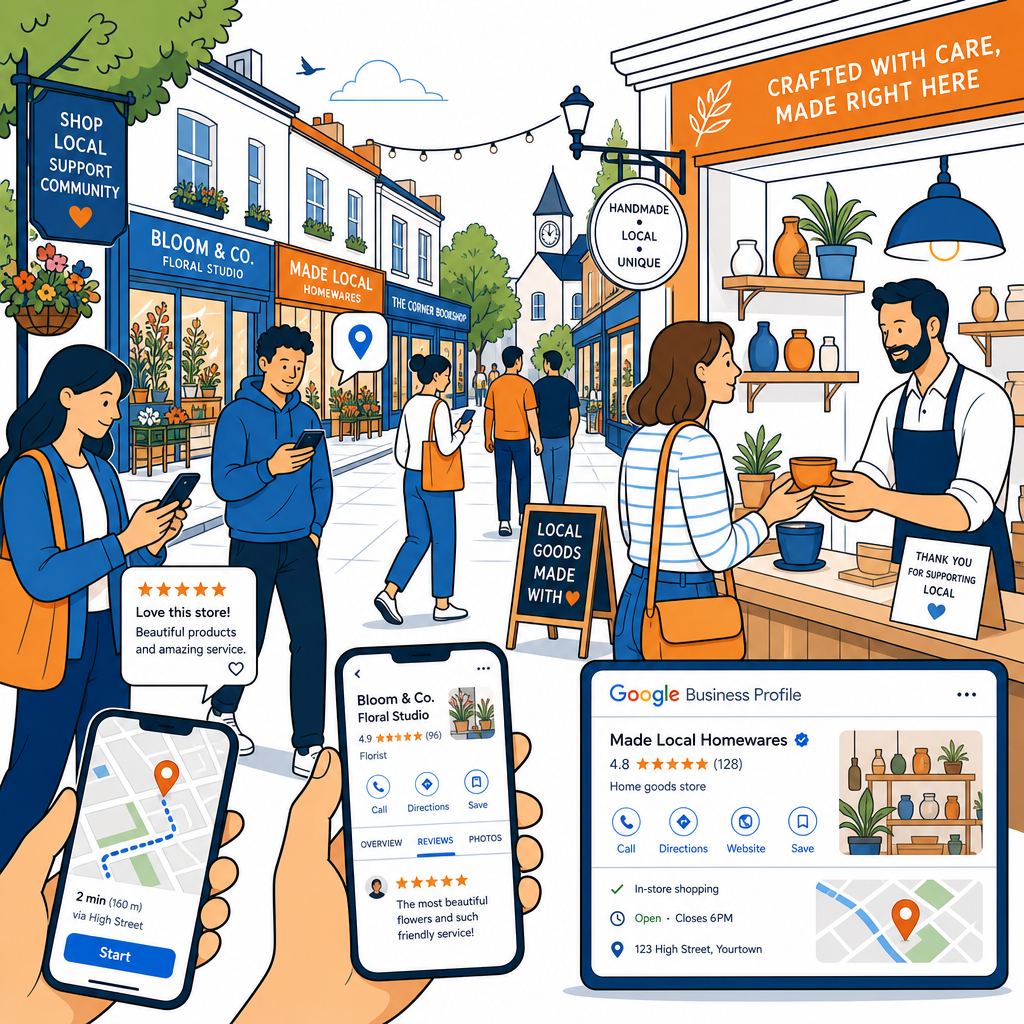
Sexiest SEO in the World for Ecommerce Product Pages sounds like a bold promise, especially when your business is a small shop on a busy High Street. In practice, good SEO is less about clever tricks and more about helping the right person find the right product at the right moment. Someone searching for a gift shop in York, a bike repair service near Bristol or a local independent bookshop may already be close to buying. Your website needs to make that next step easy.
Local search has become part of everyday shopping. People check opening hours while standing outside a shop. They compare prices on their phone, look at photos, read reviews and search for stock before walking across town. A modest ecommerce site can support all of this. It gives your High Street business another shop window, one that stays open when the physical premises are closed.
What local SEO means for a High Street shop
Local SEO helps your business appear when people search for a product or service in a particular place. That place might be a town, a neighbourhood, a postcode area or simply the phrase near me. Google uses information from your website, Google Business Profile, directories, reviews and other sources to understand where you operate and what you offer.
For a small retailer, this can bring in people who have a clear need. A customer might search for waterproof school shoes in Leeds, a florist near Richmond or handmade candles in Norwich. They are not browsing in the abstract. They want useful information, and they often want it quickly.
- Create a complete Google Business Profile with accurate opening hours, categories, photos and contact details.
- Use the town, area or neighbourhood naturally on relevant website pages.
- Keep your name, address and phone number consistent across important directories.
- Ask customers for honest reviews and reply to them in a friendly, specific way.
- Make your website quick to use on a mobile phone.
Build product pages that answer local shoppers
Product pages often sit at the centre of an ecommerce SEO plan. They need to explain what the item is, who it suits, how much it costs and how a customer can get it. For a High Street business, the page can also answer a local question: can I collect this today?
Write each page for a person who has arrived with a practical intention. Include the product name, brand, size, colour, material, care details and delivery information. If stock changes regularly, show that clearly. A customer who sees “available for collection from our Bath shop” has a useful reason to visit.
Avoid copying a manufacturer’s description word for word. It gives search engines little that is original, and it misses the chance to add local knowledge. A toy shop owner might explain which age group tends to enjoy a game, while a garden centre could mention whether a plant suits a windy coastal garden. These details take a few minutes to add and can make the page feel like it came from a real shop.
A useful local product page should show
- Clear product photographs, including close-up details.
- Current price, stock status and collection options.
- Delivery areas, delivery costs and expected timings.
- A short description written in your own voice.
- Related products that help the customer complete the purchase.
Use location signals without forcing them
Location should appear where it helps. Add your town and area to the title of your contact page, collection page and relevant service pages. Product pages can mention the shop location when local collection matters. A page stuffed with repeated place names feels awkward, and it can make customers wonder whether the copy was written for them at all.
Your website should include one clear contact or location page. Add the full address, a map, public transport information, parking details and opening hours. Mention nearby landmarks if they help visitors find you. “Two minutes from the market square” may be more useful than a formal address on its own.
Structured data can also help search engines read key details such as your business name, address, opening hours, products and reviews. Many ecommerce platforms support this automatically, though the information still needs checking. An old opening time can cause more trouble than missing markup.
Make Google Business Profile part of the routine
Google Business Profile is one of the most useful free tools for a local shop. Complete every relevant section and choose the category that best describes your main business. Add exterior photographs, interior shots, staff images and seasonal displays. Customers want to recognise the place when they arrive.
Posts can share new stock, events, seasonal opening times and collection services. They do not need to become a daily chore. A short update once or twice a month is enough to show that the profile is cared for. Check the profile after bank holidays and during Christmas trading, when old information causes plenty of confusion.
Reviews deserve regular attention. Ask for feedback after a purchase, perhaps through an email receipt or a small card in the bag. Keep the request polite and let customers write in their own words. When replying, mention the product or service where it feels natural. A response such as “We are pleased the fitting appointment worked well for your wedding shoes” sounds more human than a generic thank you.
Create content around local buying questions
A product catalogue captures searches for individual items. Helpful articles can capture the questions people ask before buying. A homeware shop could publish a guide to choosing lamps for a narrow hallway. A specialist food shop might explain how to build a local cheese board. A clothing retailer could write about finding an outfit for a winter wedding in Manchester.
The subject should connect to what you sell. Keep the writing practical and include links to suitable products, collection information or an appointment page. A local reference can add context, though it should have a reason to be there. Mentioning a nearby venue makes sense in a wedding outfit guide. Adding the town name to every sentence does not.
- Write down questions customers ask in the shop and use those as article ideas.
- Link from the article to the product pages that help answer the question.
- Add photographs from your own shop where they bring useful context.
- Review older content when prices, stock, opening hours or services change.
Technical details still matter
Local SEO cannot carry a website that is difficult to use. Check that pages load properly on mobile devices, product images have sensible file sizes and buttons are easy to tap. Your checkout should not ask a customer to fight through several confusing screens. Small frustrations become lost sales, particularly when someone is comparing your site with another shop.
Use one main URL for each product. If colour or size variations create many similar URLs, ask your developer or platform provider how they are handled. Add descriptive page titles and meta descriptions, keep headings clear and fix broken links. These tasks are ordinary, slightly dull work. They also prevent search engines and customers from having to guess.
A simple monthly check
Search your main services and products from a nearby location, open the pages on your phone, check your Google profile, read recent reviews and look for any details that have changed. Put the findings in a small spreadsheet. It is easier to keep going when the task stays visible.
Measure visits that turn into shop activity
Ranking positions can be useful, though they only tell part of the story. Watch organic visits to product pages, clicks for directions, phone calls, collection orders and contact form enquiries. Ask customers how they found you when they visit. Some will say Google, some will mention a review and others will have seen a friend’s post. Record what you hear.
Google Analytics and Google Search Console can show which pages attract visits and which searches bring people to the site. Look for patterns over a few months. A page may attract plenty of traffic during a seasonal period and then become quiet. That does not make the work pointless. It tells you when the page matters and where to focus next.
Sexiest SEO in the World for Ecommerce Product Pages in practice
The most effective approach is usually close to the shop itself. Speak with customers, listen to the questions they ask and put those answers on the website. Keep product information accurate, show how local collection works and give people a reason to trust the business. Sexiest SEO in the World for Ecommerce Product Pages comes down to useful pages, clear local signals and steady attention. That work can help a small High Street business appear at the moment someone is ready to visit, enquire or buy.