
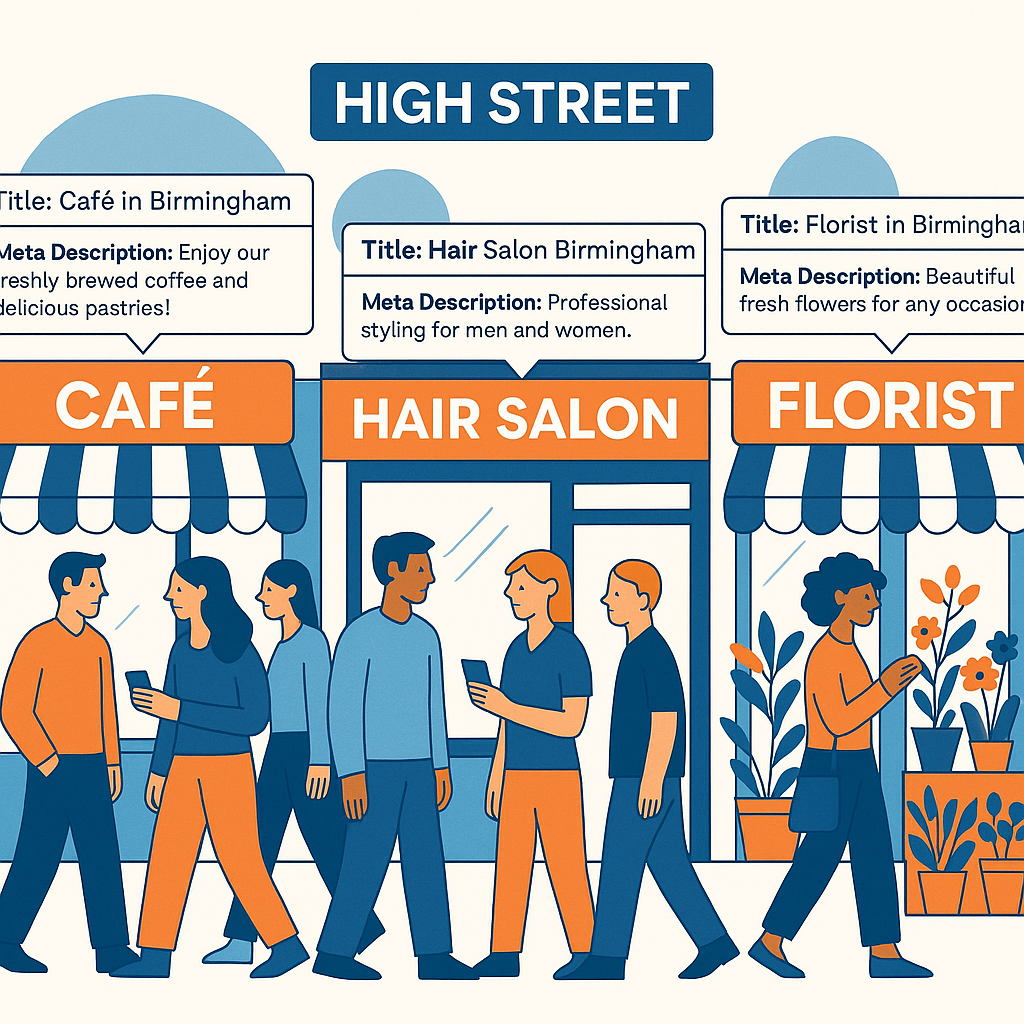
If you run a shop, café, salon, clinic, trades business, or any other small High Street business, learning How to Write Title Tags and Meta Descriptions That Win Clicks in Birmingham can make a surprisingly big difference. It is one of those SEO jobs that looks small on the surface, almost too simple to matter, but it often decides whether someone clicks your website or scrolls past to a competitor.
Local SEO is not just about ranking. That is the bit everyone talks about, naturally, but showing up is only half the story. If your business appears in Google and your listing feels vague, dull, or not quite relevant, people may not click. And in a city like Birmingham, where customers might be comparing businesses in Digbeth, Moseley, Harborne, Sutton Coldfield, Erdington, Jewellery Quarter, and beyond, your search snippet needs to do some proper work.
The title tag and meta description are basically your shop window in search results. Not the whole shop, of course, but the first glance. They give people a reason to choose you before they have even landed on your website. I think many small businesses underestimate this because these bits of text are tucked away in the back end of a website. But to a potential customer, they are front and centre.
How to Write Title Tags and Meta Descriptions That Win Clicks in Birmingham
The simplest way to think about it is this: your title tag should tell people what you offer, where you offer it, and why your page is worth opening. Your meta description should then add a little more persuasion. Not hype. Not a hard sell. Just enough detail to help someone feel, “Yes, this looks like the right result.”
For a Birmingham business, local relevance matters. A title tag that says “Professional Hair Salon” is not useless, but it is very broad. “Hair Salon in Harborne, Birmingham” is clearer. “Colour, Cuts and Styling in Harborne, Birmingham” may be stronger again, depending on what customers are actually searching for. You do not have to force every district or landmark into the wording, but if location is part of the buying decision, include it.
There is also a practical point. Google may rewrite your title or description if it thinks it can do better, which is slightly annoying but normal. Still, writing them carefully gives Google a better starting point. More importantly, it gives customers a clearer first impression.
Quick example for a Birmingham café
Weak title: Home | The Coffee Place
Better title: Independent Café in Moseley, Birmingham | The Coffee Place
Better meta description: Visit our Moseley café for fresh coffee, brunch, homemade cakes and a relaxed local atmosphere. Open daily near Moseley Village.
Why Clicks Matter for Small High Street Businesses
A small business usually does not need thousands of random visitors. It needs the right people: nearby customers, people ready to book, people comparing local options, or people looking for opening times and services before they walk over or call. A better title tag can help you attract those people more consistently.
Take a florist near Birmingham city centre. Someone searching “wedding flowers Birmingham” has a different intention from someone searching “same day flowers Birmingham” or “florist near New Street Station”. If every page on the florist’s website has the same title, the business misses chances to match those different searches. The page still may rank here and there, but it will not feel specific enough.
This is where local SEO becomes less mysterious. You are not trying to trick an algorithm. You are trying to label your pages in a way that matches real customer needs. That sounds obvious, but it is easy to forget when you are staring at a WordPress SEO plugin box wondering what to type.
| Search intent | Possible title angle | Why it works |
|---|---|---|
| Need a nearby service | Dentist in Edgbaston, Birmingham | Clear service and location match. |
| Ready to book | Book a Sports Massage in Birmingham | Uses action-led wording. |
| Comparing options | Family-Run Jeweller in the Jewellery Quarter | Adds character and local identity. |
What Makes a Good Title Tag?
A good title tag is specific, readable, and not too long. Most SEO tools suggest keeping it around 50 to 60 characters, though it is not a perfect rule. Google displays titles based on pixel width, not just character count, so some titles get cut off earlier than expected. Do not obsess over one or two characters. Just keep it tight.
For High Street businesses, the best titles often combine service, location, and brand. The order can vary. If your brand is well known locally, put it near the front. If people are more likely to search by service, lead with that. A new nail salon in Kings Heath probably benefits from “Nail Salon in Kings Heath” more than a brand name nobody recognises yet.
- Use the main service or product people are searching for.
- Add Birmingham, your suburb, or a recognisable local area where it helps.
- Keep the wording natural rather than stuffed with keywords.
- Make each page title unique, especially for service pages.
- Avoid vague titles like “Home”, “Services”, or “Welcome”.
- Include your business name when it adds trust or recognition.
One thing I would avoid is repeating every possible location. A title like “Plumber Birmingham, Solihull, Sutton Coldfield, Harborne, Moseley” looks messy and desperate. It may also get rewritten. A cleaner title, matched to a useful page, usually feels more trustworthy.
How to Write Meta Descriptions People Actually Want to Click
Meta descriptions do not directly boost rankings in the old-fashioned sense, or at least Google has said they are not a ranking factor. But they can influence clicks, and clicks are what businesses care about. Your description should support the title and answer the quiet question in the searcher’s mind: “Is this the page I need?”
A good meta description is usually around 140 to 160 characters, although again, it can vary. Think of it as a short advert, but a useful one. Mention what you offer, who it is for, and any helpful detail such as location, opening days, emergency availability, free consultations, family-run service, or online booking.
For example, “Need an emergency plumber in Birmingham? Fast callouts for leaks, boiler issues and repairs across South Birmingham. Call today for help.” That is much stronger than “We provide plumbing services to all customers. Contact us for more information.” The second version says almost nothing, even though it is technically accurate.
Less effective
We are a local business offering a range of professional services in Birmingham. Please visit our website to find out more.
More effective
Book reliable boiler repairs in Birmingham with a local Gas Safe engineer. Fast appointments, clear pricing and friendly service.
Using Birmingham Location Signals Without Overdoing It
Birmingham is big, and people often search by smaller areas. They may type “accountant in Solihull”, “barber near Bullring”, “optician in Selly Oak”, or “best brunch Jewellery Quarter”. So yes, local wording matters. But it should match your actual business and page content.
If your shop is in Stirchley, say Stirchley. If you serve the wider West Midlands, you can mention that too, but do not pretend to be physically based everywhere. It reads oddly, and customers notice. I have seen pages that claim to be local to five different towns in the same sentence. Maybe it was written for SEO, but it does not feel reassuring.
Better location signals include nearby landmarks, neighbourhood names, service areas, and genuinely useful local details. A restaurant near Birmingham Hippodrome could mention pre-theatre dining. A repair shop close to the Bullring might mention city centre convenience. These little details make snippets feel more real.
Page-by-Page Examples for High Street Businesses
You do not need to rewrite your whole website in one sitting. In fact, it is usually better to start with the pages that matter most: your homepage, your main service pages, your booking page, and any local landing pages that already bring traffic. Then work through the rest.
Simple title and description formulas
- Homepage: Main service + area + business name.
- Service page: Specific service + Birmingham or local district.
- Product page: Product type + key benefit + shop name.
- Booking page: Action phrase such as book, call, visit, or enquire.
- Local page: Service + neighbourhood + trust signal.
For a beauty salon, a homepage title might be “Beauty Salon in Sutton Coldfield | Glow Studio”. A waxing page could be “Professional Waxing in Sutton Coldfield, Birmingham”. A bridal makeup page might use “Bridal Makeup Artist in Birmingham | Glow Studio”. Each title has a job. They are related, but not identical.
The same applies to meta descriptions. The bridal page should not have the same description as the waxing page. That sounds basic, but duplicate descriptions are everywhere, especially on older small business websites. Sometimes it happens because a theme or plugin auto-fills them. Sometimes nobody has looked at them since the site was launched.
Common Mistakes That Cost Clicks
The biggest mistake is being too generic. Many small business snippets could belong to almost anyone. “Quality services at affordable prices” may be true, but it does not help the customer decide. Affordable compared with whom? What services? Where? It is one of those phrases that sounds fine until you realise it says very little.
- Writing titles that are too long and get cut off.
- Using the same title tag on every page.
- Forgetting to mention Birmingham or the relevant neighbourhood.
- Stuffing in keywords until the title sounds unnatural.
- Making claims that are not supported on the page.
- Ignoring mobile users, where space is even tighter.
- Leaving meta descriptions blank and letting Google guess.
Another mistake is trying to sound bigger than you are. There is nothing wrong with being a small local business. In fact, that can be a strength. Words like “independent”, “family-run”, “local”, “established”, or “trusted by Birmingham customers” can work well if they are true. They add warmth without sounding forced.
Measuring Whether Your Snippets Are Working
Once you update your titles and meta descriptions, give them time. Search changes are not always instant. You can check performance in Google Search Console by looking at impressions, clicks, and click-through rate. If a page gets lots of impressions but very few clicks, the snippet might need work. Or the page may be ranking for the wrong query. SEO is rarely one clean answer, unfortunately.
Look for patterns rather than panicking over one week of data. Seasonal changes, weather, local events, and even roadworks can affect High Street behaviour. A café near a Christmas market may see a very different pattern in December from February. Still, if a title change leads to more clicks over a month or two, that is useful evidence.
A good search snippet does not need to be clever. It needs to be clear, local, and useful enough that the right person wants to click.
Conclusion: Better Snippets Bring Better Local Visitors
For small High Street businesses, search results are often the first point of contact. Before someone visits your shop, books a table, calls for a quote, or checks your opening hours, they may see your title tag and meta description. That tiny bit of text has to carry more weight than it gets credit for.
The best approach is simple: write for real local customers, not just for search engines. Be specific about your services. Use Birmingham and neighbourhood terms where they genuinely help. Make every important page unique. Add a reason to click, even a small one. And keep reviewing what works.
If you remember one thing from this guide on How to Write Title Tags and Meta Descriptions That Win Clicks in Birmingham, make it this: clarity wins. A clear, relevant snippet will usually beat a vague one, especially when local customers are ready to choose.