
Zero-Click Searches: Highest in the UK, Lowest in Germany, and France has the Most Efficient Searchers is more than a neat data point from SparkToro. For small High Street businesses, it points to something many owners already feel in their bones: people are still searching, but they are not always visiting websites in the way they used to. They ask Google for opening hours, directions, phone numbers, menus, prices, reviews, and quick answers. Often, they get enough information on the results page itself and move on.
That might sound worrying at first. If fewer people click through to your website, surely local SEO is becoming less valuable? I do not think that is quite right. If anything, local SEO has become more visible, more immediate, and, slightly annoyingly, more dependent on the details that appear before someone ever reaches your site.
For UK businesses on the High Street, from independent cafés and opticians to hair salons, hardware shops, clinics, and solicitors, the question is not simply “How do we get more website traffic?” It is “How do we show up properly when customers make fast local decisions?” That is where zero-click behaviour becomes genuinely important.
What zero-click searches actually mean
A zero-click search happens when someone searches on Google or another search engine but does not click through to a traditional organic result. They may find the answer in a featured snippet, a map pack, a business profile, a knowledge panel, a weather box, a calculator, or another search feature. In local search, this is especially common.
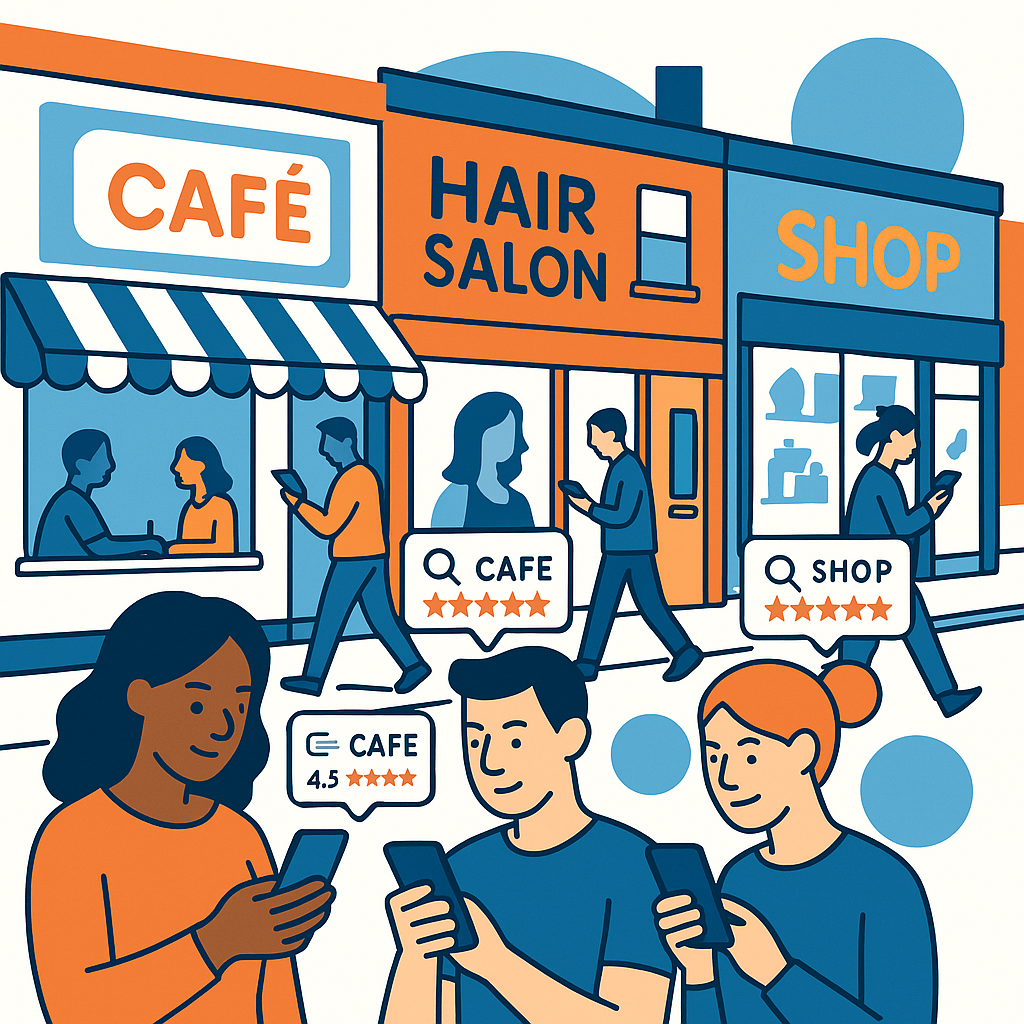
Think about someone searching “chemist near me open now” or “best coffee shop in York city centre”. They might look at the map results, compare star ratings, check who is open, tap for directions, and leave. No website visit. Still a customer action. Still a valuable search. It just does not show up neatly in your Google Analytics reports, which can make performance look flatter than it really is.
Common local zero-click actions
Zero-Click Searches: Highest in the UK, Lowest in Germany, and France has the Most Efficient Searchers
SparkToro’s analysis argues that zero-click searches are highest in the UK, lowest in Germany, and that France has the most efficient searchers. The wording is memorable, but the underlying point matters more: search behaviour varies by market. UK users appear particularly comfortable getting what they need straight from the results page.
There are a few likely reasons for this. The UK is a highly mobile search market, and mobile searches naturally encourage quick decisions. Local intent is often urgent. People are walking down a street, sitting on a train, or trying to sort something out between meetings. They do not necessarily want to browse a full website. They want the closest branch, the right phone number, or the answer to “are they open on Sunday?”
Google’s UK results are also rich with information. Map packs, local profiles, images, reviews, booking buttons, product availability, FAQs, and snippets all reduce the need for a click. This is useful for users, but it makes the search landscape feel a bit harsher for businesses that still judge SEO purely by sessions and page views.
| Market insight | What it suggests | Local SEO implication |
|---|---|---|
| UK has high zero-click behaviour | Users often complete tasks in the results page | Your Google Business Profile must be treated like a front door |
| Germany has lower zero-click rates | Users may be more likely to click through | Website content may carry more of the conversion journey |
| France has efficient searchers | People may refine searches well and act quickly | Clear titles, categories, and structured answers matter |
Why this matters for small High Street businesses
Small businesses are often told to “get more traffic”, which is not wrong, but it is incomplete. A florist in Bristol, a bike repair shop in Leeds, or a barber in Glasgow may not need thousands of monthly visits. They need people nearby to choose them at the right moment. In zero-click search, that choice might happen entirely inside Google.
This is where things become slightly uncomfortable. Google is both the discovery platform and, in many cases, the decision platform. Your opening hours, review score, service category, photos, and proximity can do a lot of persuasion before anyone sees your homepage. If those details are missing, messy, or outdated, you may lose customers without realising it.
I have seen this with local businesses that have perfectly decent websites but neglected profiles. The website says they open at 9am. Google says 10am. The photos are five years old. The category is too broad. There are unanswered reviews from last winter. None of these things feels dramatic on its own, but together they create doubt. And in local search, doubt is expensive.
- Your business may receive fewer website clicks but more calls or direction requests.
- Competitors with weaker websites can still win if their local search presence is clearer.
- Reviews and photos can influence decisions before your brand message is ever read.
- Incorrect opening hours can quietly cost footfall, especially around bank holidays and weekends.
- SEO reporting needs to include visibility and actions, not only organic traffic.
The Google Business Profile is now part of your shopfront
For a High Street business, your Google Business Profile is no longer just a listing. It is a public-facing asset, almost like a second homepage. In some cases, it may be seen more often than your actual homepage. That may feel unfair, because you have less control over it, but it is the reality of local search in the UK.
The basics still matter: name, address, phone number, opening hours, primary category, services, website link, and photos. Yet many businesses stop there. The stronger profiles tend to go further. They add regular images, answer common questions, respond to reviews, publish updates, and make sure service descriptions match what people actually search for.
Practical note: if your Google Business Profile has not been reviewed in the last month, it is probably worth checking today. Not because everything will be wrong, but because small errors have a habit of sitting there unnoticed.
Photos are especially underestimated. A current photo of your shopfront helps people recognise you from the street. Interior photos reduce uncertainty. Product or service images can answer small questions quickly. For restaurants, salons, clinics, and retail shops, images can do the work of several paragraphs of website copy.
How to adapt your local SEO strategy for zero-click behaviour
Adapting to zero-click search does not mean giving up on your website. Your site still matters for trust, depth, accessibility, service pages, and conversions that need more explanation. But it does mean your SEO strategy should spread across the whole search experience, not just the blue links.
A sensible approach is to make sure every important search result gives a potential customer enough confidence to take the next step. That next step may be a visit, a call, a booking, or a click. Sometimes it is not glamorous. It is just making sure the phone number works.
- Audit your Google Business Profile and fix gaps in categories, hours, services, and contact details.
- Build location-specific website pages if you serve multiple towns, neighbourhoods, or branches.
- Use clear service language, such as “shoe repairs in Cardiff” or “emergency dentist in Norwich”, rather than vague marketing phrases.
- Add FAQs that answer real local questions, including parking, access, pricing, appointments, and same-day availability.
- Encourage reviews steadily, not in one sudden burst, and reply to them in a calm, useful way.
- Track calls, direction requests, bookings, and profile interactions alongside website traffic.
Structured data can also help, particularly LocalBusiness schema, opening hours, reviews, products, and FAQs where appropriate. It will not magically guarantee rich results, and anyone promising that is probably overselling it, but it gives search engines clearer information. At the very least, it reduces ambiguity.
Do zero-click searches make websites less important?
Not really. They make weak websites less defensible, perhaps. If a website only repeats your address and says “welcome to our business”, then yes, Google may already provide most of that information. But a useful local website still has a strong role.
Your site can explain services in more detail, show pricing guidance, introduce your team, answer complex questions, host booking forms, publish helpful local content, and build credibility. For trades, healthcare, legal services, and higher-value purchases, people often need reassurance before contacting you. They may discover you in a zero-click result, then return later and visit your site. Attribution rarely captures that cleanly.
This is why measurement needs a bit of humility. A rise in direction requests might coincide with flat organic traffic. A customer might read your reviews on Google, check your opening hours, then walk in. Another might see your profile three times before finally searching your brand name. The journey is messy. It always was, actually, but zero-click searches make the mess more obvious.
A better local SEO scorecard
- Organic website visits from local queries
- Google Business Profile views and actions
- Phone calls and booking enquiries
- Direction requests and map visibility
- Review quantity, quality, and response rate
- Rankings in the local pack for priority services
What UK businesses should prioritise next
If the UK really is a leading zero-click market, small businesses here should avoid treating Google as merely a traffic source. It is more like a decision layer. That sounds a bit grand, but it is a useful mental shift.
Start by searching for your own business and your main services from a phone. Not from your office computer, and not while logged into every business account you own. Look at what a normal customer sees. Are your hours right? Do your competitors look more active? Are your reviews recent? Is your website title clear? Does the map pin land in the right place? These small checks can be surprisingly revealing.
Then search for the problem you solve, not just your business name. For example, “watch battery replacement near me”, “accountant for small business in Exeter”, or “women’s haircut Brighton open Sunday”. This shows whether you are visible when customers do not already know you. That is where local SEO earns its keep.
Conclusion: turning zero-click searches into real-world customers
Zero-Click Searches: Highest in the UK, Lowest in Germany, and France has the Most Efficient Searchers is a useful reminder that search is not only about clicks. For UK High Street businesses, the results page itself has become a place where customers compare, judge, and act.
The implication is not to abandon traditional SEO, but to widen it. Keep improving your website, yes, but give equal attention to your Google Business Profile, reviews, local pack visibility, images, opening hours, and the quick answers people need before they decide. In a zero-click environment, being chosen may happen before the click ever arrives.