
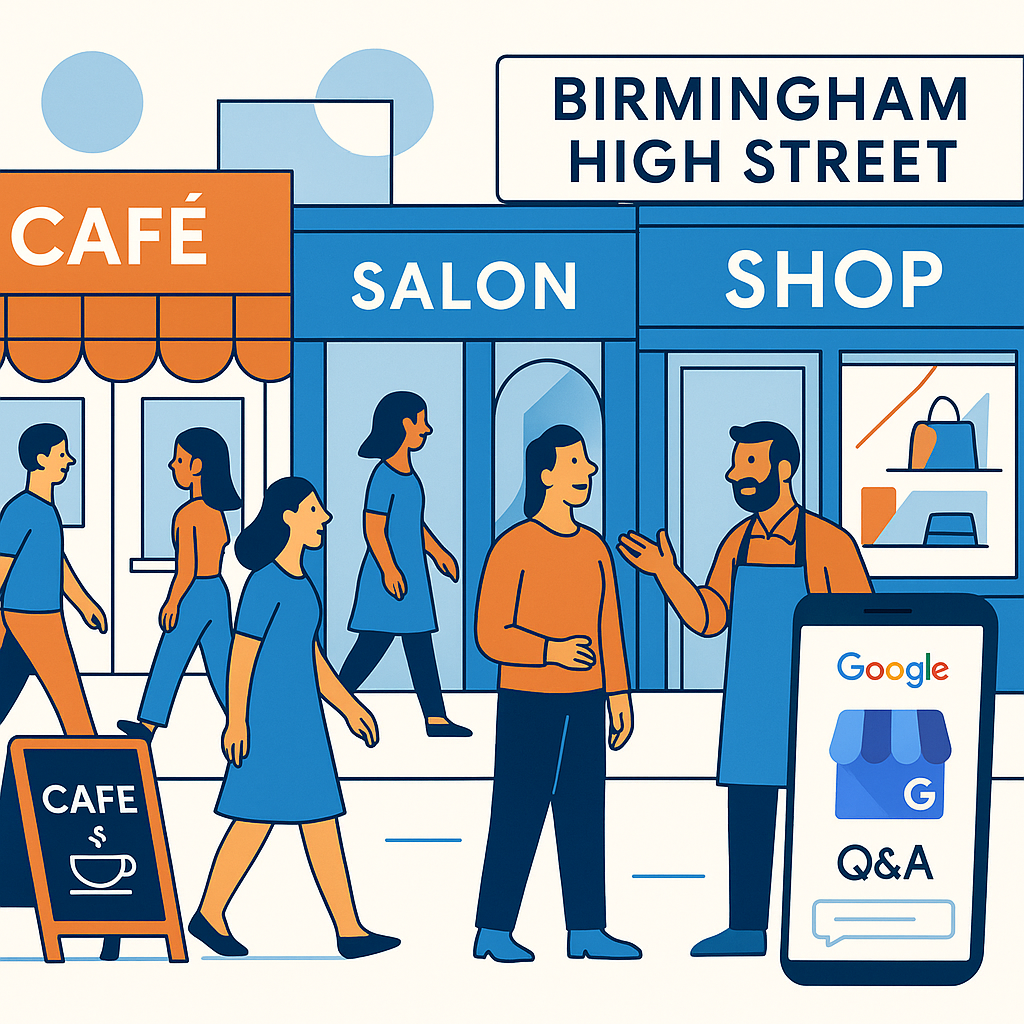
If you run a shop, salon, café, clinic, showroom, or any other High Street business, learning How to Use Google Q&A to Win More Customers in Birmingham is one of those small local SEO tasks that can quietly make a real difference. It is not glamorous, and it is easy to forget about, but it sits right there on your Google Business Profile where potential customers are already deciding whether to call, visit, book, or move on to someone else.
Google Q&A is the question and answer section on your Google Business Profile. People can ask things like “Do you have parking?”, “Are you open on bank holidays?”, or “Do you stock vegan cakes?” and, slightly worryingly, anyone can answer. That means a helpful customer might reply, but so might someone who is guessing. For a Birmingham business competing locally, especially in busy areas like the city centre, Moseley, Harborne, Kings Heath, Jewellery Quarter, or Sutton Coldfield, leaving those answers to chance is not ideal.
I think of Google Q&A as a digital shop window conversation. It is not quite a review, not quite a FAQ page, but somewhere in between. Done well, it removes doubt. And when people feel less unsure, they are much more likely to take the next step.
How to Use Google Q&A to Win More Customers in Birmingham
The first thing to understand is that Google Q&A is visible to people who are already close to buying. They have searched for your business name, or something related to your service, and they are now checking the details. Maybe they are standing outside New Street Station trying to find somewhere for lunch. Maybe they are comparing two dentists in Edgbaston. Maybe they need a locksmith in Digbeth and do not want to waste time phoning three places.
At that point, a clear answer can be surprisingly powerful. If your Q&A says, “Yes, we offer same-day appointments where available. Please call before visiting,” that is more useful than a blank section. If it says, “There is paid parking behind the store and limited street parking nearby,” you have just removed a small but real barrier.
Quick local SEO idea
Open your Google Business Profile and read your Q&A as if you were a first-time customer. If the answers feel vague, old, missing, or slightly awkward, there is probably a small opportunity to improve conversions.
For Birmingham High Street businesses, the key is to answer practical questions before people ask them. This does not mean stuffing the section with sales copy. In fact, that tends to look a bit forced. It means adding genuine questions that customers often raise in-store, on the phone, over email, or through social media.
Why Google Q&A matters for local High Street businesses
Local SEO is often talked about in big terms: rankings, citations, backlinks, reviews, schema, content strategy. All of that has its place. But for a small business owner, the most valuable local SEO improvements are often the ones that help a real person make a decision faster.
Google Q&A does exactly that. It supports trust. It gives you another place to include useful local details. It can reduce repetitive phone calls. It may also help Google better understand what your business offers, though I would be cautious about promising rankings from Q&A alone. It is one part of the wider picture, not a magic switch.
- It answers common buying questions before someone contacts you.
- It helps nervous or time-poor customers feel more confident.
- It allows you to correct inaccurate answers from the public.
- It can highlight useful local details, such as nearby parking or service areas.
- It makes your Google Business Profile look active and cared for.
There is another benefit that is easy to underestimate. Many small businesses sound more approachable when they answer simple questions plainly. A profile with warm, practical answers feels more human than one that only has opening hours and a few reviews. It gives people a hint of what dealing with you might be like.
| Customer question | Why it matters | Better answer style |
|---|---|---|
| Do you have parking? | Visitors in Birmingham often plan around parking and traffic. | Mention nearest car park, street parking, or public transport links. |
| Do I need to book? | People want to avoid wasted journeys. | Explain when walk-ins are welcome and when booking is best. |
| Are you open on Sundays? | Opening hours can change around weekends and holidays. | Confirm normal hours and suggest checking Google for updates. |
Set up your Q&A properly before customers do it for you
One odd thing about Google Q&A is that business owners do not always realise they can seed it with their own questions. You can ask and answer common questions from your own Google account, ideally while logged into the account that manages the business profile. It is allowed, as long as the content is honest and helpful.
Start by making a quick list of the questions you hear all the time. Do not overthink it. If you run a barbershop, people might ask about walk-ins, children’s cuts, card payments, and late openings. If you run a florist, they may ask about same-day delivery, wedding flowers, funeral arrangements, or delivery to specific Birmingham postcodes. If you run a restaurant, questions about halal options, gluten-free dishes, prams, dogs, and large groups come up again and again.
- Open your Google Business Profile and check the existing Q&A section.
- Remove or report anything misleading, spammy, or inappropriate if possible.
- Write down 8 to 12 real questions customers ask before buying.
- Post each question in natural language, the way a customer would ask it.
- Answer clearly, using your business name or location only where it sounds natural.
- Review the section monthly, especially after changes to hours, prices, or services.
The wording matters. A question like “Do you offer professional award-winning hair services in Birmingham?” sounds fake. Nobody talks like that. A better version is, “Do I need to book a haircut, or can I walk in?” It is ordinary, but that is why it works.
What Birmingham customers actually want to know
Birmingham is a big, varied city, and local intent can change from one area to another. Someone searching in the Bullring may care about immediate availability. Someone in Bournville may care more about family-friendly service or easy parking. A customer in Erdington might be checking whether you deliver nearby. It sounds obvious, perhaps too obvious, but your Q&A should reflect the real behaviour of people around you.
The best questions usually fall into a few simple categories: access, availability, price, suitability, speed, and reassurance. You do not have to answer every possible question. In fact, a bloated Q&A section can feel messy. Aim for the questions most likely to stop someone from choosing you.
Access
Parking, step-free access, bus routes, train stations, lifts, toilets, pram space, and dog policies.
Availability
Walk-ins, appointments, same-day slots, weekend opening, bank holidays, and seasonal hours.
Reassurance
Payment methods, guarantees, consultations, returns, allergies, qualifications, and what to bring.
For example, a Birmingham optician might answer, “Do you offer eye tests on Saturdays?” A jeweller in the Jewellery Quarter might answer, “Can I visit without an appointment to discuss an engagement ring?” A gym in Selly Oak might answer, “Can students join on a short-term membership?” These are not just FAQs. They are buying signals.
How to write answers that bring people through the door
A good Google Q&A answer is short, specific, and useful. It should sound like a helpful member of staff, not a brochure. Try to answer the question directly in the first sentence, then add one extra detail if needed.
Here is a simple formula: answer first, clarify second, invite action third. For instance: “Yes, we accept walk-ins when staff are available. Saturdays can be busy, so we recommend booking if you need a specific time. You can call us or book online.” That answer does a lot without feeling pushy.
- Use plain UK English and avoid jargon.
- Keep most answers to two or three sentences.
- Include local details when they genuinely help, such as nearby landmarks.
- Avoid keyword stuffing, as it looks unnatural and can put people off.
- Update answers when your services, pricing, or opening hours change.
- Do not argue with customers in Q&A, even if the question is irritating.
That last point is worth saying twice, although maybe not too dramatically. Public replies are part of your brand. If someone asks a blunt question, answer politely. If the question is unfair or irrelevant, keep your response calm or report it if it breaks Google’s guidelines. Future customers are watching how you behave.
Use Q&A alongside reviews, posts, photos, and your website
Google Q&A works best when it matches the rest of your online presence. If your Q&A says you offer emergency appointments, your website should say the same. If your photos show outdoor seating, your Q&A can explain whether it is heated, covered, or dog-friendly. If reviews often mention friendly staff, your Q&A tone should reinforce that same feeling.
This is where small businesses can beat bigger, slower competitors. A national chain may have a polished website, but its local profile can feel generic. A Birmingham independent can answer local questions with more personality and accuracy. Mention the tram stop nearby. Mention that your entrance is on the side street. Mention that match days affect parking if you are near Villa Park or St Andrew’s. These tiny details feel useful because they are useful.
A small warning: do not use Google Q&A as a place to publish long policy documents. If an answer needs more than a few sentences, give the short version and point people to your website or ask them to contact you.
It also helps to link your thinking together. If a question comes up repeatedly in Google Q&A, that might deserve a section on your website. If a service page on your website gets a lot of calls about pricing, add a Q&A answer that explains your starting prices or consultation process. You are not just filling in a Google feature; you are learning what your market is unsure about.
Common mistakes to avoid
The biggest mistake is ignoring Q&A completely. The second biggest is treating it like a keyword dumping ground. People can spot forced wording very quickly. A phrase such as “best affordable Birmingham city centre hair salon near me” does not belong in a natural answer. It may even make the business look less trustworthy.
Another mistake is letting old answers linger. A customer might answer a question correctly in 2022, but your policy may have changed since then. If you now require appointments, or no longer accept cash, or have moved premises, your Q&A needs updating. In local search, outdated details can cost you actual footfall.
- Do not leave questions unanswered for weeks.
- Do not give vague answers such as “call us” to every question.
- Do not contradict your website or opening hours.
- Do not ask fake-looking promotional questions.
- Do not forget to monitor answers added by the public.
A practical routine is to check Q&A at the same time you check reviews. For many small businesses, once a week is enough. If you are in a high-volume sector, such as hospitality, urgent repairs, beauty, or healthcare, you may want to check more often.
A simple Google Q&A plan for the next 30 days
If you want to make progress without turning this into a huge project, use a 30-day plan. It does not need to be complicated. In week one, audit what is already there. In week two, add your most important questions. In week three, improve weak answers. In week four, connect Q&A insights to your website, staff scripts, and social content.
This is also a good moment to involve your team. Staff who answer the phone or serve customers every day usually know the best questions. They hear the hesitation. They know what people ask just before buying. Sometimes the owner is too close to the business to notice these things, which is understandable.
Conclusion: How to Use Google Q&A to Win More Customers in Birmingham
The real value of Google Q&A is not that it is clever or technical. It is that it helps people feel ready to choose you. For small High Street businesses, that can mean more calls, more bookings, more visits, and fewer missed opportunities from people who were interested but uncertain.
If you want a simple place to start with local SEO, start here. Check your existing questions, answer them properly, add the questions customers already ask, and keep the section up to date. That is the practical answer to How to Use Google Q&A to Win More Customers in Birmingham: be visible, be useful, be local, and make the next step feel easy.