
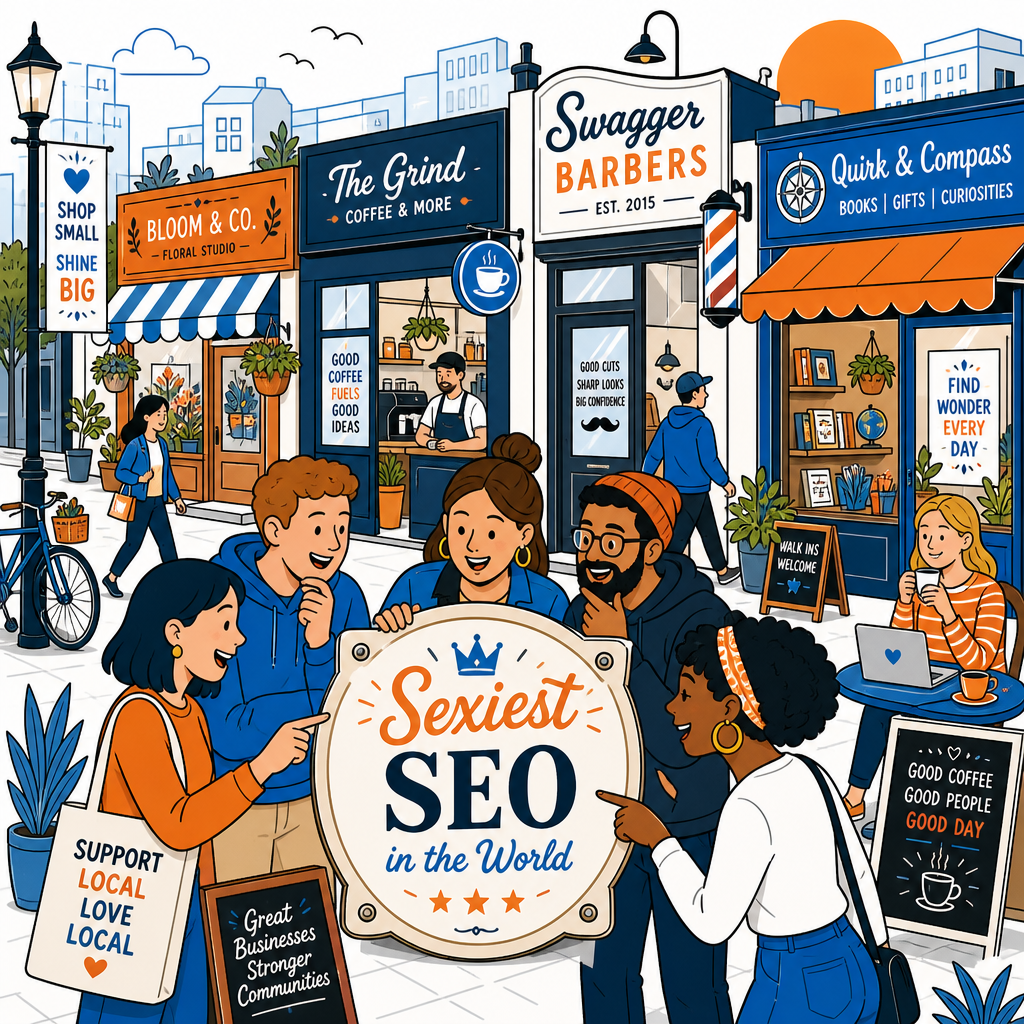
Is “Sexiest SEO in the World” a Real Ranking Factor? In short, the phrase sounds like a search engine metric, though Google does not list it among its ranking systems. It is more likely a playful SEO phrase, campaign name, competition, or piece of online content designed to attract attention. For a small High Street business, that matters because memorable wording can bring people to a page, while the practical work behind the page helps it appear in local search.
A shop owner might come across the phrase in an article, a social media post, or an SEO challenge. It has the right ingredients for curiosity. People may search the exact wording, websites may publish pages around it, and links can start to appear. Those signals can create visibility for a particular page. They do not turn the phrase into a secret Google ranking factor.
What does “Sexiest SEO in the World” mean?
There is no recognised Google ranking factor called “Sexiest SEO in the World”. Google uses many systems to decide which pages appear for a search, and its results can depend on relevance, quality, location, freshness, website usability, and the wording of the query. Google does not award extra ranking strength because a business uses a catchy phrase.
The phrase could still have an effect in a different way. If a page uses it in a clear headline, people who search for that wording may find the page more easily. If visitors enjoy the page and share it, the business can gain attention. A journalist might mention it. Someone could link to it. These outcomes may support a wider SEO effort, although the phrase itself remains a piece of text rather than a formal signal.
“Sexiest SEO in the World” is not an official Google ranking factor. It may attract searches and attention, but local rankings still depend on relevance, prominence, distance, useful content, and a trustworthy business presence.
Why catchy phrases can help a local business
A memorable phrase can give a local business something to talk about. A café might use it in a light-hearted blog post about its website. A barber could create a page explaining how local search works. A bookshop might run a small campaign around the phrase and invite customers to share it. The idea gives people a reason to visit a page that would otherwise feel fairly dry.
This is useful for High Street businesses because local SEO can feel crowded. Several nearby shops may sell similar products and use similar wording. An individual idea helps a business develop a recognisable voice. It can also make the website feel less like a list of services copied from every competitor in town.
There is a limit. A clever headline cannot answer a customer’s practical question on its own. Someone searching for an independent shoe shop in York wants opening hours, directions, stock information, contact details, and a sense of what the shop sells. A page that gives them those details has a better chance of being useful. The fun phrase can sit around that information.
The local SEO factors that matter more
Google’s local results often show businesses in the map pack, alongside organic website listings. The exact order changes from search to search. Location has a part to play, as does the connection between the searcher’s wording and the business. A shop near the searcher may appear for one query, while a more prominent business may appear for another.
- A complete and accurate Google Business Profile with the right category, address, phone number, website, hours, and services.
- A website that explains what the business offers and where it serves, using natural language.
- Reviews from genuine customers, with thoughtful replies from the business.
- Consistent business details across trusted directories and local websites.
- Helpful pages for products, services, locations, events, delivery areas, or frequently asked questions.
- A website that works well on mobile and lets visitors find important information quickly.
- Mentions and links from local organisations, newspapers, community groups, suppliers, and relevant websites.
These areas tend to create a stronger foundation than adding an unusual phrase to a page. They also support people who are close to making a purchase. Someone checking whether a florist opens on Sunday has a clear need. The page should meet it without making the visitor hunt around.
| SEO activity | Likely value for a High Street business |
|---|---|
| Catchy campaign phrase | Can attract attention, searches, shares, and discussion |
| Accurate Google Business Profile | Helps Google and customers understand the business |
| Useful local service page | Matches specific searches and supports enquiries |
| Genuine customer reviews | Builds trust and gives prospective customers useful detail |
How small businesses can use the phrase sensibly
A business can use “Sexiest SEO in the World” as a creative hook, provided the page still has a clear purpose. The headline might introduce a guide for local business owners, a behind-the-scenes story, or a campaign about improving the shop’s website. The title should give readers a reason to continue. The body copy then needs to deliver something useful.
Keep the phrase in places where it reads naturally. A page title, introduction, social post, or campaign heading may be enough. Repeating it throughout a page can make the writing awkward and may look like an attempt to manipulate search results. Search engines are good at understanding topics through related wording, so a local business can mention its town, products, services, opening times, and customer questions in a normal way.
The same approach works for a shop’s other content. A hardware store could publish a guide to choosing wall plugs for an older terrace house. A bakery might explain how to order a celebration cake in Leeds. A record shop could write about its Saturday buying service. Each page has a genuine local subject, and each can bring in people who may visit the premises.
Common mistakes to avoid
Some businesses spend too much time chasing phrases that sound impressive. Rankings can then become the main goal, while the site remains thin and difficult to use. Another issue appears when a business creates pages for every nearby town without offering anything specific to those places. Visitors notice that kind of page quickly.
- Do not claim that a playful phrase is an official Google signal.
- Do not fill pages with repeated keywords or awkward variations.
- Do not create local landing pages with copied text and no local detail.
- Do not buy reviews or use reviews that describe experiences customers never had.
- Do not leave old opening hours, broken links, or missing contact details on the site.
Small improvements often have a practical effect. Updating holiday hours can prevent a wasted journey. Adding photographs of the shopfront can help a first-time visitor recognise the building. A clear service page may answer a question that previously generated a phone call. SEO sits inside the wider customer experience, and that is easy to forget when attention shifts towards ranking terminology.
How to measure whether the idea helped
A campaign based on a memorable phrase should have a simple way to track results. Google Search Console can show impressions and clicks for searches connected with the page. Google Analytics can show visits and actions, such as contact form submissions or visits to the directions page. A business can also ask customers how they heard about the campaign.
Look at the quality of the attention. A large number of visits from people who leave immediately may tell a different story from a smaller group who read the article, call the shop, or come in later that week. Local businesses often benefit from modest, steady visibility. A single customer who finds the right service at the right moment can matter more than a spike in worldwide traffic.
A memorable SEO phrase can open the door. Useful local information gives people a reason to stay.
So, is “Sexiest SEO in the World” a Real Ranking Factor? It is not an official Google ranking factor, and using the words alone will not move a High Street business up the results. The phrase can still support a creative campaign when it leads to useful content, local relevance, genuine interest, and a better experience for customers. For most small businesses, the strongest SEO work remains fairly grounded: accurate details, helpful pages, good reviews, and a website that makes visiting the shop feel straightforward.