
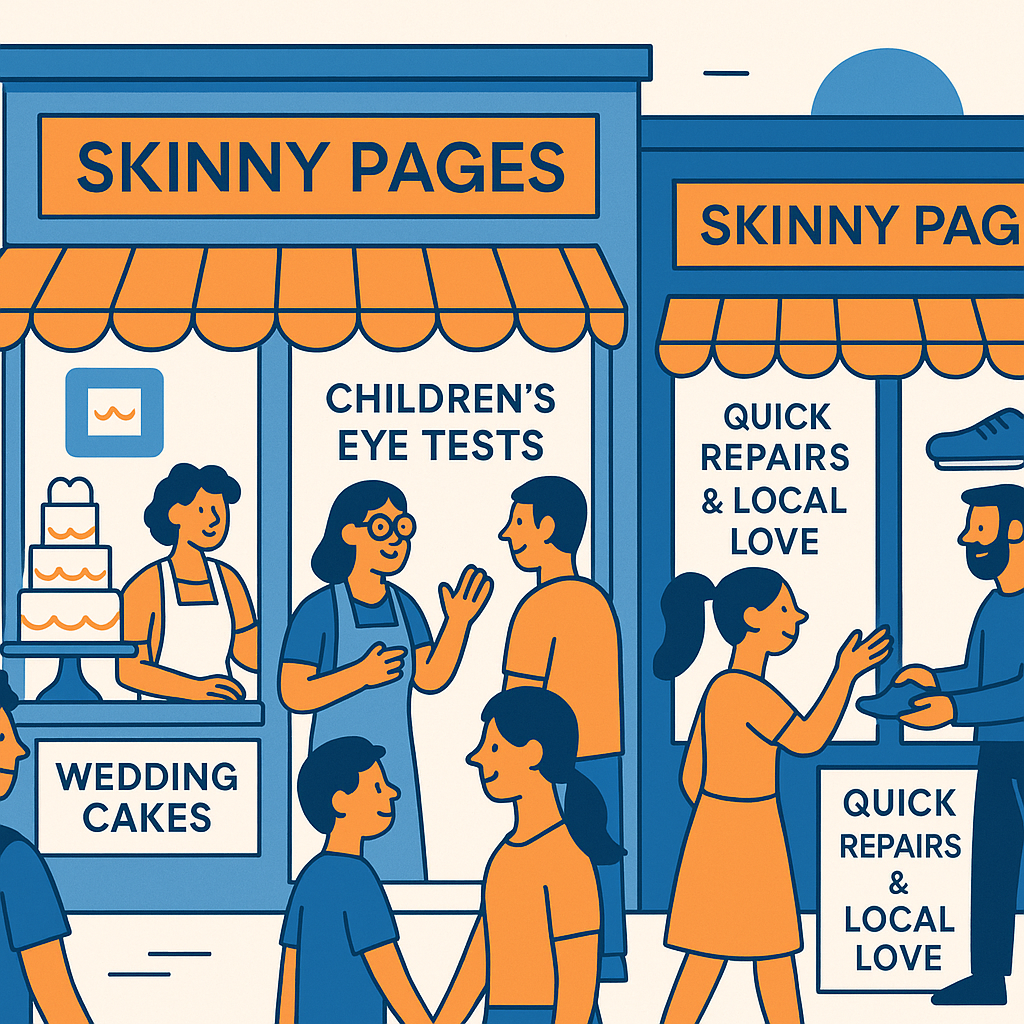
When Can Skinny Pages Help Your Local SEO? It is a fair question, especially for small High Street businesses that do not have the time, budget, or frankly the need to publish huge guides every week. A skinny page, in this context, is not automatically a bad page. It is usually a short, specific page built around a very particular location, service, product, or customer need. The problem is that “skinny” has picked up a stigma, as if every short page is weak, lazy, or somehow risky. That is not quite true.
For local businesses, especially in the UK, search behaviour is often narrow. People search for “shoe repairs near me”, “emergency dentist in Stockport”, “school uniform shop in Bromley”, or “watch battery replacement Bath”. They are not always looking for a 2,500-word essay. Sometimes they just want to know if you offer the thing, where you are, when you are open, and whether parking is going to be a nuisance. A shorter page can do that perfectly well.
This article takes inspiration from the core argument made by Local Visibility System: skinny pages can work when they serve a clear local purpose and avoid becoming doorway pages or empty filler. I think that is the key distinction. It is not about word count. It is about usefulness.
The myth: short pages are always bad for SEO
A lot of small business owners have been told, usually by someone selling content packages, that every page needs to be “comprehensive”. That sounds sensible enough. Google likes helpful content, and detailed pages can perform very well. But comprehensive does not always mean long.
Think about a local bakery in York that offers wedding cake consultations. A page about that service may only need 500 or 600 words to be genuinely useful. It could explain what the consultation includes, show a few examples, mention delivery areas, include starting prices, and answer two or three common questions. Would another 1,500 words improve it? Maybe. But it might also make the page feel padded and annoying.
The stigma comes from old-style SEO tactics. Businesses used to create dozens, sometimes hundreds, of near-identical pages targeting every town in a county: “plumber in Reading”, “plumber in Wokingham”, “plumber in Bracknell”, all saying basically the same thing. Those pages were skinny in the worst way. They did not help people. They just tried to catch search traffic.
Quick distinction
Helpful skinny page
Short, specific, accurate, and useful for a real local search.
Unhelpful thin page
Generic, duplicated, vague, and created mainly to manipulate rankings.
When Can Skinny Pages Help Your Local SEO?
Skinny pages can help your local SEO when the search intent is precise and the answer does not require a long explanation. This is common for High Street businesses because customers often search with immediate intent. They want to visit, call, book, buy, or check availability. They are not always in research mode.
A good skinny page acts a bit like a well-trained member of staff at the counter. It does not waffle. It answers the obvious questions, gives reassurance, and points the customer to the next step. For example, a local optician might create a short page for “children’s eye tests in Cheltenham”. That page can include who the service is for, NHS eligibility basics, appointment times, location details, and a booking button. That is enough, if it is done well.
Here are a few situations where a shorter local page can make sense:
- A specific service that customers search for by name, such as key cutting, dry cleaning alterations, ear wax removal, or dog nail clipping.
- A product or category that is locally important, such as school uniforms, prom dresses, mobility scooters, or fresh Christmas wreaths.
- A nearby area page where you genuinely serve that area and can add real local detail.
- A seasonal or event-led page, such as Mother’s Day flowers, back-to-school shoes, or Christmas opening hours.
- A page supporting your Google Business Profile, especially where the service is listed there and needs a clearer landing page.
The page does not have to be long. But it does have to be complete enough. That is the bit people sometimes miss. A 350-word page can be useful; a 900-word page can still be useless if it never says where you are or how to book.
| Local page idea | Why a skinny page may work | What to include |
|---|---|---|
| Watch battery replacement | Customers want speed, price, and location. | Typical time, brands handled, price range, address, opening hours. |
| School uniform fitting | Highly seasonal and locally searched. | Schools stocked, booking advice, busy periods, parking notes. |
| Emergency dental appointment | Urgent intent, little patience for fluff. | Same-day options, phone number, symptoms covered, fees or guidance. |
Why High Street businesses are different
Local SEO for a High Street shop, clinic, café, or repair business is not the same as SEO for a national ecommerce site. You are not trying to rank for everything. You are trying to show up when nearby people need what you sell. That sounds obvious, but it changes the role of your website quite a lot.
Your potential customers may already know the street you are on. They may have walked past your window. They may be comparing you with two other businesses they saw in Google Maps. In that moment, a focused service page can be more useful than a broad, polished “ultimate guide”.
There is also a practical issue. Many small businesses cannot keep producing long-form content. The owner is serving customers, handling stock, chasing suppliers, covering staff sickness, and trying to remember whether the card machine has been updated. Asking them to publish a giant blog post for every small service is unrealistic. A set of carefully chosen skinny pages is often more manageable.
This does not mean you should create a page for every tiny variation. That can get messy very quickly. But if a service has real search demand, real value to your business, and a real customer need behind it, it deserves its own space.
What makes a skinny page strong rather than thin?
A strong skinny page feels intentional. It is short because the topic is narrow, not because nobody bothered. That is a subtle difference, but users can sense it. Google probably can too, at least indirectly through the page’s relevance, internal links, engagement, and the wider trust signals around your business.
For a local page, the basics matter more than people like to admit. I have seen pages with elegant copy that forget to mention the town. I have seen service pages with no phone number anywhere near the top. It is oddly common.
- Name the service clearly in the title and opening copy.
- Mention the town, neighbourhood, or area naturally, not ten times in a row.
- Add practical details: prices, timescales, booking process, availability, or what to bring.
- Include trust signals such as reviews, years in business, accreditations, guarantees, or photos of the team.
- Link to and from related pages, including your main services page and contact page.
- Make the call to action obvious, especially on mobile.
- Keep business information consistent with your Google Business Profile and other local listings.
The page should also look alive. A photo of your actual shopfront, counter, treatment room, van, or staff member can do more for local trust than a long paragraph of generic copy. People want to know they are dealing with a real business in a real place.
A simple skinny page checklist
Before publishing, ask yourself: if someone landed on this page from Google, could they confidently take the next step?
- Do they know what you offer?
- Do they know where you are or where you serve?
- Do they know how to contact or book?
- Do they have at least one reason to trust you?
- Is the page different enough from your other pages?
The risks: where skinny pages go wrong
The biggest risk is duplication. If you create ten local pages and simply swap the town name each time, you are not really helping anyone. That is the classic doorway page problem. It can make your site look low quality, even if the business itself is excellent.
Another risk is over-segmentation. A florist probably does not need separate pages for “red roses in Leeds”, “pink roses in Leeds”, and “white roses in Leeds” unless there is a very good reason. Too many tiny pages can compete with each other and dilute your efforts. Sometimes one solid page is better than six fragile ones.
You also need to be careful with claims. If you create an “emergency locksmith in Oxford” page but you only offer appointments during normal shop hours, that is misleading. Local SEO is not just about ranking. It is about matching expectation. If the page gets people to call and then disappoints them, it has not really worked.
A skinny page is not a shortcut around quality. It is a way to answer a narrow local question without pretending the answer needs to be enormous.
How to choose which skinny pages to create
Start with your customers, not a keyword tool. What do people ask for over the phone? What do they misunderstand? Which services are profitable but slightly hidden on your website? Which products bring people into the shop?
Then look at search data. Google Search Console can show queries where you are already getting impressions but not many clicks. Your Google Business Profile insights may also reveal common actions and search themes, though the data is not perfect. You can use keyword tools too, but for local searches they often underreport volume. A query can be valuable even if the tool says it has “zero” searches.
A sensible process might look like this:
- List your core services, products, and customer questions.
- Group them by intent, not just by wording.
- Check whether each topic deserves its own page or can be part of a larger page.
- Create pages only where you can add specific, useful detail.
- Review performance after a few months and improve, merge, or remove pages that are not helping.
This last step matters. Skinny pages should not be left to gather dust forever. If a page gets impressions but no clicks, perhaps the title needs improving. If it gets visits but no enquiries, perhaps the call to action is weak. If it never gets seen at all, maybe the topic is too obscure, or maybe it needs better internal links.
A realistic example for a small High Street business
Imagine a small independent hardware shop in Bristol. Its main website has a homepage, an about page, and a general products page. That is fine, but it does not capture specific local searches very well. The owner notices that people regularly ask whether they cut keys, mix paint, and stock Calor Gas.
Instead of writing one huge article about hardware shopping, the business creates three focused pages: “Key Cutting in Bristol”, “Paint Mixing in Bristol”, and “Calor Gas Stockist in Bristol”. Each page is short, perhaps 450 to 700 words. But each includes useful details: typical waiting times, brands available, ID requirements if relevant, parking nearby, opening hours, and a clear phone number.
Those pages are skinny, yes. But they are not weak. They match real services, real customer questions, and real local intent. They also support the shop’s Google Business Profile because Google has more evidence that the business provides those services. It is not magic, and rankings are never guaranteed, but it is a practical move.
Conclusion: skinny is not the same as shallow
The question is not whether skinny pages are good or bad in some absolute sense. The better question is: When Can Skinny Pages Help Your Local SEO? The answer is when they satisfy a specific local search better than a broader page would, and when they contain enough detail to help a real person make a decision.
For small High Street businesses, that can be powerful. You do not need to turn every service into an epic guide. You need clear, trustworthy, locally relevant pages that reflect what customers actually want to know. Some will be long. Some will be short. And honestly, that is how a useful local website should feel.